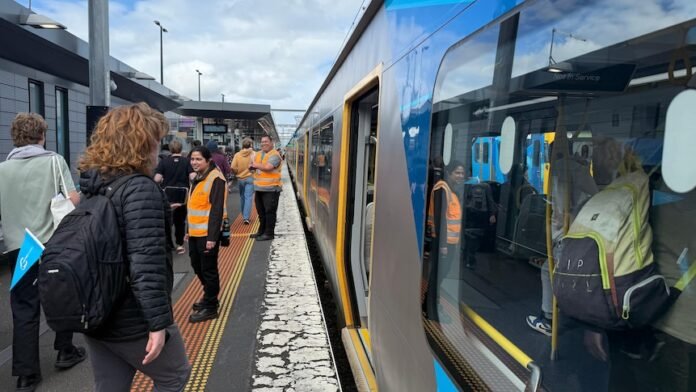
Melbourne’s $15 billion Metro Tunnel activates its full operations today, introducing new timetables and over 1,200 additional weekly train services. Authorities describe this rollout as “the big switch,” aimed at reducing congestion across the network. Announced in 2015, the tunnel opened in November with limited services through its five new stations. Starting Sunday, expanded timetables will maximize its potential, promising smoother travel for commuters.
Key Changes Effective Today
Several Melbourne train lines adopt new timetables from today, alongside adjustments to regional bus routes and inner-city services. For a complete overview, commuters can check the official Transport Victoria site.
Frankston Line
Beginning February 1, all Frankston Line trains route through the City Loop via Parliament, Melbourne Central, Flagstaff, Southern Cross, and Flinders Street stations. These services no longer extend to Werribee or Williamstown, gaining a dedicated tunnel section for improved reliability. A revised timetable supports this shift, with 12 extra weekly services planned after level crossing removals later this year.
Cranbourne and Pakenham Lines
From February 1, the Cranbourne, Pakenham, and Sunbury lines link through the Metro Tunnel. Trains operate every 10 minutes on weekdays, adding 100 weekly services, including peak-hour frequencies every four and a half minutes. These routes bypass Armadale, Toorak, Hawksburn, South Yarra, Richmond, and the City Loop.
Werribee and Williamstown Lines
Werribee and Williamstown trains now begin and end at Flinders Street Station starting February 1, without connecting to Frankston. A new timetable applies, and authorities plan to integrate these with the Sandringham Line later this year for a cross-city route. Temporary schedules persist until late April due to level crossing works, with more peak services promised soon.
Sunbury Line
The Sunbury Line introduces a new timetable from February 1, connecting with Cranbourne and Pakenham through the Metro Tunnel. This adds 1,000 weekly services, with trains every 5–10 minutes during peaks. Services skip North Melbourne; passengers heading there should transfer at Footscray to Werribee or Williamstown trains. For City Loop access, use the new pedestrian links between Melbourne Central and State Library or Flinders Street and Town Hall. End-of-line residents, like those in Sunbury, see wait times halved.
V/Line and Bus Services
Regional coaches and buses update timetables from February 1 to reduce waits and align with trains. Over 270 routes adjust for better connections, including 18 extra weekly Traralgon services, 10 more on the Seymour line, and four additional weekend Echuca trips. Inner-north Melbourne buses change now, with outer and middle suburb updates slated for later this year.
Craigieburn and Upfield Lines
A February timetable evens out frequencies on the loop. These lines separate from the Sunbury Line in the City Loop, enhancing reliability and cutting delays, according to transport officials.
What Stays the Same
Despite added services on select lines, many commuters notice minimal differences. Transport Users Association spokesperson Daniel Bowen notes ongoing needs for network-wide improvements. “They have really pitched it as ‘the big switch’. It is for some lines, but for other lines there’s actually no change at all,” Bowen stated. He highlights gaps in the east and north-eastern suburbs, where waits beyond Ringwood can reach 30 minutes, and Mernda or Hurstbridge lines face 40-minute Sunday morning intervals.
Town Hall Station remains the sole Metro Tunnel stop open overnight, while Parkville Station near universities and medical areas closes during night hours. Bowen views this as a starting point: “Hopefully it’s the first step in terms of upgrading Melbourne’s train timetables, not the last step.”
Behind the New Timetables
The Metro Tunnel project spans a decade, but timetable development involved years of detailed planning. Department of Transport executive director of modal planning Stuart Johns explained that his team tested “literally hundreds if not thousands of iterations.” Models forecast demand and growth through the 2050s to ensure scalability.
“We’re looking right out to the 2050s at the moment to look at how Melbourne and Victoria will grow,” Johns said. “What we’ve got an eye on is: ‘what does the future look like?’ so we can scale up in the future.” Human elements guide refinements, starting with a Gippsland Line train for school students. “You’ve got to take the algorithm and the data it puts out, then you’ve got to apply a bit of a common-sense test to it,” he added.
After extensive preparation, Johns anticipates the rollout: “You only get one go at something like this in your entire career, so for us … it’s a massive, massive day. It’s been years of effort, it’s been years of excitement.”