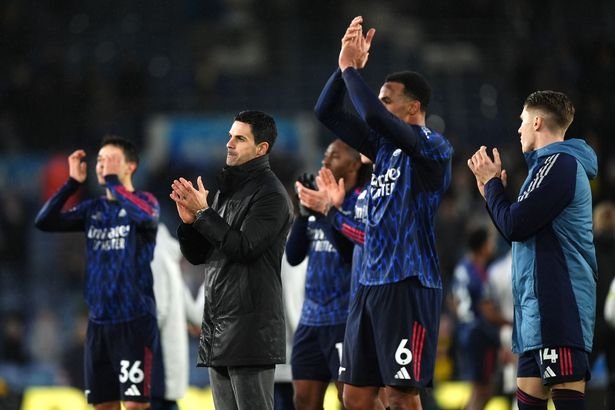
Arsenal’s direct approach and reliance on set-pieces have drawn sharp criticism, yet Mikel Arteta’s tactical shifts appear to be the key to breaking their title drought after years of near-misses.
Overcoming Adversity at Leeds
Recent scrutiny intensified as Arsenal collected just two points from three matches, placing them under intense pressure. Facing Leeds at Elland Road—a notoriously tough venue—they suffered a blow when star player Bukayo Saka withdrew during warm-up. Despite this, Arsenal delivered a commanding 4-0 victory, marking only Leeds’ third home loss of the season.
Noni Madueke stepped up from the substitutes, earning a start and shining with an assist and a pinpoint cross that led to a goal, officially recorded as an own goal by Karl Darlow. Notably, just one of Arsenal’s four goals came from a set-piece, challenging the narrative of overdependence on such plays.
Impressive Achievements Across Competitions
Arsenal currently lead the Premier League standings, topped their Champions League group with a perfect eight wins, reached the Carabao Cup semi-finals, and remain in contention for the FA Cup. They rank as the league’s second-highest scorers, demonstrating offensive potency.
Critics often qualify their praise, pointing to Manchester City’s superior possession-based style—a point even Pep Guardiola acknowledged with his lighthearted comment about defensive tactics at the Emirates. Former player Paul Scholes labeled them potential ‘worst champions’ in Premier League history, overlooking their wealth of international talent.
Adapting to Secure Results
Arsenal’s set-piece goals account for 57% of their tally, placing them 17th in the league. This safety-first evolution under Arteta stems from three consecutive runner-up finishes, including last season’s dropped leads that earned them ‘bottlers’ tags. Now, adapting to opponents’ low blocks, they’ve prioritized results over flair.
At Leeds, three of four goals arose from open play, including a stunning cross from Madueke finished by Martin Zubimendi after a clearance. This performance underscores a statement win that demands recognition beyond nitpicking.
Recruitment Challenges and Tactical Success
Questions linger over summer signings, with Viktor Gyokeres deemed insufficient for Arsenal’s ambitions. Sporting director Andrea Berta faces scrutiny for not elevating the squad sufficiently, though Arteta maximizes available resources.
In Europe, Arsenal’s dominance shines: a +19 goal difference (five better than Bayern Munich), 17 open-play goals (second to Bayern), and an expected goals figure of 15.2 from open play. Liverpool actually outscored them from set-pieces. European sides play more openly, creating space, while Premier League defenses compact tightly—prompting Arsenal’s strategic pivot.
Arteta’s earlier free-flowing style won neutral fans but yielded second place. This winning formula, if it falters, warrants critique, but for now, it merits acclaim for positioning Arsenal as frontrunners.