Groundbreaking Instrument Challenges Conventional Guitar Engineering
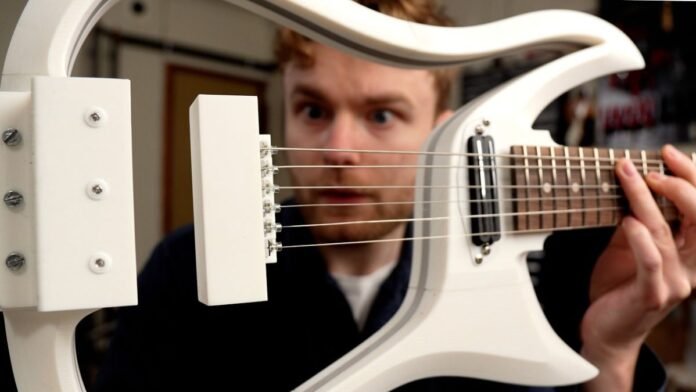
A content creator has unveiled an experimental electric guitar with magnetically suspended strings, creating an instrument that appears lifted from science fiction. The prototype completely reimagines how strings interact with the guitar body, eliminating traditional physical connections.
The Experimental Build
“This began with attaching small magnets to string ends,” the developer explained in a demonstration video. Initial tests proved unsuccessful as the strings floated without tension – so loose they could be displaced by air movement. Significant magnet upgrades were required to create playable tension.
Overcoming Technical Challenges
Early prototypes used industrial-grade magnets so powerful they snapped wooden shielding components. “The forces involved were exponentially greater than anticipated,” the creator noted, describing how magnetic interactions caused -10x power loss across gaps. After multiple iterations, a single ultra-powerful magnet plate proved the solution.
Safety became a paramount concern during development. “Only four thin strings prevented these magnets from violently colliding,” the inventor stated, revealing that one magnet required packaging comparable to explosive materials. Testing showed such intense magnetic force that components bonded permanently to metal surfaces.
Innovative Tuning System
The floating string design created unique tuning challenges where adjusting one string affected all others. Engineers developed a custom bridge with micro-adjustment screws resembling fine-tuning systems, though initial setup required 24 hours of precise calibration.
“I couldn’t believe I was playing a guitar where strings weren’t physically attached,” the creator remarked during final testing. The completed instrument features a reinforced metal frame and unconventional controls – the floating bridge can function as a pitch-bending mechanism or be shifted toward pickups to modify output volume.
Future of Instrument Design
While not yet ready for commercial production due to safety considerations, this build demonstrates the complexities of reinventing established instrument designs. The project highlights how fundamental engineering principles continue to challenge even radical innovations in musical technology.