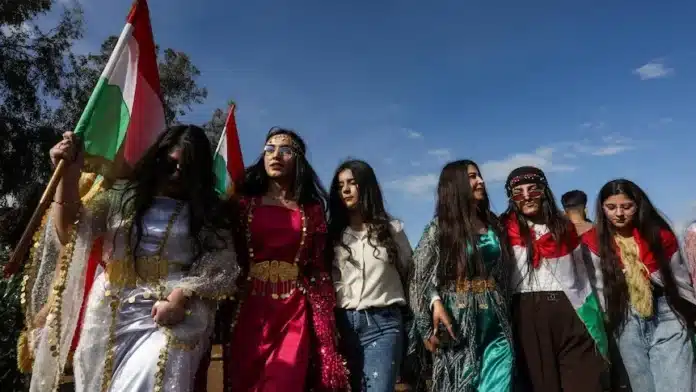
Amid ongoing bombings, resilient Iranians across the country celebrate Nowruz, the Persian New Year marking the arrival of spring. Bonfires light up backyards and homes, while families set elaborate tables, even as authorities impose surveillance and issue arrest threats.
Iranians remain committed to this ancient ritual, resisting long-standing efforts by officials to suppress pre-Islamic customs. Ali Beyk Zadeh, an Iranian Australian human rights advocate, noted that the regime has worked for decades to eliminate Nowruz. “Celebrating what came before Islam has always been about defiance and resistance,” he said.
Fire Rituals: Purification and Renewal
In the lead-up to Nowruz, Iranians participate in Chaharshanbe Suri by jumping over bonfires in backyards, a tradition spanning over 3,000 years from the Persian Empire era. Rooted in Zoroastrianism, which predates Christianity and Islam, the fire symbolizes purification, warding off illness and misfortune as spring begins.
Mediya Rangi, an Iranian Australian who fled Iran at age 14, described the ritual: “Everything dark within me — the fire takes it.” She emphasized its deeper meaning: “It’s not a celebration; it is an honouring moment.”
The atmosphere carries heaviness, with many grieving lost family members, prisoners, or the missing. Families inside Iran urge continuation of the traditions despite the pain, Rangi added.
Diaspora Observances in Australia
Members of the Iranian diaspora gathered in Sydney’s Martin Place to pass down rituals to younger generations, fostering joy and release amid sorrow. “Fire is seen as a sacred symbol to purify all means of darkness — I give my sadness and sorrow and it takes away everything dark within my soul,” Beyk Zadeh explained.
After 26 years in Australia, Farzaneh Ghadirian highlighted the growing urgency: “With everything happening in Iran, there is a deep sense of strength and unity within the Iranian community.”
The Symbolic Haft Seen Table
Families arrange the Haft Seen table with seven symbolic items representing renewal, often including photos of those killed in Iran. Key elements include:
- Painted eggs for fertility and new beginnings
- Candles for light and happiness
- Mirror for reflection and clarity
- Flowers for spring
- Sweets and nuts for joy
- Goldfish for life and movement
“Decorating the Haft Seen table wasn’t just about tradition — it felt like an act of hope, resilience and staying connected to our roots and identity,” Ghadirian said. This year’s observances stayed low-profile yet conveyed solidarity with the fallen.
Iranian woman Melody Nia called Nowruz “bittersweet and powerful,” transcending religion, ethnicity, and borders. “Nowruz is not just a celebration — it is a reflection of who we are, connecting hearts across generations.”
Recent events, including the execution of 19-year-old wrestler Saleh Mohammadi for alleged anti-government protests, underscore the stakes. Nia incorporated photos of victims from regime actions and US-Israel strikes onto her table: “In a way, they embody the essence of the table, courage and rebirth. This is a form of resilience, a reminder that even through the darkest times, our spirit endures.”
Global and Domestic Defiance
Nowruz extends beyond Iran to Central Asia, Iraq, and worldwide diasporas. In Tehran, people shop for sprouts and flowers amid rubble, with social media videos showing songs and fires despite arrest risks.
Authorities warn against gatherings and intensify crackdowns, including on expatriates. “They’re afraid of us being the voice,” one observer noted, “because inside Iran, that voice has been suppressed.”
Targol Khorram, an Iranian in Melbourne, captured the enduring spirit: “While my country endures unimaginable pain and war casts its shadow over everything, I hold images of Nowruz close. Years of poetry, beauty and a people who have always known how to tend to green things in the cold, this is also Iran. May Iran be free and happy, may spring finally stay.”