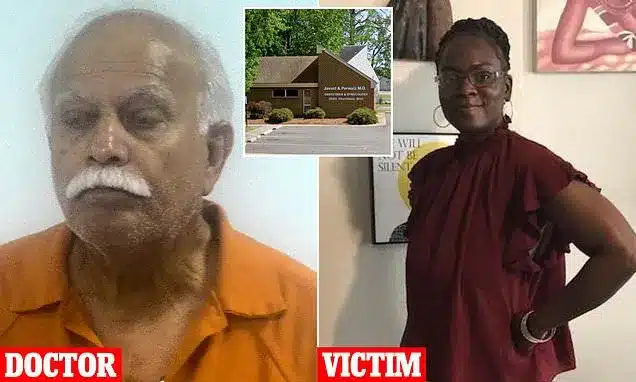
A Virginia obstetrician-gynecologist billed insurance companies up to $20 million by performing unnecessary surgeries on hundreds of women over decades. Javaid Perwaiz, who practiced for more than 30 years, convinced patients their health faced immediate threats, such as cancer diagnoses, to push invasive procedures. Federal investigators determined he lacked qualifications for many operations and targeted vulnerable patients at his practice.
Victims’ Harrowing Experiences
Dracena Holloway, a mother of six, started seeing Perwaiz at age 19 in 2001. Over nearly 20 years, she endured countless vaginal exams, an involuntary hysterectomy, major surgeries, and false cancer diagnoses—all while under anesthesia when signing consents.
After her mother’s death from stomach cancer, Perwaiz claimed Holloway had the same condition. “We’re going to have to do a surgery on you because you have cancer like your mother,” he told her, prompting tears and fears of dying young. Tests later confirmed no cancer. Holloway now suffers chronic pain, unable to stand for long periods or continue her warehouse job. “I can’t stand on my feet after four hours,” she said. “It hurts really badly.”
During one exam, while pregnant with her fourth child, Perwaiz made inappropriate comments. “I must have ‘good, good,” he remarked, which Holloway described as flirtatious behavior.
Jivondra Tucker, 39 and mother of four, underwent at least 14 surgeries over nine years starting in 2010. In April 2013 alone, she had three procedures in one month. Perwaiz performed frequent pap smears and diagnosed stage-three cancer during her pregnancy, warning she would die. He recommended early delivery at 37 weeks via C-section, after which a nurse revealed her tubes had been tied without consent.
“I didn’t sign no papers to get my tubes tied,” Tucker stated. Years later, records showed no cancer and intact tubes—she even experienced an ectopic pregnancy. The surgeries led to addiction, mental health struggles, constant pain, and complications with Crohn’s disease. “I trust him with my life and I’m thinking that he saved my life and the whole time he doesn’t,” she said. “He’s hurting me the whole time.”
Conviction and Scheme Details
Perwaiz performed thousands of unneeded procedures on over 1,000 patients, mostly Black women, collecting payouts from Medicaid, Medicare, Tricare, and private insurers. Federal authorities noted his greed drove the fraud: lavish spending on luxury cars and high-end shopping at patients’ expense.
Convicted on 52 of 63 felony health care fraud counts in 2021, he received a 59-year prison sentence. A 1982 Virginia Board of Medicine censure had previously flagged him for unnecessary surgeries and a sexual relationship with a patient.
Mass Lawsuit Against Medical Center
In December 2025, Holloway hired out-of-state attorney Victoria Wickman, joining a lawsuit now involving 1,000 plaintiffs against Chesapeake Regional Medical Center, where Perwaiz practiced. Attorneys Anthony T. DiPietro and Wickman lead the case, calling it “the biggest lawsuit that no one has heard about yet” and “the largest healthcare civil rights violation in modern American history.”
The complaint accuses the center and executives—James Reese Jackson, Peter Francis Bastone, Wynn Lawton Dixon Jr., Donald S. Buckley, and Christopher R. Mosley—of enabling Perwaiz despite reports of misconduct. “They actively participated in it by silencing people who tried to speak up,” DiPietro said, alleging executives prioritized revenue.
Wickman highlighted generational impacts: “CRMC’s actions have impacted generations of Chesapeake families. Women seeking care were instead subjected to a Frankenstein-style chop shop… Hundreds of women were sterilized, and more continue to come forward.”
Hospital’s Defense
Chesapeake Regional Medical Center states Perwaiz was never a direct employee but an independent practitioner. “His actions occurred without the knowledge of the organization,” a spokesperson said. The center cooperated with the federal investigation leading to his conviction and expresses empathy for victims while declining further comment on ongoing litigation due to respect for the legal process.