
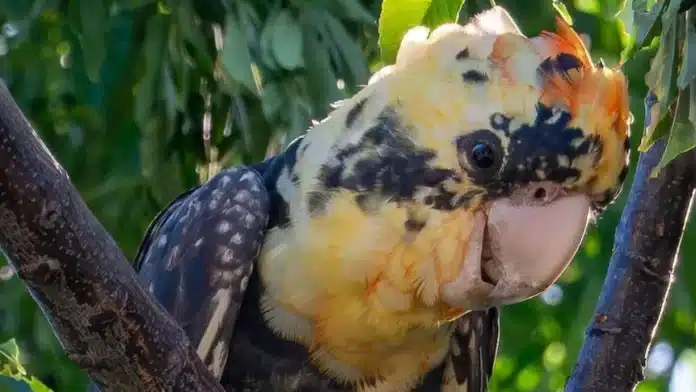
A distinctive orange red-tailed black cockatoo, struck by a rare leucistic condition affecting roughly one in 30,000 birds, has appeared in southern Western Australia. These birds, already vulnerable due to habitat loss and urban expansion, delight locals, scientists, and bird lovers whenever they show up.
Understanding the Leucistic Phenomenon
Local photographer Julie Guglielmana captured images of the female bird last month, highlighting its unique orange hue. Leucism, akin to albinism, causes pigment loss in the feathers. Tegan Douglas from BirdLife Australia describes it as a genetic mishap where signals for black pigmentation falter. “She’s essentially lost some component of her colour; it’s a genetic mutation, an error in the genetic coding,” Dr. Douglas stated. “It’s not giving superpowers or anything like that, it’s just a little glitch.”
Repeat Visitor to Bunbury Area
Observers have noted similar orange cockatoos near Bunbury multiple times over the past decade, pointing to the same bird. Suburban food shortages and heightened competition likely drive its occasional disappearances. “We know our parrots are really smart; they get up to all sorts of mischief as they explore the environment,” Dr. Douglas explained. “That can vary a bit in the suburbs, because there’s not as much food.”
Corella Plague Adds Pressure
The sighting occurs during a corella outbreak in Greater Bunbury, where these invasives ravage native plants and edge out species like the red-tailed black cockatoo.
Dr. Douglas views the event as a prompt to value community birds. “We can comfortably say it’s a bird that’s hung around Bunbury for most of its life,” she noted. “I think that’s lovely … we think about birds in a way; they come and go. This is just delightful, talking about neighbourhood birds.”