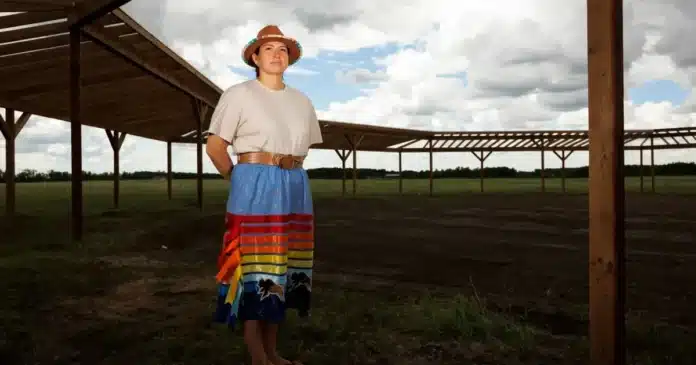
A significant shift is underway in Indigenous leadership across Canada, with women increasingly stepping into prominent roles. This trend is particularly evident in Westman, where communities are witnessing a new generation of female chiefs making history.
Young Leaders Pave the Way
Tréchelle Bunn, a member of Birdtail Sioux First Nation, recently made headlines after being elected chief of her community at the remarkable age of 25. Described on a podcast as embodying a transformative movement, Bunn is balancing her legal studies with community leadership and national advocacy. Her ascent highlights that the next wave of leadership is not just preparing, but actively leading.
Bunn’s election marked a historic moment, as she is the first woman and the youngest individual ever to hold the position of chief for her First Nation. This achievement is part of a larger narrative of evolving roles for women within First Nations across the country.
Record Numbers of Female Chiefs
Earlier this year, Assembly of First Nations National Chief Cindy Woodhouse Nepinak announced a record-breaking 164 female chiefs leading First Nations nationwide. This number later increased to 165. Nepinak emphasized on social media that “First Nations women continue to guide pathways of healing, sovereignty, and opportunity.”
Bunn’s visibility, due to her youth and extensive leadership experience, positions her as a key example of this growing movement. She has represented Indigenous people at the United Nations Human Rights Council, served as a youth chief for the Southern Chiefs Organization, and founded the Reconciliation Run. Notably, she also completed law school while serving as chief.
Challenging Perceptions and Inspiring Future Generations
Bunn believes she represents not just her community, but the aspirations of the next generation and young people nationwide. She aims to lead by example, demonstrating the possibilities for other women and girls. “I’m still challenging the narrative of what it looks like and what it means to be a chief,” Bunn stated. “I think it’s also challenging society’s perception of seeing a young woman as a chief.”
She sees her story resonating beyond her own community, stating that for decades, young women in her community lacked tangible representation. “They didn’t have a female chief of our community that they could look to and say, ‘If they can do it, so can I.’ And that’s what I’m hearing from not only young people in my community, but when I go to other events or connect with other young people across the country.”
Matriarchal Resurgence in Westman
The Dakota First Nations in Westman exemplify this trend, with women now heading three out of five communities. Bunn described this as a revival of traditional decision-making roles for women, rather than entirely new ground being broken. “I think that that’s a beautiful resurgence of, you know, our matriarchs reclaiming our place within leadership and decision making in our communities,” she said.
Sioux Valley Dakota Nation is led by Chief Jennifer Bone, and Canupawakpa Dakota Nation by Chief Charlene Higheagle-Moore, both elected within the past year. Chief Bone agrees that a significant shift is occurring, noting that while women have always held important positions, they are now increasingly entering political and professional leadership roles.
Entrepreneurship and Education Fueling Progress
Bone shared an example of a female entrepreneur who recently conducted a workshop in Sioux Valley, training approximately 30 women in eyelash styling and equipping them to start their own businesses. “Seeing Indigenous women taking on those roles and being successful with their entrepreneurship is inspiring for other women,” Bone commented. “I think it’s more inspiring for young women to further their education.”
Bone, who is pursuing a master of business administration and has extensive experience in Sioux Valley’s council and governance, believes the momentum for First Nation women will continue to grow and inspire future generations. She recently attended an inaugural “matriarch summit” in Ottawa, where female chiefs from across the country gathered to discuss community issues.
Strengthening Communities Through Diverse Voices
Bone emphasized that increased female representation in professional and political spheres strengthens First Nations communities broadly, by ensuring more voices advocate on their behalf. “I think it really helps us, not just to advance our nations, but all First Nations collectively. You have more people that are advocating for you — not only politically, but financially and economically.”
This spirit of advocacy was a key factor for Kyra Wilson when she was elected grand chief of the Assembly of Manitoba Chiefs. Wilson stated after her win that she saw herself as a powerful voice for First Nations issues. “That is something that I shared with our leadership: I am a strong advocate, and I will continue to push to see the results that we want, and I won’t stop until we see the results,” Wilson said in an interview at the time. “My education, my career, my experience has always been advocating for our people. So I’ve really been able to develop the skill.” Wilson became the Assembly of Manitoba Chiefs’ second female chief, following Cathy Merrick, who was the first woman to hold the position since its inception in 1987.
Bunn acknowledges the added pressure of being the first woman chief in her community, keenly aware of the impact her tenure will have on those who follow. “I’m hopeful that anything that I do now in this role, with the opportunities I’m given, is paving the way for those that come after me,” she said. “I’m maybe the first, but I’m not going to be the last.”