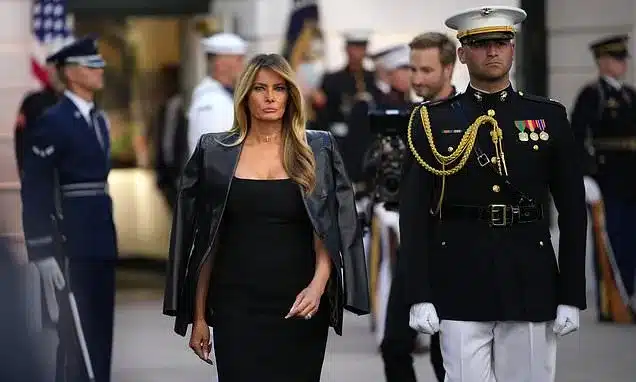
In a notable public statement, former First Lady Melania Trump has expressed her support for the LGBTQIA+ community, coinciding with a significant Supreme Court decision concerning transgender athletes in sports. The statement, made via the social media platform X, articulated a dual stance: full backing for LGBTQ+ rights alongside a commitment to ensuring fairness and protection for female athletes.
Supreme Court Ruling and Melania Trump’s Response
The Supreme Court’s recent ruling affirmed the legality of state-level bans that prevent transgender athletes from competing in girls’ and women’s sports. This decision has sparked considerable debate, and Melania Trump’s statement offered a perspective that seeks to bridge differing viewpoints. She began her post by referencing her own memoir, where she previously stated her ‘full’ support for the ‘LGBTQIA+ community.’
However, she immediately followed this by emphasizing the parallel need to ‘ensure that our female athletes are protected and respected.’ According to her statement, the Supreme Court’s ruling legally validates this position. She quoted the majority opinion, which concluded that the bans on transgender athletes do not contravene Title IX, the federal law prohibiting sex-based discrimination in education, nor the Equal Protection Clause of the Fourteenth Amendment.
Balancing Rights and Fairness
Melania Trump concluded her remarks by stating, ‘America, we can support the rights of the LGBTQIA+ community and also protect opportunities for female athletes.’ She underscored the importance of both principles, adding, ‘Respect everyone and keep girls’ sports fair. Both ideals are essential.’ This articulation suggests a belief that these two objectives are not mutually exclusive but can be pursued concurrently.
Background of the Supreme Court Case
The Supreme Court’s decision on Tuesday effectively overturned rulings from lower courts that had favored transgender students. These students had challenged bans in states like Idaho and West Virginia, arguing that such restrictions violated the Constitution and federal anti-discrimination statutes. For instance, West Virginia’s ban, enacted in April 2021, had been temporarily blocked by the Fourth Circuit Court of Appeals three years later, highlighting the legal back-and-forth preceding the Supreme Court’s final judgment.
The legal challenge centered on whether these state bans infringed upon the rights of transgender individuals, particularly concerning their ability to participate in sports consistent with their gender identity. The Supreme Court’s majority, however, found that the bans were permissible under existing federal law and constitutional protections.
The Nuance of Policy and Inclusion
Melania Trump’s statement is significant as it represents a rare foray into direct political commentary on a contentious social issue. Her approach, which she frames as a balance between inclusivity and fairness, reflects a broader societal discussion about how to navigate the complexities of gender identity in public life, especially within the realm of sports. The emphasis on protecting ‘female athletes’ and keeping ‘girls’ sports fair’ speaks to concerns about competitive balance and the integrity of women’s sports categories.
This perspective acknowledges the validity of LGBTQ+ rights while simultaneously raising questions about the specific implications of transgender participation in women’s sports. The former First Lady’s words suggest a framework where both the rights of the LGBTQIA+ community and the specific needs and protections of female athletes can be addressed without necessarily compromising one for the other. This nuanced position aims to find common ground in a debate often characterized by polarization.
Broader Implications and Societal Dialogue
The Supreme Court’s ruling and Melania Trump’s subsequent statement are likely to fuel ongoing discussions across the nation. The intersection of civil rights, gender identity, and athletic participation remains a focal point for policymakers, legal scholars, and the public. As states continue to grapple with these issues, the differing viewpoints, including those advocating for broad LGBTQ+ inclusion and those prioritizing sex-based categories in sports, will continue to shape policy and legal challenges.
The former First Lady’s intervention, drawing from her personal reflections and the highest court’s legal interpretation, adds another layer to this complex dialogue. Her call for mutual respect and fairness underscores the challenge of creating policies that are both equitable and inclusive, acknowledging the diverse needs and concerns of all individuals involved. The debate over transgender participation in sports is far from settled, and this statement highlights the various perspectives seeking resolution.
Conclusion: A Call for Unified Respect
Melania Trump’s rare political statement offers a perspective that seeks to reconcile support for the LGBTQIA+ community with the protection of women’s sports. By referencing her own writings and the Supreme Court’s majority opinion, she articulated a vision where inclusivity and fairness can coexist. Her concluding remarks, emphasizing respect for all and the importance of fair competition in girls’ sports, encapsulate a desire for a balanced approach to these sensitive issues. The ongoing societal conversation will undoubtedly continue to explore these themes as legal and policy landscapes evolve.