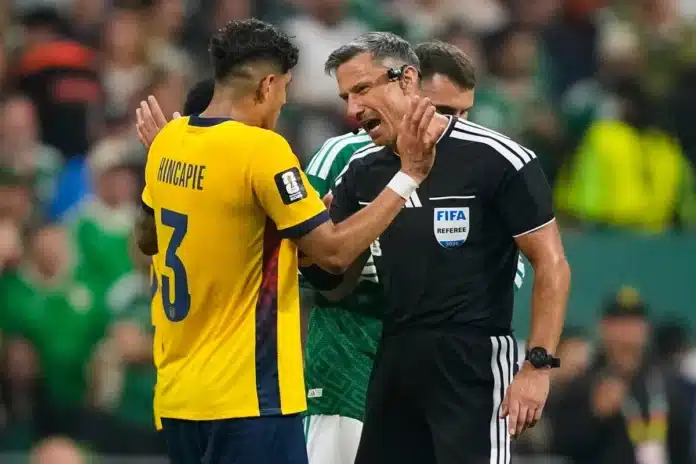
A strict new directive is reshaping player conduct at the World Cup, leading to immediate red cards for those caught covering their mouths during verbal exchanges. This policy, implemented before the tournament began, aims to curb abusive, discriminatory, or offensive language by ensuring such remarks cannot be concealed. The rule’s rigorous application was starkly demonstrated when Ecuador defender Piero Hincapié received a red card in stoppage time during his team’s 2-0 defeat to Mexico in the round of 32.
The “Prestianni Law” and its Origins
The impetus behind this stringent measure, colloquially known as the “Prestianni Law,” stems from a significant controversy in international soccer. FIFA President Gianni Infantino championed the rule change following an incident involving Benfica winger Gianluca Prestianni and Real Madrid forward Vinícius Júnior. During a Champions League match in February, Vinícius Júnior alleged that Prestianni covered his mouth with his jersey while directing racially charged insults towards him. This alleged attempt to hide offensive language prompted FIFA to seek a more robust enforcement mechanism.
The International Football Association Board (IFAB), the body responsible for the Laws of the Game, unanimously approved the guideline. While not a mandatory component of the fundamental Laws of the Game, the rule grants tournament organizers, such as FIFA, the authority to implement it at their discretion. IFAB, comprising representatives from FIFA and the four British football associations, ratified the proposal during a dedicated meeting, signaling a unified stance against unsportsmanlike conduct.
How the Rule is Applied
Under the new guideline, players who cover their mouths while verbally confronting an opponent can be penalized with a red card. This action is interpreted as an attempt to conceal potentially abusive or offensive speech, thereby circumventing accountability. The decision to issue a red card rests with the match officials, who are empowered to enforce this rule to maintain the integrity and respect of the game.
Notable Incidents and Enforcement
The World Cup has already seen instances where this rule has been enforced. Piero Hincapié’s dismissal against Mexico, though occurring late in a match that was already decided, served as a clear signal of the rule’s strict enforcement. Prior to this, Paraguay midfielder Miguel Almirón became the first player to be sanctioned under the new policy. He was sent off during a group stage match against Turkey after covering his mouth during an altercation with defender Mert Mulder. Although Paraguay secured a 1-0 victory, Almirón’s expulsion resulted in him missing Paraguay’s subsequent group game against Australia. FIFA confirmed that this decision was not subject to appeal, highlighting the finality of such rulings.
Consequences of a Red Card
Receiving a red card in a World Cup match carries significant consequences for both the player and their team. A player shown a red card is immediately ejected from the current match. Furthermore, they are automatically suspended for the team’s next match, forcing them to sit out a crucial fixture. The team must then continue the remainder of the game with one fewer player, placing them at a considerable tactical disadvantage. However, the suspension applies only to the individual player; the team is permitted to field a full-strength squad of 11 players in the match following the one they played shorthanded, provided the suspended player is not included.
Broader Implications for Player Conduct
The introduction and strict enforcement of this rule underscore a broader commitment by FIFA and IFAB to foster a more respectful and equitable environment in professional football. By specifically targeting the concealment of potentially offensive language, the authorities aim to deter verbal abuse and ensure that players are held accountable for their words, regardless of whether they attempt to hide them. This proactive approach seeks to protect players from discrimination and abuse, promoting a positive image of the sport on a global stage.
The rule’s effectiveness will likely be monitored throughout the tournament, with potential adjustments or further clarifications to follow based on its application. For players, it serves as a clear reminder that conduct, both on and off the ball, is under scrutiny, and that attempts to circumvent fair play or respectful communication will be met with stern penalties. The goal is to ensure that the World Cup remains a celebration of athletic prowess and sportsmanship, free from the stain of verbal abuse and discrimination.