
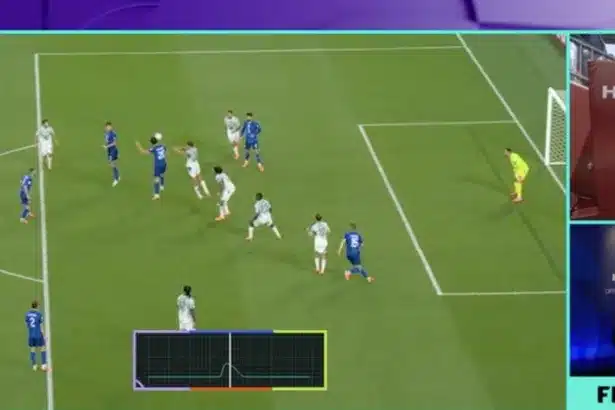
Portugal has secured a place in the last-16 of the World Cup, with a crucial late goal for Croatia being disallowed thanks to the intervention of advanced ball-tracking technology. The controversial decision, which confirmed Portugal’s progression, hinged on the precise detection capabilities of the new Adidas “Trionda” ball, featuring integrated microchip technology.
Technology Decides Crucial World Cup Moment
During a tense passage of play in the 113th minute, with the match seemingly heading towards a penalty shootout, Croatia’s Josko Gvardiol appeared to have scored an equalizer. However, the goal was ultimately chalked off by the match officials following a review facilitated by the Snickometer system. This technology, embedded within the official 2026 World Cup ball, utilizes sound waves generated by the microchip to detect any contact made with the ball.
VAR officials employed the Snickometer to determine if Croatian striker Igor Matanovic had touched the ball before it deflected off Portuguese defender Renato Veiga. The technology indicated that Matanovic had indeed made contact. This touch was critical because the ball subsequently rebounded to Mario Pasalic, who was positioned in an offside position when the initial cross was made. Pasalic then controlled the ball and passed it to Gvardiol, who scored.
The disallowed goal came shortly after Cristiano Ronaldo had scored his first World Cup knockout stage goal in the second half. Ronaldo was later substituted, appearing visibly displeased.
VAR and Snicko’s Role in the Decision
Following the play, Croatian players and fans celebrated what they believed was a game-tying goal. However, referee Espen Eskas was alerted by VAR to a potential offside infringement. After consulting the on-field monitor and analyzing the sound wave data from the ball’s microchip to confirm the touch by Matanovic, Eskas made the final decision to disallow the goal.
The use of Snicko technology, a system that has roots in cricket where it was developed by an English inventor in the 1990s, has become more prominent in football. While a version of this technology was present at the 2022 World Cup, its role in broadcast and decision-making has been significantly amplified in 2026.
Broadcasting commentary highlighted the technology’s effectiveness. A message shared by veteran official Darren Cann, as read by BBC host Mark Chapman, supported the referee’s decision. Cann’s message explained that the offside stood because the ball was last played by a teammate and deflected off a defender without being deliberately played by him. He stated that Snicko “100% proves that he touched it with the flick-on.”
Ronaldo’s World Cup Journey and Technology’s Influence
This incident echoes a previous World Cup match in 2022 involving Cristiano Ronaldo. On that occasion, a goal scored by Ronaldo was disallowed after he insisted a cross from Bruno Fernandes had grazed his head. Technology, however, determined there was no contact, and the goal was ultimately credited to Fernandes. Ronaldo’s frustration was evident as he tapped his head, suggesting otherwise.
In the match against Croatia, Ronaldo experienced a mixed game. Besides his disallowed second-half effort, he later converted a penalty. Despite only having these two touches within the Croatian penalty area, Ronaldo was recognized with the Man of the Match award.
Portugal’s Next Challenge
With the victory secured by the crucial disallowed goal, Portugal now advances to a Round of 16 fixture against their Iberian neighbors, Spain. The match is anticipated to be a highly competitive encounter between two strong European nations.
The Future of Football Technology
The implementation of advanced technologies like Snicko in football is reshaping how decisions are made, particularly in critical moments. The integration of microchips in balls allows for unprecedented accuracy in detecting touches and potential infringements, aiming to reduce controversial calls and enhance the fairness of the game. As football continues to evolve, such technological advancements are likely to play an increasingly significant role in major tournaments.