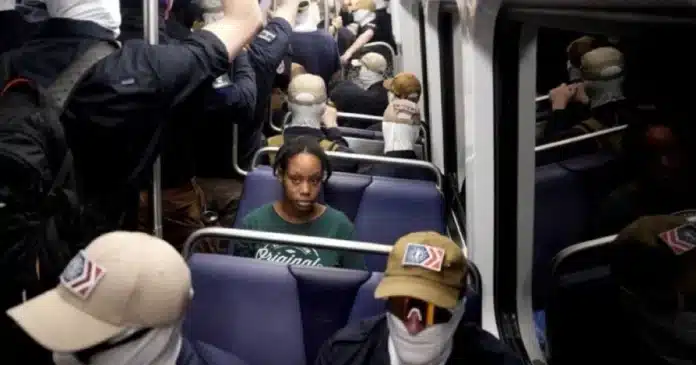
As the United States marked its 250th anniversary of independence over the weekend, a striking photograph captured in Washington D.C. has been widely described as a potentially “defining image” of the nation at this moment. The image depicts a young Black woman seated on a suburban train, surrounded by numerous individuals identified as members of the white supremacist group Patriot Front, many of whom were masked.
A Powerful and Contentious Photograph
The photograph, taken by Reuters photographer Cheney Orr on Saturday, has resonated deeply due to its stark visual contrast. Melanie D’Arrigo, executive director of Campaign for New York Health, commented on the image’s potential to symbolize the current era in American society. “I feel like the photo of this black woman surrounded by dozens of masked, anonymous, white nationalists is going to be a defining picture of this moment in America for a long, long time,” D’Arrigo stated.
Details surrounding the interaction remain unclear. The identity of the woman has not been released, and it is unknown if she had any direct engagement with the Patriot Front members. The group itself marched through Washington D.C. over the weekend, displaying American flags flown upside down and flags reminiscent of the American Civil War era. Participants wore masks, sunglasses, and hats, obscuring their faces. Video footage reportedly captured some members chanting slogans such as, “Life, liberty, victory!” and “Reclaim America!”
Government Response to the Parade
The presence and actions of the Patriot Front were met with a measured response from some government officials. A former Trump administration official, speaking on condition of anonymity, characterized the parade as an illustration of “messy” democracy, falling under the protection of constitutionally guaranteed free speech. During an appearance on CNN’s State of the Union, Interior Secretary Doug Burgum acknowledged the group’s ideology was disagreeable but emphasized the principle of free speech. “Certainly what they stand for is nothing that I could possibly agree with. But one of the foundational principles of the United States, which makes democracy messy, is free speech,” Burgum said.
Presidential Address and Political Messaging
In parallel with the weekend’s events, President Donald Trump delivered a campaign-style speech on the National Mall, coinciding with the anniversary celebrations. His address touched upon themes of patriotism, national achievements, and warnings against perceived ideological threats, both domestically and internationally. Amidst a significant delay due to severe weather, Trump spoke late Saturday, blending appeals to national pride with critiques of political opponents.
The President highlighted historical American accomplishments, including military victories, the moon landing, and the pioneering flight of the Wright brothers. He also took the opportunity to advocate for legislative changes, urging Congress to pass the SAVE America Act. This proposed legislation aims to restrict mail-in voting and mandate proof of citizenship for voter registration.
Departing from the typical unifying tone of Independence Day addresses, Trump injected partisan commentary. He reiterated his support for Second Amendment rights and revived his criticisms of communism, a theme increasingly prominent in his rhetoric ahead of upcoming midterm elections. “We like to stop a threat like that immediately and before it begins. It’s like a cancer – you’ve got to cut it out and you got to cut it out fast,” Trump stated, likening the threat to a disease requiring swift removal.
The event, dubbed “Salute to America,” was notably shaped by organizers closely aligned with the White House, a departure from previous bipartisan approaches to national holiday celebrations. Trump concluded his remarks with affirmations of national strength and resilience: “We will always be on top. We will never let our country fall. We will always be the best.” While he spoke less about himself than is typical for his rallies, he included a lighthearted remark about seeking a third presidential term and paid tribute to the “greatest generation” of World War II veterans.
Holiday Celebrations Amidst Extreme Weather
Anticipation for the nation’s 250th anniversary had been building throughout the year, offering a moment for reflection on America’s complex history, from its colonial origins to its status as a global superpower. However, widespread extreme weather conditions significantly impacted holiday plans across the East Coast. Record-breaking heat, with temperatures approaching and exceeding 100 degrees Fahrenheit in many areas, forced organizers to modify or cancel numerous events.
Severe weather prompted the cancellation of celebrations in cities such as Hartford, Connecticut, and Harrisburg and Wilkes-Barre, Pennsylvania. In Boston, attendees at a fireworks and concert event were temporarily advised to seek shelter before festivities resumed. Philadelphia also experienced an evacuation order. While New York and Pittsburgh proceeded with their fireworks displays, the timing was adjusted to account for the weather patterns. The disruptions were particularly pronounced in Washington D.C., where large crowds had gathered on the National Mall hours before an evacuation was ordered.
Conclusion: A Moment of Reflection
The confluence of a visually arresting photograph symbolizing societal divisions, a presidential address emphasizing national identity and political agendas, and the backdrop of extreme weather created a complex and memorable observance of America’s 250th birthday. The image of the young Black woman surrounded by masked white supremacists, in particular, has become a focal point for discussions about the nation’s current social and political landscape, serving as a potent, albeit somber, symbol for many.