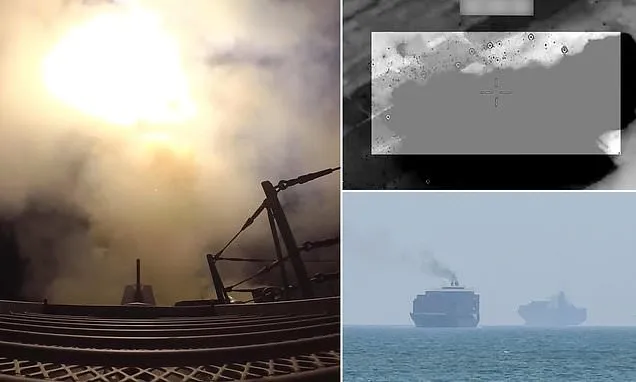
In a significant escalation of regional tensions, United States forces have conducted extensive strikes against Iranian drone and missile sites, aiming to secure the vital Strait of Hormuz for international shipping. The offensive actions, announced late Sunday night by U.S. Central Command (CENTCOM), targeted numerous locations in Iran with the stated goal of degrading the country’s capacity to attack maritime traffic. The Strait of Hormuz, a critical chokepoint through which approximately one-fifth of the world’s oil supply transits, has become a focal point of conflict between the two nations.
US Offensive Strikes Target Iranian Military Capabilities
CENTCOM reported that American troops executed a new series of ‘offensive strikes’ designed to neutralize Iran’s ability to threaten commercial vessels. The operation involved a multi-faceted approach, utilizing fighter jets, naval vessels, and drones, including newly deployed one-way attack sea drones. These forces struck a range of Iranian military assets, including air defense systems, coastal radar installations, and missile and drone launch sites. Dramatic video footage released by the U.S. military depicted fighter jets launching from aircraft carriers at night and explosions occurring at various targeted locations.
A statement from CENTCOM emphasized the U.S. commitment to maintaining freedom of navigation. “US forces are postured and prepared to ensure that freedom of navigation remains available to commercial shipping, despite Iran’s continued unwarranted aggression, harassment, threats and arbitrary declarations,” the command stated on the social media platform X. The U.S. asserts that it possesses the authority to ensure passage through the waterway, a claim contested by Iran.
Iran’s Response and Claims of Territorial Control
Iranian state media confirmed early Monday that explosions had been heard in several locations within the country, reporting at least one fatality as a result of the U.S. strikes. In response, Iran launched retaliatory actions against Gulf nations it perceives as supporting the United States. Tehran reiterated its claim over the Strait of Hormuz, with its paramilitary Revolutionary Guard declaring, “The Strait of Hormuz is our territory, and we will not allow a rogue and child-killing army from the other side of the world to continue its illegal interference in it.”
Iranian officials accused the United States of violating international law and committing war crimes, alleging that the strikes damaged transportation infrastructure, fishing vessels, cargo barges, and meteorological facilities. Iran also claimed that the U.S. military had directed its allies in the Persian Gulf to carry out attacks against Iran and warned of conducting ‘defensive strikes’ against any country assisting U.S. forces. Tehran called for the United Nations and the Security Council to hold the involved parties accountable.
Strait of Hormuz: A Contested Waterway
The Strait of Hormuz has been a persistent point of contention, particularly in the context of recent ceasefire negotiations aimed at ending hostilities. Iranian officials maintain that they alone should control the strait and have the authority to regulate passage, even suggesting ships might be charged for transit. They have advocated for vessels to use a northern route within Iran’s territorial waters.
However, the U.S. military has supported a southern route along the coast of Oman, a development that has reportedly angered Iran and led to repeated attacks on ships utilizing this path. The Joint Maritime Information Center, a U.S.-led naval coalition based in Bahrain, has advised mariners to exercise “extreme vigilance” when transiting the strait.
Recent incidents have underscored the volatile situation. Last week, Iranian forces reportedly struck three ships in the Strait of Hormuz, including a Qatari liquefied natural gas tanker and a Saudi crude oil tanker. In response, U.S. forces conducted strikes on approximately 90 military targets, including numerous IRGC boats. These actions followed earlier strikes that hit over 300 targets.
Economic Impact and International Concerns
The escalating conflict has had immediate economic repercussions, with oil prices surging following the weekend’s events. U.S. crude oil futures saw a notable increase, as did Brent futures, the international benchmark. These price fluctuations highlight the global economic significance of stability in the Strait of Hormuz.
International leaders have expressed deep concern over the potential for a full-scale return to hostilities. United Nations Secretary-General António Guterres issued a warning that such a scenario “would have catastrophic consequences.” The ongoing confrontations threaten to derail efforts to establish a lasting peace and could lead to wider regional instability.
Recent Incidents and Diplomatic Efforts
The latest round of U.S. strikes followed an incident where Iranian forces attacked a container ship in the strait, causing a fire and leaving one crew member missing. Iran claimed the vessel, identified as the M/V GFS Galaxy, was attempting to use an unauthorized route. The U.S. military reported significant engine room damage to the ship, and Omani authorities later confirmed the rescue of 23 crew members, with one Indian national still unaccounted for.
In the aftermath of the ship attack, U.S. military retaliation reportedly targeted around 140 sites, including missile and drone launch facilities, ammunition depots, and communication equipment. Statements from U.S. officials indicated a strong resolve to respond to Iranian aggression.
Iran’s response extended to attacks on several Gulf countries, including Bahrain, Kuwait, Qatar, Jordan, and Oman. Kuwaiti air defenses were reportedly activated, and Jordan confirmed intercepting missiles within its airspace. These actions indicate a broadening of the conflict beyond direct confrontations between the U.S. and Iran.
Despite the heightened military activity, diplomatic channels remain active. Iranian Foreign Minister Abbas Araghchi reportedly met with his Omani counterpart to discuss mechanisms for ensuring safe passage of ships. Mediation efforts are ongoing, with officials urging de-escalation. However, statements from U.S. President Donald Trump suggested a breakdown in ceasefire negotiations, while Iran’s Supreme Leader Ayatollah Mojtaba Khamenei vowed retribution for perceived aggressions.
The situation remains highly fluid, with both sides demonstrating a willingness to employ military force while diplomatic efforts continue to seek a de-escalation and a return to stability in this critical global waterway.