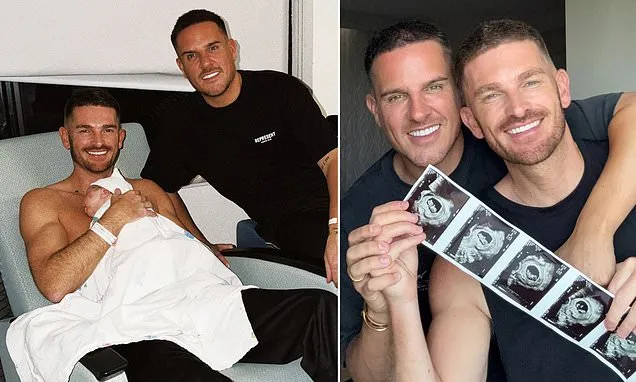
A significant campaign to reform the United Kingdom’s surrogacy laws, spearheaded by former fashion entrepreneur Adam Frisby, has culminated in a parliamentary debate scheduled for early September. Frisby, co-founder of the online fashion retailer In The Style, has been advocating for changes to what he describes as an outdated and burdensome legal framework surrounding surrogacy in Britain. His efforts, amplified by a public petition, have now secured a formal discussion in Parliament, a development he and his fiancé, Jamie Corbett, initially found hard to imagine.
The Genesis of the Campaign
Frisby and Corbett recently welcomed their six-month-old daughter, Leven Rose, through surrogacy in the United States. While they are the biological parents and have embraced parenthood, UK law currently does not recognize them as Leven’s legal parents from birth. Under existing legislation, the surrogate mother is automatically considered the legal parent, and if she is married, her spouse is recognized as the legal father, regardless of biological ties or intent to parent. This legal reality has prompted Frisby’s passionate advocacy for reform.
“The fact our petition has now secured a debate in Parliament is something Jamie and I never imagined when we first shared our story,” Frisby stated. “We simply wanted to make sure no other family had to go through what we did, so to see so many people get behind this campaign means more than we can put into words.”
Challenges with Current UK Surrogacy Laws
The core of Frisby’s argument centers on the lengthy and complex process intended parents must undertake to gain legal recognition. In the UK, even when parents are biologically related to the child, they must navigate a ‘parental order’ process. This typically involves extensive paperwork, social worker assessments, and court appearances, which can take up to a year in some regions, such as Manchester, where the process can extend for 12 months.
Frisby highlighted the emotional toll of this legal hurdle. “No parent should have to spend months waiting to become their own child’s legal parent simply because of the way their child was born,” he explained. “When we came back to the UK, we discovered that the law doesn’t really see intended parents as the child’s legal parents. When our daughter was born through surrogacy, we became dads the moment we held her. But under current law, the surrogate is automatically recognised as the legal mother, and if she is married, her spouse is recorded as the legal father, even with no biological connection or intention to parent the child.”
He further elaborated on the difficulties encountered, recalling a conversation with their lawyer before Leven’s birth. “Our lawyer explained that we wouldn’t be able to make certain decisions for her, apply for documents in the usual way or automatically provide consent for medical treatment,” Frisby said. “We came off that call devastated because this is our daughter. We’d wanted her for years.”
The couple chose surrogacy in the United States specifically because it offers legal recognition for intended parents from the moment of birth, a stark contrast to the UK system. “The law must change so intended parents in surrogacy arrangements are recognised as their child’s legal parents from birth,” Frisby asserted.
Public Support and Petition Success
Frisby launched his petition in April, calling for a fundamental reform of the surrogacy laws. The response from the public was overwhelmingly positive, far exceeding his expectations. The petition rapidly gathered momentum, reaching 100,000 signatures within just 48 hours, a milestone that qualified it for a parliamentary debate. As of the latest count, the petition has amassed over 112,000 signatures.
“We’re incredibly grateful to every single person who signed the petition, shared it or supported us along the way. You’ve helped get us to this moment,” Frisby expressed. “I thought we might reach 10,000 over the course of a year, but to hit 100,000 so quickly was amazing.”
Hopes for the Future
While acknowledging that a parliamentary debate does not guarantee legislative change, Frisby and Corbett are hopeful that it represents a significant step forward. They are seeking the opportunity to meet with the Member