
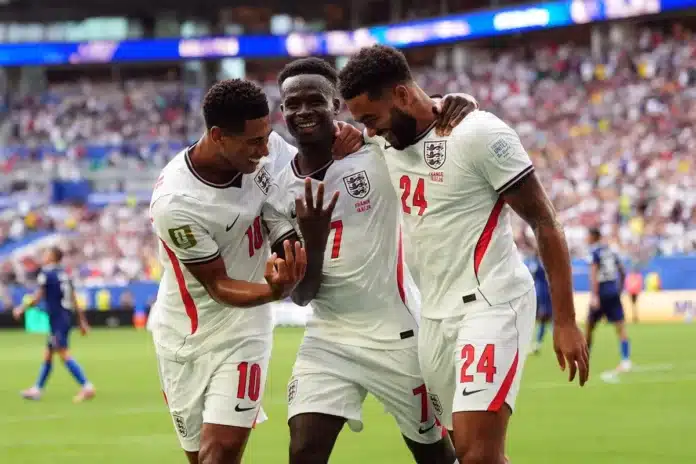
In a stunning display of offensive power, England played with the brilliance of World Cup champions, albeit in a match that ultimately determined third place. The team delivered a captivating 10-goal thriller against France, showcasing a dynamic performance that left many wondering what could have been achieved earlier in the tournament. While the bronze medal was secured, the match highlighted England’s potential, contrasting sharply with their earlier performances.
England’s Explosive Performance Against France
The match against France was a tale of two halves for England. For 45 minutes, the team played with the confidence and skill of world-beaters, dismantling the French defense with an attacking onslaught. However, the subsequent 45 minutes saw a significant shift, with the team appearing vulnerable and struggling to maintain their dominance. Despite this inconsistency, the game was historic for England. Bukayo Saka etched his name in the record books, becoming only the fourth Englishman to score a World Cup hat-trick, joining legendary figures like Geoff Hurst, Gary Lineker, and Harry Kane. Furthermore, Jude Bellingham’s late goal marked a significant achievement, making England the first team ever to score six goals against France in World Cup history.
This vibrant and dynamic display raised questions about why such form wasn’t evident in crucial earlier matches, particularly against Argentina. The performance suggested that this level of play might indeed be inherent to the team’s capabilities, despite any previous doubts. The manager, Thomas Tuchel, faced criticism for a perceived overly defensive strategy in the semi-final against Argentina, a stark contrast to the attacking freedom shown against France. Even though France appeared weakened and perhaps less motivated, England’s offensive surge was undeniable.
Tactical Reflections and Player Performances
The match saw significant tactical decisions and personnel changes from both sides, with seven alterations made by each team. England demonstrated considerable squad depth, which, while impressive against France, amplified the frustration that some of these impactful players were not given the opportunity to feature more prominently in earlier, more critical fixtures, such as the match against Argentina. Bukayo Saka, who was notably overlooked in Tuchel’s more conservative approach against Argentina, delivered a potent reminder of his attacking prowess. Similarly, Marcus Rashford’s late introduction in the semi-final contrasted with his dynamic presence in this game, underlining England’s potential for greater attacking penetration and acceleration.
Tuchel’s tactical approach, which was intended to leverage fast wingers, was spectacularly validated by the performances on display. While the team’s performance was an emphatic response to the semi-final disappointment, with assistant coach Anthony Barry noting the players were “playing with broken hearts,” it also served as an indictment of past tactical choices. An ironic twist came with the scorer of England’s second goal, Ezri Konsa. Konsa, who was part of a controversial substitution by Tuchel in a previous match, found the net with a header from a corner while playing in a back four, demonstrating his effectiveness in a different role.
There was some justification for Tuchel’s tactical considerations, particularly with Declan Rice delivering a dominant performance. Rice, who had been hampered by injuries and illness, was instrumental in the victory. He scored the opening goal and was involved in the build-up to the second. The strong contribution from Arsenal players was evident, with Rice and Saka combining for four goals and two assists between them. Rice captained the side in the absence of Harry Kane, who was rested due to accumulated fatigue, as noted by Tuchel.
Individual Brilliance and a Historic French Comeback
The starting lineup also featured Ivan Toney, who had previously seen only limited, injury-time action. Kobbie Mainoo’s World Cup campaign concluded without any playing time due to injury. Morgan Rogers, who started the match, showcased flashes of potential, though his impact was arguably less significant than that of Saka or Rice. Rogers opened the scoring with a powerful shot from 25 yards after intercepting a pass, and his corner led to Konsa’s headed goal.
Saka then took center stage, spearheading a brilliant counter-attack. After an effort was cleared off the line, he was set up by Rashford for his second goal. Saka completed his hat-trick from the penalty spot after Djed Spence was fouled. The victory was sealed by Jude Bellingham, who came off the bench to score a solo goal. However, Bellingham’s goal was part of a dramatic French resurgence.
Following several substitutions by France’s manager, Didier Deschamps, the French team mounted an impressive comeback, scoring four goals. Kylian Mbappé was central to this effort, scoring twice to surpass Lionel Messi in the World Cup’s all-time scoring charts, at least temporarily. Mbappé became the first player since Gerd Müller to score 10 goals in a single World Cup tournament and is a strong contender for the Golden Boot. Bradley Barcola, assisted by Mbappé, also found the net. Michael Olise, another substitute, provided assists for Mbappé’s goals, bringing his tournament tally to a record seven assists. Ousmane Dembélé briefly gave France the lead at 5-4 before Bellingham’s decisive equalizer.
A Fitting End to an Era and a Tournament
The match was not only historic for its scoreline but also marked the final game for Didier Deschamps as the manager of France, concluding his 187th match in charge and 290th overall for the nation, including his playing career. While the comeback echoed France’s resilience in the 2022 final, the defeat was not the farewell desired for Deschamps.
For Tuchel, who aims to continue his managerial career, this result solidifies England’s most successful World Cup campaign since 1966. With six victories and winning the third-place play-off, England achieved a notable feat. However, the exhilarating performance against France ultimately served to underscore the missed opportunities and the potential that remained unfulfilled in earlier stages of the competition.