Beyond the celebrated works that shaped literature, many renowned authors harbored complex and unconventional personal lives. These intimate details, often far removed from the classroom curriculum, reveal a fascinating, and sometimes shocking, dimension to their biographies. From unusual desires to unconventional relationships, the private worlds of these literary giants offer a stark contrast to their public personas.
Unconventional Desires and Early Influences
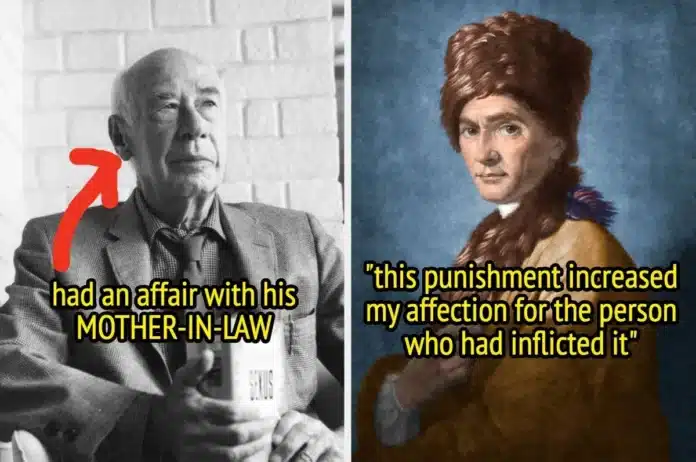
The development of personal tastes and desires can be influenced by formative experiences. For philosopher and writer Jean-Jacques Rousseau, an early childhood punishment by his guardian, Miss Lambercier, led to unexpected psychological and sensual associations. In his autobiography, Confessions, Rousseau detailed how this disciplinary experience, intended to be corrective, instead fostered a complex connection between physical sensation and affection. He wrote of the punishment, “this punishment increased my affection for the person who had inflicted it.” He further reflected on how this early event shaped his desires throughout his life, stating, “Who would believe this childish discipline, received at eight years old… should influence my propensities, my desires, my passions, for the rest of my life…”
Similarly, author Henry Miller’s relationships were marked by unconventional circumstances. After a period of study and brief college attendance, Miller became involved with Pauline Chouteau, a woman significantly older than him. Their affair involved Miller moving with her, though he experienced guilt over her son’s illness. After a period of separation, they reconnected, but Miller’s desire to marry Chouteau was met with strong opposition from his mother. Later, Miller’s relationship with his piano teacher, Beatrice Sylvas Wickens, was characterized by her more puritanical views on sex. Their physical intimacy was initially limited, and Miller eventually married her to avoid World War I conscription. During their marriage, Miller engaged in affairs, even with Wickens’s mother.
Complex Romantic Entanglements
The lives of writers Anaïs Nin and Henry Miller were deeply intertwined with complex relationships. When Nin met Miller, she felt an immediate connection. Her husband, Hugh Parker Guiler, was aware of their bond. Adding another layer, Miller’s second wife, June, also became involved with Nin, though Nin’s diaries describe this as primarily an emotional connection. Nin also maintained a secret marriage to Rupert Pole, a man sixteen years her junior, for over a decade while still married to Guiler. She managed a dual existence, dividing her time between a luxurious life in New York with Guiler and a more rustic life in California with Pole, describing herself as being “pulled by my two loves at each end of the trapeze.”
Benjamin Franklin, known for his wisdom and inventions, also offered advice on romantic pursuits, notably in his essay “Advice to a Friend on Choosing a Mistress,” where he advocated for preferring older women. The poet Lord Byron, famous for works like Don Juan, was known for his prolific romantic life, reportedly claiming to have had affairs with 200 women in under three years. His life also included a highly scandalous relationship with his half-sister, Augusta Leigh, which led to his social ostracization and the end of his marriage to Annabella Milbanke. Byron’s exile was followed by letters to Leigh expressing his “perfect and boundless attachment” to her.
Literary Circles and Scandal
The circle of Romantic writers was rife with complex relationships. Mary Shelley, the author of Frankenstein, and Percy Bysshe Shelley, the poet, reportedly first confessed their love at the grave of Mary’s mother. At the time, Percy was still married. When the Shelleys eloped, they were accompanied by Mary’s younger half-sister, Claire Clairmont. Reports suggest Clairmont may have had a romantic involvement with Percy, though evidence is scarce. Clairmont later had a daughter, Allegra, with Lord Byron.
Victor Hugo, the celebrated author of Les Misérables, was known for his intense sexual appetite. After his wife’s waning interest in intimacy, he frequented Parisian brothels. His death was reportedly mourned by sex workers in the city. James Joyce, the author of Ulysses, exchanged explicit letters with his wife, Nora Barnacle, revealing an unusual fascination with bodily functions, specifically her flatulence. Hans Christian Andersen, the beloved fairy tale writer, is widely believed to have never had sex, though he reportedly visited brothels and engaged in solitary practices afterward.
Exploring Controversial Themes
The origins of certain psychological terms are linked to literary figures. The term “masochism” is derived from Leopold von Sacher-Masoch, an author known for exploring themes of subjugation and receiving pleasure from pain in his writings. C.S. Lewis, the author of The Chronicles of Narnia, reportedly developed an interest in sadomasochism after reading the works of the Marquis de Sade. His writings to a friend, Arthur Greeves, were signed as “lover of the whip.”
Oscar Wilde, renowned for The Picture of Dorian Gray, married Constance Lloyd but later became involved with Robbie Ross, a young man who lived with the couple. H.G. Wells, author of The Time Machine, famously left his first wife for Amy Catherine Robbins. However, he continued to have affairs, including one with Elizabeth von Arnim, an author whose books Robbins enjoyed. Wells and von Arnim reportedly engaged in a symbolic act of defiance against a critic by making love outdoors and then burning a letter from the critic.
Prolific and Unconventional Lives
Novelist Georges Simenon, creator of the Inspector Maigret series, claimed to have had sexual encounters with approximately 10,000 women over his lifetime, a figure his son suggested was realistic, considering his father’s lifestyle and potential visits to brothels. Ernest Hemingway, the Nobel laureate, was known for his desire for role-playing in his intimate life. His fourth wife, Mary Welsh Hemingway, recounted his interest in switching sex roles, with Hemingway enjoying her playing a male role and her enjoying him playing a female role, a dynamic she described as “quite new and outside all tribal law.”
These accounts, while often sensational, offer a glimpse into the private lives of individuals whose written words have left an indelible mark on culture. They underscore the often-surprising complexity and diversity of human experience, even among those whose lives are most publicly documented.