
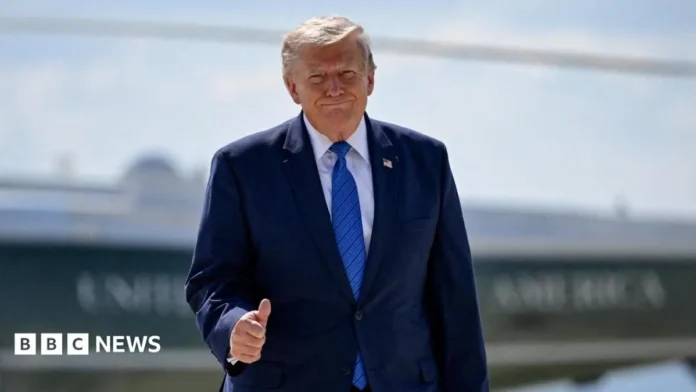
President Donald Trump announced on Friday that he had decided to halt planned military strikes against Iran, contingent upon the swift negotiation of a comprehensive deal. The decision, he stated, was made for the “future benefit of the WORLD and, likewise, the survival of a successful and prosperous Iran.” Trump indicated that this move was coordinated with Israel and came after he was reportedly asked by Iran and other regional nations to delay any action to allow for diplomatic efforts.
Context of the Decision
The announcement followed reports in US media suggesting that the United States was preparing for significant retaliatory strikes against Iran over the weekend. These potential actions were reportedly in response to Iran shooting down a US drone. The situation had been escalating, with Tehran previously accusing the US of increasing regional tensions. Iranian officials warned that any state collaborating with Washington would face the “flames of war.”
Trump elaborated on the conditions for his decision, specifying that any agreement would need to include the “Immediate, Complete, and Total OPENING OF THE HORMUZ STRAIT, and an end to Iran’s nuclear threat.” The Strait of Hormuz is a critical chokepoint for global oil shipments, and its closure would have significant economic repercussions worldwide. Iran’s nuclear program has also been a persistent concern for the international community.
Diplomatic Overtures and Warnings
The President’s statement on Truth Social suggested a willingness to engage in high-level negotiations to de-escalate the crisis. The reported request from Iran and other Middle Eastern countries to “hold off” indicates a potential opening for dialogue, though the specifics of these requests remain unclear. Trump’s framing of the decision as being for the “survival of a successful and prosperous Iran” suggests an aspiration for a resolution that avoids destabilizing the region.
However, the underlying tensions remain high. Prior to Trump’s announcement, the US government had issued security alerts urging American citizens in the Middle East to remain vigilant. The alert advised Americans to be prepared for potential travel disruptions, including flight cancellations and airspace closures, should the situation escalate further. This advisory underscored the volatile nature of the regional security environment and the potential for rapid developments.
Regional Dynamics and International Concerns
The involvement of Israel in the decision-making process highlights the complex web of alliances and rivalries in the Middle East. Iran’s actions, including the downing of the drone, have been viewed by the US and its allies as provocative. Conversely, Iran has consistently framed its actions as defensive responses to perceived US and regional aggression.
The potential for a wider conflict in the region is a significant international concern. The Strait of Hormuz, through which a substantial portion of the world’s oil passes, is particularly vulnerable. Any disruption to shipping in this vital waterway could lead to global energy price shocks and economic instability. Furthermore, Iran’s pursuit of nuclear capabilities remains a focal point of international diplomacy and security concerns.
Path Forward: Deal or Escalation?
Trump’s conditional cancellation of the strikes places the onus on Iran to engage in negotiations that meet his stated demands. The success of this approach hinges on Iran’s willingness and ability to agree to terms that address the opening of the Strait of Hormuz and halt its nuclear activities. The timeline for making a “DEAL” is described as “rapid,” suggesting a limited window for diplomacy.
The international community will be closely watching the unfolding diplomatic exchanges. The United States, under Trump’s leadership, has adopted a policy of maximum pressure against Iran, which has included sanctions and heightened military posturing. This latest development represents a potential shift, albeit a conditional one, towards a diplomatic resolution rather than immediate military confrontation. The coming days and weeks will be crucial in determining whether a deal can be reached or if tensions will re-escalate.
Conclusion
President Trump’s decision to cancel planned strikes on Iran, pending a rapid deal, introduces a critical diplomatic juncture. The move aims to avert immediate military conflict while setting clear conditions for a broader agreement concerning regional security and Iran’s nuclear program. The effectiveness of this strategy will depend on the responses of Iran and other key regional players, as well as the capacity for swift and substantive negotiations.