
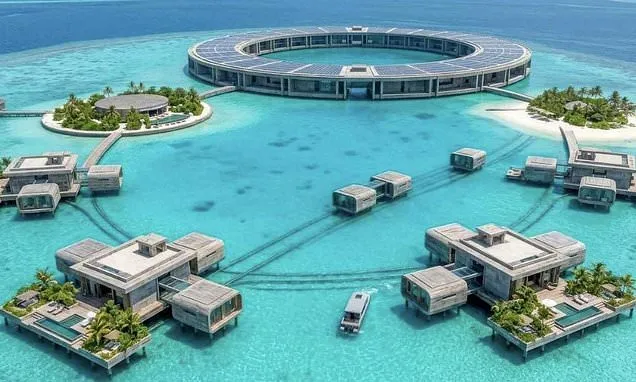
A visionary concept for a private, man-made island in the Maldives, designed to withstand environmental challenges like rising sea levels and earthquakes, is being offered for a staggering $450 million. Dubbed the ‘Adaptive Atoll’, this ambitious project aims to provide a secure and sustainable haven for ultra-high-net-worth individuals, envisioning a resilient luxury retreat engineered for the 22nd century.
The Adaptive Atoll: A Future-Proof Luxury Retreat
The proposed 155-acre development is envisioned as a ‘future-proof deep-water lagoon’ capable of remaining safely above projected 2100 ocean levels. This innovative design seeks to offer a permanent solution in an increasingly uncertain world, addressing concerns about climate change and its impact on coastal properties. The concept, brought forth by Private Islands Inc., a company specializing in the sale of private islands to affluent clients, is being marketed as a legacy asset designed for long-term operational viability and high yield well into the future.
Chris Krolow, CEO of Private Islands Inc., explained the rationale behind the Adaptive Atoll’s design. “Traditional overwater resorts face rapid depreciation from rising sea levels and the relentless operational costs of sand dredging,” Krolow stated. “This isn’t a distant, theoretical risk – it’s visible in real time.” He cited the visible efforts to combat rising waters in the Maldives, such as seawalls around the capital, Malé, and sandbags at resorts, as evidence of the pressing need for such resilient infrastructure. The Adaptive Atoll concept, he added, was developed to directly solve this problem by “bypassing the land-submersion crisis” through technology that “combats rising sea levels by decoupling the resort from fixed land.”
Innovative Engineering and Design Features
The Adaptive Atoll boasts a unique engineering approach, featuring ten large, Brutalist-style ‘mothership’ fortresses constructed from robust materials like raw timber and coralline stone. These structures are designed to be resilient, with the intention that they can “rise with the ocean.” The development also includes an underwater rail network, described as a “massive guiding system” built into the lagoon floor. This system would allow the fortresses to be repositioned as sea levels change, ensuring their continued safety and functionality.
Key features of the proposed island include:
- Ten ‘master estate’ fortresses built with earthquake-resistant foundations.
- An underwater rail network for repositioning structures.
- Space for over 30 guest suites.
- A dedicated kids’ club.
- A central building designed for 100% solar energy utilization.
- Tunnels engineered to remain above projected 2100 sea levels.
The core principle of the design is its ability to adapt. “As sea levels rise, your resort simply floats higher. No dredging, no reef destruction, and no loss of beach acreage- because your ‘land’ is the ocean itself,” Krolow elaborated. This approach aims to minimize environmental impact while maximizing the longevity of the development.
Target Market and Cost Considerations
The $450 million price tag positions the Adaptive Atoll exclusively for ultra-high-net-worth individuals, including successful entrepreneurs, tech founders, and corporate entities. The company also suggests sovereign wealth funds and ultra-luxury hospitality brands as potential buyers. The 155-acre deep-water lagoon concession is described as a real, physical site in the Maldives, with the layout accommodating direct access via seaplane or private helicopter for international clients.
Krolow noted that while headline-grabbing mega-assets attract attention, the majority of private island sales typically range from $1 million to $3 million. However, he acknowledged that island sales involve complex processes, including navigating cross-border tax structures, foreign corporate holdings, and the hidden costs of essential infrastructure like power, water, and waste management.
The Brutalist Aesthetic: A Statement of Permanence
The choice of Brutalist architecture for the fortresses is deliberate, intended to convey a sense of permanence and resilience. Krolow explained that this style was chosen over more conventional luxury aesthetics to visually and structurally communicate strength against the changing ocean. “Fragile, traditional thatched roofs and slender wooden stilts do not visually or structurally communicate resilience against a changing ocean,” he said. “By building the ten permanent fortresses from heavy raw timber and coralline stone, the design creates a heavy, anchored, ‘mothership’ aesthetic that provides structural synchronisation and a rock-solid, land-locked feel even during heavy swells.” This aesthetic, while reminiscent of a Bond villain’s lair to some, is intended by the developers to signify an unyielding structure built for the future.
Current Status and Future Prospects
It is important to note that the Adaptive Atoll is currently a concept, not an active construction project. No formal contractor quotes or engineering estimates have yet been commissioned. The next stage would involve engaging specialised marine industrial contractors to develop detailed engineering and cost projections. The $450 million figure is a preliminary estimate based on the scale of the required marine infrastructure, rather than a final quote.
Private Islands Inc. has been in the business of selling private islands for nearly 30 years, with a current portfolio of around 800 islands listed on its website, starting from approximately $49,000. The company aims to provide unique, resilient property solutions for a clientele seeking security and exclusivity in the face of global environmental changes.
Conclusion
The Adaptive Atoll represents a bold vision for luxury real estate in an era of climate uncertainty. By combining cutting-edge marine engineering with a unique architectural style, the concept aims to offer an unparalleled private island experience that is both sustainable and secure. While still in its conceptual phase, it highlights a growing trend towards resilient infrastructure designed to meet the challenges of the 22nd century and beyond, catering to a discerning clientele willing to invest significantly in long-term security and exclusivity.