Former President Donald Trump reportedly departed Turkey on a clandestine military flight in July, utilizing a catering truck to reach a smaller aircraft while official channels suggested he was aboard the customary Air Force One. This elaborate maneuver, detailed by U.S. media citing official sources, was reportedly prompted by a credible Iranian assassination threat.
Secret Departure from Ankara
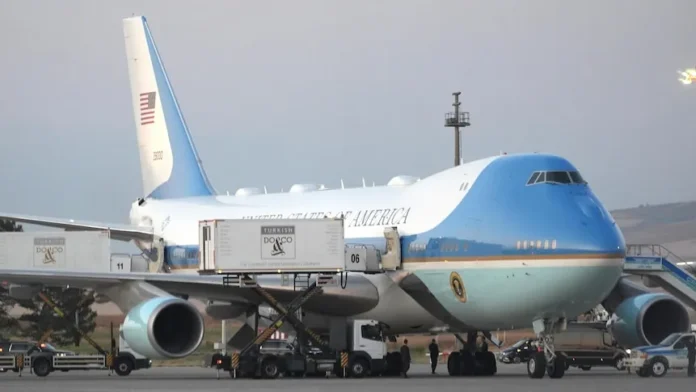
The operation unfolded in Ankara, Turkey, during a NATO summit. While the White House indicated Trump was traveling on Air Force One, he was allegedly transported in a catering truck from the tarmac to a separate Air Force C-32A aircraft for his departure. This departure followed his use of a newly refurbished, Qatari-donated jet for his arrival in Ankara. However, for his exit, an older, less conspicuous Air Force One was publicly presented.
The newly acquired jet, a Boeing 747 gifted by Qatar and refitted by L3Harris Technologies, was intended as a temporary replacement for the long-delayed next-generation Air Force One planes. Its rapid upgrades and security features had already drawn scrutiny. Trump himself had publicly stated on social media that he would use the older, “baby blue” Air Force One for his flight to RAF Mildenhall in Britain, a move he described as “for old time’s sake.” Meanwhile, the newer aircraft reportedly stopped at the same British base to allow U.S. service members to tour it.
Security Concerns and Iranian Threat
The decision to employ a decoy plane and a secret departure route was reportedly driven by intelligence indicating a significant threat to Trump’s safety from Iran. Tensions between the U.S. and Iran were high at the time, with Iran bordering Turkey. The urgency of the situation apparently necessitated extraordinary security measures to ensure the former president’s safe passage.
According to reports, the older Air Force One served as a decoy, with journalists and some White House staff aboard who were instructed to keep their window shades closed during the flight. When questioned later about the closed shades, Trump reportedly remarked that they were likely on a “dangerous flight” and that “if I go, you go.”
The C-32A carrying Trump reportedly landed in Britain around 10:20 p.m. local time, with the decoy Air Force One and the press contingent arriving shortly thereafter. The exact method of Trump’s transfer from the C-32A back to the older Air Force One, or to another aircraft, remains unclear. His public appearance from the decoy Air Force One occurred later, around 10:56 p.m. UK time, where he offered a peace sign to the press before proceeding to greet service members and then, reportedly, boarding the new Qatari-donated plane.
Historical Precedents and Official Response
This incident echoes a similar tactic employed in 2000, when President Bill Clinton reportedly used an unmarked executive jet to enter Pakistan while sending his official Air Force One as a decoy. Such operations highlight the complex security considerations involved in protecting high-profile individuals, especially during periods of heightened geopolitical tension.
When reached for comment regarding the revelation of the secret flight, a White House spokesperson, Communications Director Steve Cheung, reiterated the robust security protocols on the Qatari-donated jet. Cheung stated, “As the President has said recently, there are many enemies of America who have their sights on him, and we use every tool at our disposal to address those threats.” This statement was consistent with remarks provided to other news outlets.
The Pentagon had not immediately responded to requests for comment on the matter at the time of the initial reports. The use of a catering truck for a presidential departure, while unusual, underscores the lengths to which security agencies may go to mitigate perceived threats to national figures.