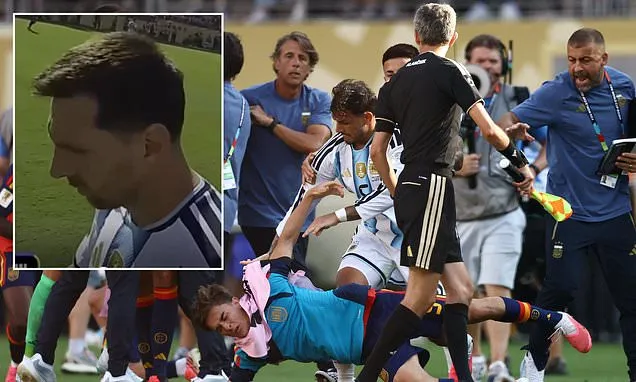
New footage from the World Cup final has revealed that the referee, Slavko Vincic, had previously urged Argentinian captain Lionel Messi to manage midfielder Leandro Paredes during the match. This plea came before the unsavoury incidents that transpired after the final whistle, which saw Paredes involved in altercations with Spanish players.
Referee’s Plea to Messi
The newly surfaced footage, captured from the referee’s perspective, shows Vincic speaking to Messi during the game. He is heard saying, “Messi, control Paredes. I don’t want to… he has yellow. Control please. Always, always.” This indicates that even during the high-stakes match, the referee was concerned about Paredes’s temperament and sought Messi’s intervention to prevent potential disciplinary issues.
Leandro Paredes, who was substituted into the game at halftime, received a yellow card just six minutes later. Despite this caution, he remained on the field until the end of the match. However, following Argentina’s defeat, the midfielder appeared to lose his composure.
Post-Match Confrontations
After the final whistle confirmed Spain’s victory, Paredes was seen engaging in physical altercations. Reports and video evidence indicate that he grabbed defender Eric Garcia by the neck and pushed over Gavi. There were also suggestions of punches being thrown. These actions occurred amidst the general chaos that followed the conclusion of the game.
Paredes was also noted for a foul towards the end of regular time, for which he was fortunate not to receive a red card. FIFA has since initiated disciplinary proceedings against Paredes concerning the post-match events. He faces multiple charges, including three counts of assault and one of unsporting behaviour.
Referee’s Medal Ceremony
The referee cam footage also captured a moment during the medal ceremony. It shows Slavko Vincic receiving his medal from Donald Trump, who reportedly told the referee he had done a “great job.” This detail offers a glimpse into the post-match proceedings from the officials’ perspective.
Paredes’s Return to Club Action
Following the World Cup final, Paredes returned to play for his club, Boca Juniors. In a recent match against Newell’s Old Boys in the Argentine Primera Division, which ended in a 2-2 draw, the 32-year-old midfielder was involved in another contentious incident. Trailing 2-1 in the 68th minute, Paredes appeared to deliberately kick a ball at an opponent who was on the ground after being fouled. This action sparked a confrontation with players from the opposing team, leading to Paredes receiving a yellow card for his behaviour.
These incidents highlight a pattern of behaviour that has drawn scrutiny from football authorities. The referee’s pre-emptive request to Messi and Paredes’s subsequent actions on the field and after the match underscore the challenges officials face in managing player conduct during intense competitions.
The Role of Temperament in High-Stakes Football
The events surrounding Leandro Paredes in the World Cup final and subsequent club match bring to the forefront the critical role of player temperament in professional football. The pressure of a World Cup final, coupled with the disappointment of defeat, can often test the emotional control of athletes. Referees are tasked with maintaining order, and their reliance on team captains like Messi to help manage volatile players is a common, albeit sometimes challenging, aspect of officiating.
Paredes’s history of aggressive play and disciplinary issues suggests that managing his conduct requires constant vigilance from both officials and his team leaders. The FIFA proceedings initiated against him indicate the seriousness with which such behaviour is viewed by the sport’s governing body. The outcome of these proceedings will likely set a precedent for how similar incidents are handled in the future.
Broader Implications for Football Discipline
The scrutiny of Paredes’s actions also raises broader questions about player discipline and the effectiveness of existing sanctions. While yellow and red cards are standard, the severity of post-match altercations, as seen with Garcia and Gavi, can sometimes go beyond the immediate scope of on-field officiating. FIFA’s involvement in these cases suggests a commitment to addressing misconduct that occurs outside the typical flow of play.
The use of referee cameras and other technological aids continues to provide clearer insights into match dynamics and player behaviour. This technology not only aids in officiating but also in holding players accountable for their actions, both during and after games. The transparency offered by such footage can contribute to a more disciplined environment in professional football.
Conclusion
The World Cup final referee’s request to Lionel Messi to control Leandro Paredes, captured on referee cam, sheds light on the tense atmosphere and disciplinary concerns during the match. Paredes’s subsequent actions, both in the final and in club games, have led to disciplinary action, emphasizing the ongoing challenge of managing player conduct in high-pressure football environments. These events serve as a stark reminder of the fine line between competitive intensity and unsporting behaviour, and the crucial role of referees and governing bodies in upholding the integrity of the game.