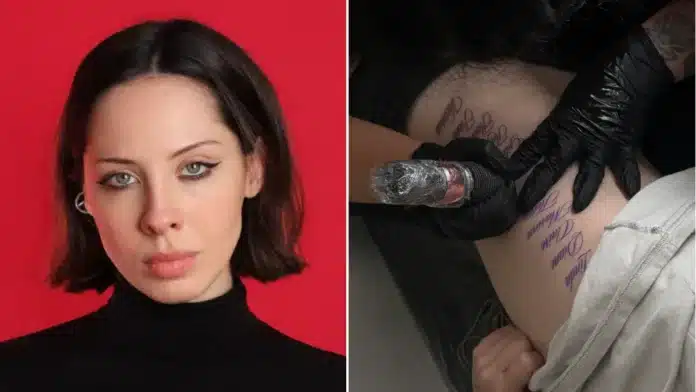
Comedian and artist Harriet Richardson has undertaken an unconventional artistic endeavor, permanently inking the names of the mothers of every man she has slept with onto her body. This unique body art, which features 15 names in chronological order, serves as a central piece of her performance art project titled ‘Temporary’.
The Genesis of a Unique Tattoo Project
Richardson, originally from Manchester, explained that the tattoo is her first and only, a fact made more striking by her personal reservations about tattoos. The project, ‘Temporary’, draws its name from the concept of a singular, revered woman in a man’s life, often contrasted with the idea of others being perceived as transient.
Initially, Richardson was familiar with 12 of the mothers’ names through personal connections, diaries, or having met her partners’ families. However, two names remained elusive, stemming from brief encounters during the pandemic. To uncover these identities, she employed a private detective, fulfilling a long-held desire to utilize such a service.
“I’ve always wanted a reason to hire a private detective,” Richardson shared. “You’ve just heard me go on about obsession for half an hour – I’ve always wanted a reason, and I finally found one.” A subsequent discovery added an additional name, bringing the total to 15.
Beyond Provocation: Art, Memory, and Identity
While the headline-grabbing nature of the tattoo is undeniable, Richardson emphasizes a deeper artistic and philosophical intent. She deliberately chose not to tattoo the men’s names, stating a strong personal aversion to having a man’s name on her body. Instead, her fascination turned to their mothers.
Richardson believes these women may have shared similar emotional experiences in their relationships with the men in question. “Every single one of these people have played a role in your life, whether it was for an evening or four years,” she explained. “They were more sort of pivotal or poignant to me than any of the men were because I actually think that woman’s had a pretty similar experience to me.”
Reclaiming Power and Memory
Another significant motivation behind ‘Temporary’ is the reclamation of power. Richardson noted that some men, particularly within the comedy circuit, have attempted to dismiss or ‘erase’ their encounters with her. The tattoo acts as a permanent assertion that these experiences did occur and cannot be simply disregarded.
“The tattoo is a way of being like: ‘No, you can’t just do that and then never speak to me again.’ I mean, you can, but it doesn’t mean that it didn’t happen,” she stated.
Public Reaction and Gender Dynamics
The artwork has predictably generated considerable discussion, particularly on social media. Richardson, who previously worked in marketing and graphic design, anticipated the provocative nature of her project.
She observed a distinct gender divide in the reactions. Women have largely expressed support and admiration, while some men, particularly in the United States, have reacted less favorably. The number of names itself has become a focal point for varying societal attitudes towards women’s sexual histories, with some commenters suggesting it indicates a lack of experience and others expressing disapproval.
Richardson views these strong reactions as indicative of a deeper engagement with her art. “Of course it’s provocative,” she remarked. “I wonder whether those people realise that what they’re having is a deep reaction to a piece of art.” She finds satisfaction in the public debate surrounding performance art, even when the audience may not initially recognize it as such.
‘Creep’ at Edinburgh Fringe: Obsession and Self-Discovery
The themes explored in ‘Temporary’ resonate with Richardson’s one-woman show, ‘Creep’, which debuted at the Edinburgh Fringe. The show delves into her personal history of romantic obsession, stemming from a parasocial relationship that evolved into an affair.
Through extensive therapy, Richardson identified a pattern of fixation, obsession, rejection, and ghosting, which she recognized as a coping mechanism to avoid confronting her own issues. “I’d much rather channel all of that into a very mediocre man that I can obsess over every single detail,” she admitted. “I think it’s like having a hobby, but the hobby is on steroids.”
Breaking Cycles and Embracing Vulnerability
To disrupt this cycle, Richardson practiced celibacy for 10 months while developing ‘Creep’. This decision was not about abstaining from sex itself, but rather about mitigating intimacy’s potential to trigger her obsessive tendencies, especially given the significant financial and personal investment in her Edinburgh Fringe show.
The Edinburgh Fringe run of ‘Creep’ proved remarkably successful, selling out its entire engagement and leading to additional performances. This success, however, brought its own set of anxieties, including the intense competition and shared anxieties among performers.
Richardson describes the show as deeply exposing, yet finds liberation in voluntarily sharing her vulnerabilities with audiences. “These are the very worst parts of me,” she said. “And if you can get on board by the end of that hour, then we might be friends – in a parasocial way.” The emotional impact of ‘Creep’ has led to audiences crying during performances, with Richardson often joining them.
Artistic Commitment and Refusal of Shame
Ultimately, both the tattoo and the performance art piece reflect Richardson’s commitment to confronting and integrating the less palatable aspects of her life. By permanently marking her body with the names of the mothers, she sees it as a profound commitment to her art.
“Putting it on my body, my most sacred possession, feels like the biggest commitment that I could ever have made,” she stated. She also noted the irony that the men involved, often characterized by emotional unavailability, are unlikely to offer any dramatic reaction to her artistic statement.
“The thing about dating avoidant men,” Richardson conceded, “is it’s very unlikely they’re ever going to react.” This lack of reaction, she implies, further underscores the personal significance and internal power derived from her artistic choices, independent of external validation.