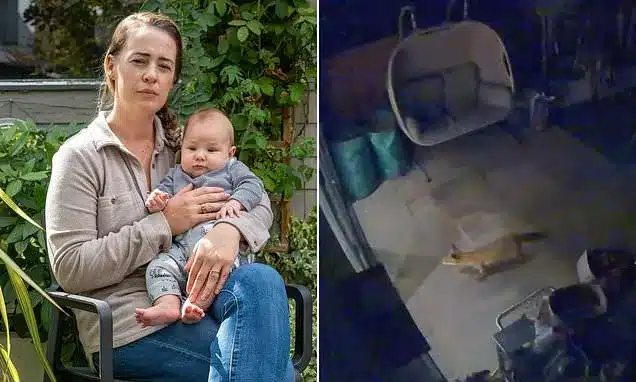
A three-month-old baby girl sustained bloody puncture wounds to her head after a fox entered her family’s home in Watford and attacked her while she slept. The incident, which occurred on Thursday night, left the mother, Carly Clarkson, 37, deeply shaken and concerned about home safety.
Fox Enters Home and Attacks Infant
The harrowing event unfolded when Ms. Clarkson dozed off while feeding her newborn daughter, Josephine. She was reportedly awakened by the sensation of a fox sniffing her face. Upon opening her eyes, she discovered her baby beside her, covered in blood. A quick inspection revealed four distinct puncture wounds on Josephine’s head.
CCTV footage from the family’s back garden showed the fox creeping around the property before entering the house through a back door that had been left open. Ms. Clarkson described the scene as ‘absolutely horrifying,’ noting that the wounds on her daughter’s head resembled ‘a dog had bitten a football.’ She immediately grabbed Josephine and chased the fox towards the top of the stairs before checking on her older, one-year-old daughter.
Medical Assessment and Mother’s Concerns
Following the attack, Ms. Clarkson rushed Josephine to Watford General Hospital. Medical professionals confirmed that the baby had no skull fractures and no immediate concerns regarding brain injury. However, Ms. Clarkson expressed that the severity of the wounds could have been far greater, suggesting that Josephine’s position may have prevented the fox from inflicting injuries to her face or a major artery.
The experience has left Ms. Clarkson feeling unsafe in her own home. ‘I feel absolutely violated, I don’t feel safe in my home with two young children,’ she stated. She voiced concerns that foxes in the area are becoming overly accustomed to human presence, possibly due to being fed or simply adapting to urban environments. Adding to the distress, as Ms. Clarkson and her husband were preparing to take Josephine to the hospital, they observed a fox, potentially the same one, approaching their front door.
Expert Commentary on Fox Behavior
Trevor Williams, founder of The Fox Project, an animal welfare charity, commented on the rarity of such incidents. He noted that attacks of this nature are exceptionally uncommon, with no similar occurrences reported in over a decade. Mr. Williams suggested that the fox involved was likely a young cub, as adult foxes typically exhibit strong avoidance behaviors towards humans and would not place themselves in such a vulnerable situation.
He explained that this time of year often sees young foxes dispersing from their family groups. While most cubs quickly revert to natural instincts and avoid human contact, some may wander into unfamiliar environments, including open homes or businesses, out of curiosity. Mr. Williams theorized that the cub, undisturbed, may have investigated the baby and tested its teeth on her skin.
Preventative Measures Against Fox Encounters
Despite the rarity of such events, Mr. Williams offered advice for homeowners concerned about foxes in their vicinity. The most basic precaution is to ensure doors and windows are kept closed, even during warmer weather. For those seeking to discourage foxes from regularly visiting their properties, the use of safe, non-toxic mammal repellents, readily available at garden centers and hardware stores, is recommended.
Ms. Clarkson has reported the incident to Watford Borough Council and has been exploring options for deterrents, though she found the available solutions, such as £300 pellets, to be costly. She has also been in contact with The Fox Project for guidance. Reflecting on the outcome, she expressed relief that Josephine only required tetanus shots and antibiotics, but voiced a broader concern: ‘I would hate to find out that in a week or in a few weeks’ time someone else isn’t so lucky.’
Community Response and Ongoing Concerns
The incident has highlighted anxieties within the community regarding the increasing boldness of urban wildlife. Local authorities are reportedly investigating the matter, and residents are being advised on preventative measures. Ms. Clarkson’s experience serves as a stark reminder of the unpredictable nature of wild animals and the importance of securing homes against potential intrusions.
The Fox Project continues to advocate for coexistence with urban wildlife, emphasizing that understanding animal behavior and implementing simple preventative measures can significantly reduce the risk of negative encounters. While the attack on Josephine was a distressing event, experts stress that it does not represent typical fox behavior and should be viewed as an isolated incident driven by the curiosity of a young animal.