
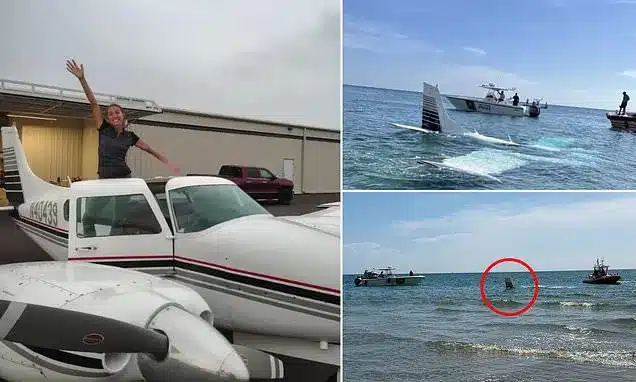
A 23-year-old pilot has shared her harrowing experience of crash-landing a twin-engine plane into the Atlantic Ocean and subsequently swimming to safety. Faith Tenkley was en route from Fort Myers, Florida, to the Bahamas on a Saturday morning to collect her parents when the aircraft encountered significant mechanical issues. Faced with a critical decision, she opted to ditch the plane in the ocean rather than attempt a risky landing at Boca Raton Airport.
Emergency Landing in the Atlantic
Tenkley, who has been flying since her high school graduation, described the incident as a moment that demanded split-second judgment. “I want to express my deepest gratitude for the concern and support following my unexpected water landing yesterday,” she stated on Sunday. “I am incredibly fortunate and relieved to share that I was able to swim away from this incident.” She explained that after assessing the situation, a landing at Boca Raton Airport was deemed the less safe option, prompting her decision to continue toward the coast.
The young pilot’s primary concern was ensuring the safety of everyone involved, including herself, as she navigated the aircraft toward open water. Her skillful maneuvering successfully avoided populated areas, including nearby buildings and beachgoers. “I want to extend my thanks to ATC [air traffic control] for being prepared, as well as the lifeguards, firefighters, and police officers whose rapid response and professionalism ensured everyone’s safety. As well as any witnesses who called for help,” Tenkley added.
Mechanical Failures Lead to Water Landing
The emergency began approximately 15 miles west of Boca Raton when Tenkley started experiencing mechanical problems with the Piper PA-30 aircraft. The twin-engine plane eventually went down in the Atlantic Ocean around two miles east of Boca Raton Airport at approximately 9:40 a.m. on Saturday.
Tenkley’s initial plan was to divert to the Florida airport. However, a new, critical problem emerged: her landing gear failed to deploy. With a substantial amount of fuel still on board, she recognized the extreme danger of attempting a runway landing without functioning landing gear. Such an attempt could have resulted in a hard impact and a potential fire.
Compounding the emergency, the right engine of the twin-engine aircraft also began to fail. With her options rapidly diminishing, Tenkley made the decisive move to head for the ocean, seeking a clear stretch of water near the shoreline.
A Smooth Ditching and Swift Rescue
Against considerable odds, Tenkley executed a controlled water landing. The aircraft remained largely intact upon impact with the sea. She was able to exit the plane unaided and without sustaining any injuries. Remarkably, a lifeguard reached her within about a minute, followed closely by a fire rescue boat.
The dramatic event unfolded before numerous beachgoers who were enjoying the morning in Boca Raton. The sight of the small plane descending towards the sea captured the attention of those on shore.
Aftermath and Investigation
As time passed, the aircraft gradually submerged, with only its tail section visible above the water’s surface as preparations began for its recovery. The Federal Aviation Administration (FAA) has announced it will investigate the circumstances surrounding the crash landing.
The aircraft involved is a Piper PA-30 series, a model manufactured between 1961 and 1972, typically configured to carry four to six occupants. These twin-engine planes were a common sight in general aviation for many years.
Pilot’s Resilience and Gratitude
Tenkley’s account highlights her composure and quick thinking under extreme duress. Her ability to prioritize safety, execute a challenging water landing, and emerge unharmed is a testament to her training and decision-making. Her expressed gratitude towards air traffic control, first responders, and witnesses underscores the collaborative effort that contributed to her safe outcome.
The incident serves as a stark reminder of the inherent risks in aviation and the critical importance of pilot training, emergency preparedness, and the swift response of rescue services. While the aircraft was lost, the successful survival of the pilot is the paramount outcome.