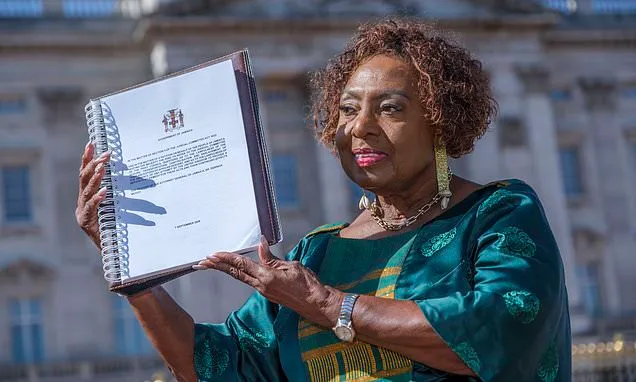
King Charles III will not personally receive a petition from Jamaican officials seeking £7.6 billion in slavery reparations from Britain. A delegation from Jamaica has arrived in London to present a formal petition to Buckingham Palace, aiming to lobby the monarch for financial redress related to the historical injustices of slavery. While royal observers initially anticipated the King, as Jamaica’s head of state, would receive the petition directly, Buckingham Palace has confirmed that this will not occur in person. The King is currently observing his annual summer break in Scotland.
Jamaica’s Campaign for Reparations
The Jamaican government views the petition and ongoing discussions with the Foreign Office as significant steps toward securing reparations from the UK. The campaign highlights the historical anomaly where, following Britain’s abolition of slavery in 1833, compensation was paid to slave owners rather than the enslaved individuals. This compensation, amounting to £20 million (approximately 40% of the Treasury’s annual income at the time), necessitated a substantial loan that Britain continued to repay until 2015.
Olivia Grange, Jamaica’s Minister of Culture, Gender, Entertainment and Sport, articulated the rationale behind the petition upon her arrival in the UK. She stated, “Up to 2015, Britain was paying the slave masters because we were considered property. The question really should be: if in modern times we’re still paying back the slave masters for the ‘property’ that was our ancestors, because of the abolition of slavery, why shouldn’t we be pursuing some remedy at this time?” Grange acknowledged that some UK taxpayers might object but suggested that a majority “may consider answers are required.”
Key Questions for the Privy Council
The petition specifically poses three questions for consideration by the Privy Council, which advises the King on matters of state:
- Was the enslavement of Africans in Jamaica legal under English law?
- Did the enslavement violate international law?
- Does Britain now have a legal obligation to provide redress for historical wrongs?
Minister Grange indicated that the next steps would be determined once responses to these questions are received. The Judicial Committee of the Privy Council, comprising experienced judges, serves as the highest court of appeal for several Commonwealth nations, including Jamaica. Historically, the British monarch has held the authority to refer legal matters to this committee for an advisory opinion.
Palace and Government Response
A spokesperson for Buckingham Palace clarified the process for lodging such a petition, stating, “We understand the Jamaican government is seeking a petition to be heard before the Judicial Committee of the Privy Council. The process for seeking a petition is to lodge it with the Judicial Committee so that referral under section four of the 1833 Act can be considered.” The spokesperson also noted that Jamaican representatives would be meeting with the Foreign, Commonwealth and Development Office for bilateral discussions.
The King’s commitment to fostering understanding about the legacy of slavery was reiterated. The spokesperson referenced a speech by King Charles in Samoa in October 2024, where he stated, “I understand, from listening to people across the Commonwealth, how the most painful aspects of our past continue to resonate… none of us can change the past. But we can commit, with all our hearts to learning its lessons and to finding creative ways to right inequalities that endure.” It is important to note that the King does not have personal authority over whether the petition is referred to the Judicial Committee; his actions would be guided by government advice.
Legal and Constitutional Perspectives
Craig Prescott, an expert in constitutional law and the monarchy at Royal Holloway, University of London, described the approach as “quite clever.” He explained that the petition leverages an “obscure constitutional procedure” to address a significant societal issue in Jamaica. The right of individuals to petition the Crown for grievances related to justice administration dates back centuries, with the 1833 law establishing the Privy Council’s committee as the supreme court for civil and criminal appeals within the British Empire.
Prescott anticipates the petition will likely be referred to the Judicial Committee, where UK Supreme Court justices would review it. However, he cautioned that such petitions are typically approached with caution due to their deviation from standard legal processes. “I think, at the very least, the board will look at this with a sceptical eye, not because of questions of whether slavery is wrong or right or otherwise, but just this is a very peculiar legal procedure that is sort of just one on the statute books that rears its head from time to time,” he commented.
The timing of the petition coincides with Jamaica’s ongoing discussions about potentially severing ties with the British Crown, a move previously announced by Prime Minister Andrew Holness. If the Privy Council rejects the petition, it could further highlight the divergence in perspectives between Britain and Jamaica, potentially strengthening the case for severing remaining links.
Historical Context and Cultural Artifacts
The petition’s filing was deliberately timed to align with the anniversary of the Zong massacre in 1781. On this voyage, enslaved Africans were thrown overboard by the crew of a Liverpool-registered ship to claim insurance money, an event that significantly fueled the abolitionist movement. Britain abolished the slave trade in 1807, with the enslavement of humans outlawed in 1834.
In addition to the reparations petition, Minister Grange is also engaging with the British Museum regarding the repatriation of three ancient carvings. These artifacts, originating from Jamaica’s indigenous Taino people, were discovered in a cave in 1792 and subsequently taken to the UK. Jamaica has previously sought their return for exhibition but was offered replicas. Grange expressed a desire for “repatriation of those artefacts” and noted that dialogue has commenced, with plans for Jamaican curators to visit the museum to identify relevant items for discussion.