
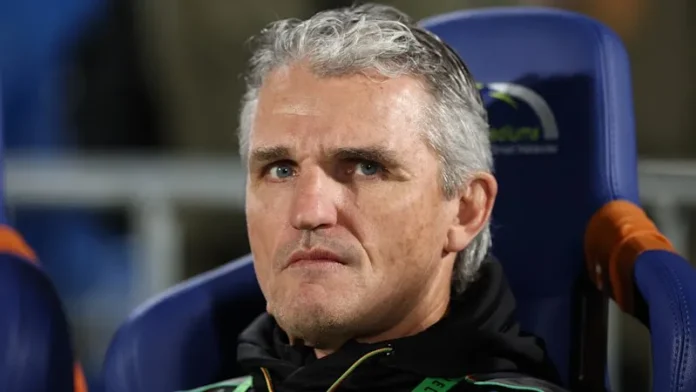
In the often fiery world of National Rugby League (NRL) coaching, where touchline theatrics and explosive press conferences are commonplace, Ivan Cleary stands out for his remarkable composure. While many of his peers resort to loud outbursts, door-slamming, or even monitor-punching to express frustration, Cleary’s methods are far more subtle, often relying on a raised eyebrow or a quiet, pointed word. This unique approach to leadership has earned him a reputation as one of the most unflappable figures in the sport.
The Contrast in Coaching Temperaments
The NRL landscape is dotted with coaches known for their passionate, and sometimes volatile, sideline demeanour. Des Hasler, for instance, has been known to physically express his displeasure, once ripping a door off its hinges. Ricky Stuart is infamous for his intense reactions that can seemingly make the stadium walls tremble. Even Craig Fitzgibbon, generally perceived as more measured, has been observed unleashing frustration on inanimate objects, like a computer monitor. Amidst this backdrop of overt emotional displays, Ivan Cleary’s consistent equanimity presents a stark contrast.
Whether facing a string of handling errors, a contentious refereeing decision, or an unlucky bounce of the ball, situations that can send other coaches into a tailspin, Cleary often maintains a calm exterior. His former Penrith playmaker, James Maloney, once described Cleary’s coaching style as, “He sprays you nicely.” This suggests that Cleary’s feedback, even when critical, is delivered in a manner that is effective without being overtly aggressive, highlighting his ability to command respect through stillness rather than volume.
Does Ivan Cleary Ever Lose His Cool?
The question naturally arises: does the composed facade ever crack? Is there a hidden temper beneath the calm surface? Players who have worked closely with Cleary suggest that such outbursts are exceedingly rare. Forward Luke Garner expressed his bewilderment, stating, “I don’t know how he does it, to be honest with you. He’s got a good temperament. Sometimes the coaches, you can ride the wave with them, but he’s always pretty cool, so keeps us pretty calm.” When pressed about finding evidence of a significant Cleary spray, Garner’s amused response was, “Yeah, good luck.”
Hooker Mitch Kenny corroborated this sentiment, acknowledging that while everyone has the capacity for emotion, it’s not characteristic of Cleary’s usual demeanour. “I’ve certainly seen it,” Kenny said, referring to moments of emotion, “but it’s not really him. It’s probably a little bit more disappointed, not angry, and that’s worse.” This distinction between disappointment and outright anger suggests that when Cleary is displeased, his reaction is more about conveying a sense of letdown than unleashing fury, a tactic that can be more impactful.
Young player Jack Cole, preparing for a finals clash, echoed these observations. “Sometimes he raises his voice and stuff,” Cole admitted, “He doesn’t really get angry.” This consistent theme suggests that Cleary’s leadership style is built on a foundation of measured responses, fostering a stable environment for his players.
A Rare Exception: The Dolphins Loss
Despite his general composure, Ivan Cleary is human, and there have been notable instances where his frustration has surfaced. One of the most significant occurred in round six of the previous season. After an initial victory in Las Vegas, the Penrith Panthers experienced a five-game losing streak, culminating in a 30-12 defeat against the Dolphins. It was during this challenging period, with the season seemingly slipping away, that Cleary’s usual calm gave way to a more forceful address.
Forward Isaiah Papali’i described the event as a “shock to everyone” given Cleary’s typical demeanour. “He’s quite calm, cool, and collected, so I think it was more just an overall spray to the whole team. At that point in the season, it had been rough, so I think it was warranted.” This suggests that the rare instances of Cleary losing his temper are reserved for moments of significant team underperformance where a strong intervention is deemed necessary.
Casey McLean recalled being on the receiving end of a rare reprimand during that same game. While qualifying that it wasn’t a “full spray,” McLean noted Cleary’s unusual display of frustration. “He’s so laid-back, cool, calm,” McLean said. “Seeing him flare up a little bit more than usual kind of shocked me. But it’s cool.” McLean further elaborated that Cleary’s reaction was a blend of “disappointed dad vibes” and a “rally up,” a combination that conveyed the seriousness of the situation while still aiming to motivate the team. “It’s the best of both worlds if you think about it like that… When you see him, you’re like, ‘Oh, I’ve definitely done something wrong!’”
McLean also reflected on Cleary’s broader impact, acknowledging his significant contributions to the game and his personal development. “He’s a one-of-a-kind coach. He has what, 500 games under his belt just recently, four premierships. He’s done so much for the game, and not just for myself as a player. I think he’s helped me as a person more than anything, so I couldn’t be more grateful to be under him.”
The Art of the Effective Spray
Coaching experts often emphasize that the effectiveness of a coach’s reprimand lies in its judicious use. The prevailing wisdom suggests that a full-blown spray should be a rare occurrence, perhaps no more than once a season, to maintain its impact. Cleary’s stern words after the Dolphins loss appear to have served their purpose; the Panthers responded the following week by defeating the Sydney Roosters with a dominant 40-point performance.
This does not imply that Cleary avoids difficult conversations. The Penrith Panthers’ consistent success, including four premierships since 2021, undoubtedly involves addressing player shortcomings. However, Cleary’s preferred method for delivering criticism is typically a private, one-on-one discussion rather than a public spectacle. Lindsay Smith highlighted this approach: “Yeah, he’s great with that sort of stuff. Obviously, there are times where you need to have tough conversations, but he does that in a really respectful way. He doesn’t like to put anyone on show in front of everyone. If he needs to talk to you about certain things, it’s normally just one-on-one… There are obviously different ways he can get his point across, and whatever he feels the team needs at the time, he judges that really well.”
The Infamous Magic Round Incident
One Cleary spray, however, stands out as particularly memorable, occurring during Magic Round in 2019 at Suncorp Stadium. This was during Cleary’s second stint with the Panthers, a period when the team’s future success was far from assured, and his departure from the Wests Tigers was still a sensitive issue. The Panthers suffered a heavy 30-4 defeat to the Tigers that night, prompting an explosive reaction from Cleary that reportedly made even the notoriously fiery Ricky Stuart blush.
One player recalled the incident as “all time.” In a moment that underscored the intensity of the situation, Cleary, after delivering his fiery address, encountered Dragons halfback Ben Hunt in a stadium lift. Hunt was also under significant pressure at the time due to his performance. As the lift doors closed, Cleary caught Hunt’s eye, offered a wry smile, and delivered a perfectly timed, dry observation: “How good is rugby league?” This anecdote perfectly encapsulates Cleary’s ability to navigate extreme pressure with a unique blend of intensity and dry wit.
Conclusion: A Masterclass in Composed Leadership
Ivan Cleary’s coaching philosophy is a testament to the idea that effective leadership doesn’t always require a loud voice or an aggressive stance. His ability to maintain composure under pressure, coupled with his skill in delivering feedback constructively and privately, has fostered a successful and stable environment for the Penrith Panthers. While rare, his moments of visible frustration serve to underscore the gravity of certain situations, making his usual calm all the more remarkable. Cleary’s approach offers a compelling case study in modern coaching, demonstrating that quiet authority and strategic communication can be just as powerful, if not more so, than overt displays of temper.