
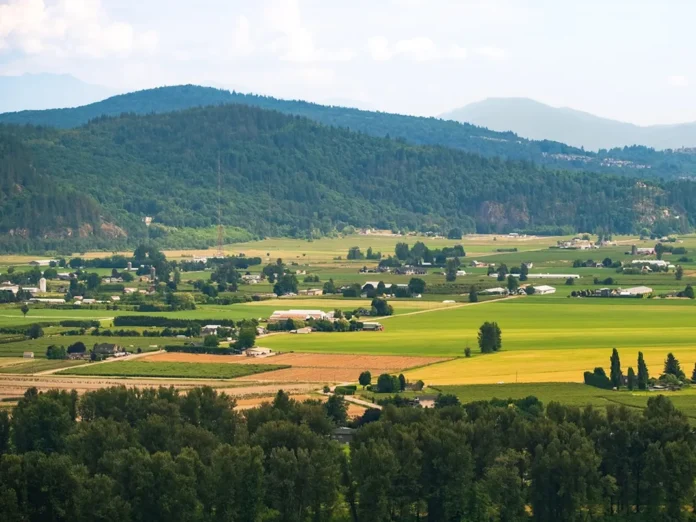
British Columbia is considering significant changes to the rules governing food processing within the Agricultural Land Reserve (ALR), a move that has drawn sharp criticism from former provincial minister Joan Sawicki. The proposed amendments aim to boost food processing activities on farmland, particularly on lower-quality land, by substantially reducing the requirement for locally sourced ingredients.
Proposed Changes to Food Processing Rules
The provincial government’s proposal, currently under public consultation until September 18, seeks to alter how food processing is permitted on ALR lands classified from Class 5 to Class 7. Under the existing regulations, food processing facilities on any ALR land must use at least 50 percent of ingredients grown or raised on the farm itself or from associated farms. This requirement is not currently tied to soil quality classifications.
The core of the proposed change involves lowering this local product threshold to just five percent for new processing facilities on Class 5 to 7 land. Crucially, this five percent could be sourced from anywhere within the province, not necessarily from the farm hosting the facility. The remaining 95 percent could be sourced internationally.
Additionally, the proposal suggests allowing food processing on Class 4 land if it is already serviced with essential infrastructure like road access, electricity, and municipal water and sewage at the time the rule is enacted. The government has stated that the rules for the top three classes of farmland (Class 1 to 3) will remain unchanged, continuing to require the 50 percent local product rule.
To establish a new food processing facility on these lower-class lands, proponents would need to undergo soil assessments by a registered professional agrologist to confirm they meet the criteria. They would also be required to obtain permits from relevant government ministries, including Water, Land and Resource Stewardship, and Environment and Parks, as well as local government approvals.
Criticism from Former Minister
Joan Sawicki, who previously served as B.C.’s Minister of Environment, Lands and Parks and as Speaker in the 1990s, has voiced strong opposition to the proposed changes. Sawicki, who was an early employee of the Agricultural Land Commission when it was established, argues that the amendments fundamentally contradict the ALR’s core purpose.
“On every level this is so blatantly negative for our farmers and farm communities,” Sawicki stated. “I cannot see any benefit whatsoever to agriculture. In fact, I see very serious negative impacts.” She believes the changes betray B.C. farmers who depend on a secure land base and could lead to increased land prices, making farming less affordable.
Sawicki contends that the government’s rationale—that the changes will protect and strengthen the ALR and create new markets—is flawed. She points out that existing rules already allow for food processing with oversight from the Agricultural Land Commission, which can assess the legitimacy of uses and ensure they benefit local producers without negatively impacting adjacent agriculture.
“The Agricultural Land Commission can then assess, is this a legitimate food-processing use, will it use the produce that our farmers are producing, and can we put enough checks and balances or conditions on this non-farm use to make sure it doesn’t have negative impact on adjacent agriculture?” she questioned. “That’s all legitimate and the Agricultural Land Commission has been doing that for decades.”
Sawicki also highlighted that the current 50 percent rule, introduced in 2002, was itself a compromise from even stricter prior regulations that required processing to be exclusively for products grown on the farm. She finds it illogical that reducing local content requirements would help local farmers or bolster food security, especially amidst trade tensions.
“How does allowing food processors to import 95 per cent of their raw product from outside B.C., how does that help reduce our dependence on imported food and how does that help our own farmers market their products? I mean, it’s ludicrous in my mind,” Sawicki remarked. She questioned the wisdom of attracting businesses that are unwilling to commit to using local produce.
Government’s Rationale and Industry Response
The government’s discussion paper suggests the proposal aims to “encourage more food processing in the ALR, while protecting and strengthening the ALR’s primary purpose of agricultural production.” It argues that when properly managed, food processing complements farming by creating new markets.
The proposal could potentially open up to 1,000 hectares in the Lower Mainland and Fraser Valley for food processing development, though the government estimates about 90 percent of the ALR in these areas would remain protected due to soil classification. The total land affected would be capped at 0.25 percent of the private land within the ALR.
The food processing sector is a significant contributor to British Columbia’s economy, generating an estimated $14.3 billion in sales and $3 billion to GDP in 2024, supporting 37,430 jobs. Business groups, including the Greater Vancouver Board of Trade and the Abbotsford Chamber of Commerce, have reportedly pushed for changes to the 50 percent rule and have applauded the government’s engagement process.
Concerns from Municipalities and Farmers
The Union of BC Municipalities (UBCM) has submitted its feedback, emphasizing the need for local regulatory control and enforcement support. UBCM’s submission notes that while local governments might not be able to prohibit processing that meets provincial standards, they could use zoning and land-use tools to regulate it. However, they are requesting reconsideration of local governments’ ability to prohibit such uses, citing potential conflicts with adjacent land uses, infrastructure capacity, and other local factors.
UBCM also highlighted the increased demand for enforcement that the proposal might create, urging the ministry to consider the financial and capacity impacts on local governments and the Agricultural Land Commission.
Sawicki advocates for food processing to occur outside the ALR, in industrial zones, where businesses would have greater flexibility. She argues that the sector is already thriving and growing under current rules, and that allowing industrial processing on farmland will inevitably drive up land prices, making it harder for farmers to operate.
The consultation period, initially set to end September 3, was extended to September 18. Sawicki believes this timeframe is still insufficient, particularly given the busy harvest season for farmers.
The Importance of the ALR
Established to protect farmland from urban sprawl and development pressures, the ALR is seen by many as crucial for B.C.’s food security. Sawicki’s concerns echo a broader sentiment that weakening protections for farmland, especially during times of global uncertainty and trade disputes, could be counterproductive.
The debate centers on balancing the economic opportunities in food processing with the fundamental mandate of the ALR: to preserve agricultural land for food production. Critics argue the proposed changes prioritize industrial development over the long-term viability of farming in the province.
The government maintains that the changes are intended to support agriculture by fostering processing capacity, while opponents fear it will dilute the ALR’s purpose and potentially displace agricultural activity.
As the consultation period concludes, stakeholders await the government’s analysis of the feedback and its final decisions on the future of food processing within British Columbia’s vital Agricultural Land Reserve.