The Resident Evil franchise, a titan in the survival horror genre, continues to captivate audiences nearly three decades after its inception. With a new film on the horizon, it’s an opportune moment to explore the enduring legacy of this multimedia phenomenon that has consistently reinvented itself across video games, films, novels, and more, amassing nearly $13 billion in global revenue.
The Genesis of Survival Horror
The origins of Resident Evil trace back to 1996, when Capcom producer Tokuro Fujiwara tasked Shinji Mikami with developing a new game. Mikami, initially hesitant due to his own fear of the dark and concerns about the commercial viability of a horror-focused title, was encouraged by Fujiwara. “People who aren’t afraid of anything don’t understand what’s frightening,” Fujiwara reportedly said. “In my view, you can’t make a horror game if you don’t have any fear.” This philosophy laid the groundwork for a groundbreaking experience.
Mikami and Fujiwara innovated by incorporating elements such as a limited inventory system, a health monitoring system instead of a traditional health bar, and a strong emphasis on atmospheric scares and gore, all presented with cinematic cut-scenes. The original game, released in Japan as Biohazard, was renamed Resident Evil for its international release due to copyright concerns. Mikami himself coined the term “survival horror” to describe the game’s unique blend of resource management, exploration, and intense fear. The game’s visual inspiration was drawn from classic horror films like The Shining and Dawn of the Dead.
The plot of the original game centered on a special operations team investigating a series of murders in Raccoon City, leading them to a derelict mansion filled with the undead and other monstrous threats. Players were tasked with conserving ammunition and health items while navigating the perilous environment. By the end of 1996, Resident Evil had achieved remarkable success, selling over 4 million copies and becoming a flagship title for the PlayStation. This initial success paved the way for numerous sequels and spin-offs, solidifying its place in gaming history.
From Pixels to the Silver Screen
The immersive world and terrifying creatures of Resident Evil proved ripe for adaptation into other media, most notably film. The franchise’s influence on the zombie genre is undeniable. Alex Garland, writer of the 2002 film 28 Days Later, cited the relentless zombies of Resident Evil as a significant inspiration, stating in 2015, “I love zombies!” This sentiment echoed a broader resurgence of interest in zombie narratives during the early 2000s and 2010s, with films like Dawn of the Dead (2004 remake), Rec (2007), and World War Z (2013) also capturing audience attention.
The first Resident Evil film adaptation, released in 2002, introduced the character of Alice, portrayed by Milla Jovovich, and established a narrative separate from the video games. Despite mixed critical reception, the film was a commercial success, grossing $109 million worldwide against a $33 million budget. This financial triumph led to a series of five sequels starring Jovovich: Resident Evil: Apocalypse (2004), Resident Evil: Extinction (2007), Resident Evil: Afterlife (2010), Resident Evil: Retribution (2012), and Resident Evil: The Final Chapter (2016). Collectively, these films generated over $1.2 billion globally.
A subsequent attempt at a cinematic reboot, Resident Evil: Welcome to Raccoon City, was released in 2021. While aiming to align more closely with the source material’s lore, the film did not meet expectations critically or commercially, leading to the shelving of its planned sequel.
A New Vision for Resident Evil
The Resident Evil franchise is set to undergo another cinematic transformation with a new film helmed by director Zach Cregger, known for his work on Weapons and Barbarian. Cregger views his upcoming project as a “love letter” to the games that have shaped a generation’s entertainment landscape. “We are the first generation to be informed as much by games as we have been by movies and television,” Cregger remarked, highlighting the profound impact of interactive media.
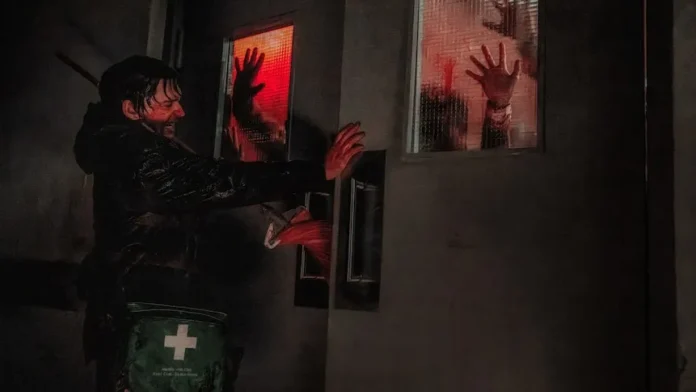
This new iteration promises to capture the immersive perspective that gaming offers, with Cregger aiming to translate the unique feel of playing Resident Evil into a cinematic experience. Unlike previous film adaptations, Cregger’s version will follow a new protagonist, Bryan (Austin Abrams), a medical courier navigating the perils of Raccoon City. Abrams described his character as someone experiencing the game’s world for the first time, learning to survive and operate within its dangerous confines.
Cregger is meticulously recreating iconic elements from the games, including the signature over-the-shoulder camera angles, the crucial act of scavenging for resources like ammunition, and the beloved typewriter save points. The attention to detail, even down to the specific model of a typewriter, underscores Cregger’s commitment to authenticity. “We actually re-shot that scene because I just wanted to get it exactly right,” Cregger stated, emphasizing his dedication to capturing the game’s essence.
The director’s ultimate goal is to recapture the thrilling, action-packed, and genuinely terrifying atmosphere that has defined Resident Evil for decades. “Resident Evil has always kind of embraced a little bit of camp, so there’s a little bit of that, but it’s really horror-forward,” Cregger explained. “I knew if I got the tone wrong, there’s no coming back from that.” With this careful balance of nostalgia, horror, and action, the new Resident Evil film aims to resonate with both long-time fans and newcomers alike.