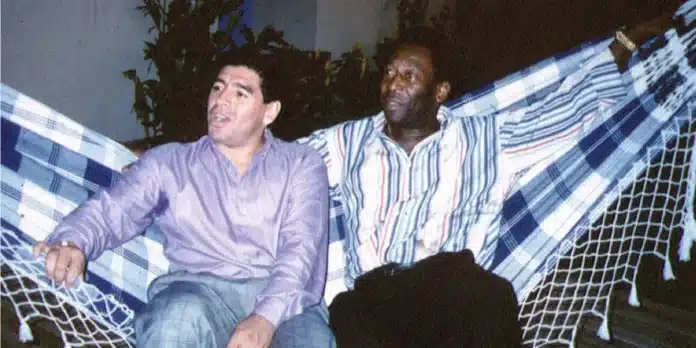
Two of football’s most iconic figures, Pelé and Diego Maradona, share a curious distinction: neither player ever received a standard Ballon d’Or award during their illustrious careers. Despite Pelé’s three World Cup triumphs and Maradona’s legendary performance in the 1986 World Cup, the prestigious individual honor eluded them. This absence from the Ballon d’Or’s historical record is not due to a subjective judgment or a missed opportunity by the awarding body, but rather a matter of administrative rules that have since been amended.
The Ballon d’Or’s Historical Eligibility Rules
The core reason behind Pelé and Maradona’s lack of Ballon d’Or awards lies in the award’s original criteria. Established in 1956 by France Football, the Ballon d’Or was initially conceived as the European Footballer of the Year award. For nearly four decades, from its inception until 1994, the award was exclusively open to players of European nationality. This restriction was a fundamental aspect of the award’s regulations, not a reflection of the players’ caliber.
Pelé’s Exclusion: A Global Phenomenon Bound by Borders
For Pelé, the eligibility rules presented an insurmountable barrier. As a Brazilian national, he was never in contention for the award. Furthermore, his club career was spent entirely outside of Europe, primarily with Santos in Brazil and later with the New York Cosmos in the United States. This meant he did not meet either the nationality or the club location requirements that were in place during his playing prime. Even during the periods when he led Brazil to World Cup glory and showcased his unparalleled talent, Pelé could not be nominated for the Ballon d’Or.
Maradona’s Case: European Stints Not Enough
Diego Maradona’s situation presents a slightly more complex, and perhaps more frustrating, scenario. His peak years coincided with his time playing for prominent European clubs, including Barcelona (1982-1984) and Napoli (1984-1991), followed by a brief spell at Sevilla (1992-1993). By all club-based criteria, he would have been eligible had the rules been different. However, his Argentine passport remained the decisive factor. Despite his immense success and influence in European football, particularly his transformative impact at Napoli, he was ineligible due to his non-European nationality.
The 1986 World Cup and a Missed Opportunity
Maradona’s performance at the 1986 FIFA World Cup in Mexico is widely regarded as one of the greatest individual displays in the tournament’s history. His mesmerizing dribbles, crucial goals, and overall leadership were instrumental in Argentina’s victory. Yet, in that same year, the Ballon d’Or was awarded to Igor Belanov, a Ukrainian player for Dynamo Kyiv. Maradona, despite his global acclaim and his dominant performance on the world stage, could not even be considered for the award.
Evolution of the Ballon d’Or Rules
Recognizing the limitations of its original scope, France Football eventually amended the Ballon d’Or rules. In 1995, the eligibility was expanded to include any player, regardless of nationality, who played for a European club. This change led to George Weah of Liberia becoming the first non-European recipient of the award. A further significant alteration occurred in 2007 when the award was opened to professional footballers worldwide, irrespective of their club’s location. Unfortunately, these rule changes came too late for both Pelé and Maradona. Pelé had retired from professional football in 1977, and Maradona had left European football by 1993, returning to play in Argentina before his retirement in 1997.
The Ballon d’Or d’Honneur: Acknowledging the Past
France Football has, in a way, acknowledged the historical anomaly. The magazine has awarded the Ballon d’Or d’Honneur, a special honorary award, on two occasions. These two instances precisely recognized the players who were most notably excluded by the original rules: Diego Maradona and Pelé. Maradona received his in 1995, coinciding with the lifting of the nationality restriction, as a tribute to his career. Pelé was presented with his honorary award, the Ballon d’Or Prix d’Honneur, in 2013 at a FIFA ceremony. Pelé himself commented on the award, stating he hadn’t won the original trophy because he “didn’t play in Europe,” highlighting the impact of the past regulations.
The scarcity of the honorary award underscores its purpose. Unlike Lionel Messi’s record eight Ballons d’Or or Cristiano Ronaldo’s five, the honorary versions were not intended as standard career achievements but as a specific correction for two legendary figures who were unfairly excluded by the award’s historical framework.
Retrospective Analysis: What Could Have Been?
To further illustrate the impact of the old rules, France Football conducted a retrospective analysis in 2016 for the award’s 60th anniversary. They re-evaluated past Ballon d’Or winners from 1956 to 1994 under the modern, global eligibility criteria. This exercise, termed ‘Le Nouveau Palmarès,’ resulted in changes to twelve of the 39 awards given during that period. Significantly, all twelve retrospective adjustments favored South American players. Pelé was retroactively awarded seven Ballons d’Or (for the years 1958, 1959, 1960, 1961, 1963, 1964, and 1970), which would place him second on the all-time list behind Messi. Maradona was awarded two (1986 and 1990), putting him level with other football legends. Other South American greats like Garrincha, Mario Kempes, and Romário also received retrospective honors. It is important to note that this was an editorial exercise and did not alter the official historical records of the Ballon d’Or, but it served as a powerful testament to the caliber of players who were denied the chance to compete for the award due to administrative limitations.
In conclusion, the absence of a standard Ballon d’Or from the trophy cabinets of Pelé and Diego Maradona is a consequence of historical eligibility rules rather than a reflection of their on-field achievements. While official records remain unchanged, honorary awards and retrospective analyses have sought to rectify this administrative oversight, acknowledging their rightful place among the sport’s greatest ever players.