
Our planet, Earth, stands as a unique celestial body, a vibrant oasis in the vastness of space known for its capacity to host life. Its delicate balance of atmosphere, gravity, and climate creates an environment where diverse ecosystems can flourish, from untouched wildernesses to bustling metropolises. This immense variety and the sheer scale of our world give rise to a wealth of astonishing facts that reveal its complexity and wonder. Here are some of the most remarkable truths about our blue planet.
The Earth’s Hidden Mountain Range and Its Vast Deserts
Beneath the ocean’s surface lies the Earth’s longest mountain range, the Mid-Ocean Ridge. This colossal underwater volcanic system stretches for an incredible 40,389 miles, dwarfing the combined lengths of major terrestrial ranges like the Andes, Rockies, and Himalayas. In stark contrast to its submerged grandeur, Antarctica holds the title of the world’s largest desert. Contrary to popular belief, deserts are defined by their low precipitation, not necessarily high temperatures. Antarctica receives less than ten inches of precipitation annually, making it the driest continent and the coldest desert on Earth, even surpassing the Arctic in its frigid conditions.
Earth’s Evolving Day and Unique Naming Convention
The length of a day on Earth has undergone significant changes throughout its history. Billions of years ago, shortly after the Moon’s formation, Earth’s rotation was much faster, resulting in days as short as 10 hours. As life evolved, including the emergence of photosynthesis and more complex organisms, the day gradually lengthened. Scientists estimate that Earth’s spin is currently slowing by about 1.35 seconds every 100,000 years, suggesting that days could eventually reach approximately 27.75 hours in length over the next billion years. Uniquely among the planets in our solar system, Earth’s name does not originate from Greek or Roman mythology. Instead, it stems from Old English and German words meaning “ground” or “soil,” reflecting humanity’s fundamental connection to the land beneath our feet.
Submarine Giants and Continental Drift
While Mount Everest is renowned as the world’s tallest mountain above sea level, Hawaii’s Mauna Kea presents a compelling counterpoint. When measured from its base on the ocean floor, Mauna Kea’s total height exceeds 10,211 meters, making it approximately 1,300 meters taller than Everest. This highlights the vast, unexplored topography beneath the waves. On a grander scale, Earth’s continents are in perpetual motion, driven by the slow but relentless shifting of tectonic plates. This continental drift occurs at a rate of about 1.5 to 5 centimeters per year, comparable to the speed at which human fingernails grow. This constant movement is a remnant of ancient supercontinents, such as Pangea, which existed around 335 million years ago before breaking apart into the landmasses we recognize today.
Atmospheric Composition and Earth’s True Shape
The air we breathe is primarily composed of nitrogen, which makes up about 78% of the atmosphere. Oxygen accounts for approximately 21%, with argon and trace gases filling the remaining fraction. Contrary to the appearance of a perfect sphere, Earth is technically an oblate spheroid. This means it bulges slightly at the equator and is flattened at the poles, with the equatorial radius being about 13 miles larger than the polar radius. This subtle deviation from a perfect sphere has interesting consequences, such as the fact that the summit of Mount Chimborazo in Ecuador is the point on Earth furthest from the planet’s center, surpassing even Mount Everest due to this equatorial bulge.
The Uncharted Depths and Extreme Trenches of the Ocean
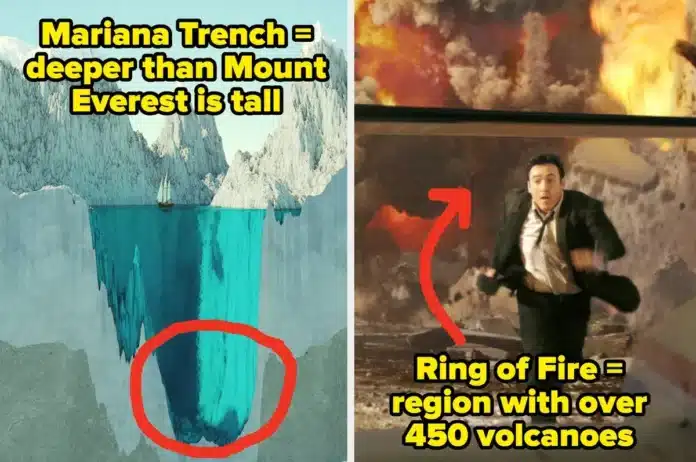
The ocean, covering over 70% of our planet’s surface, remains largely a mystery. Scientists have successfully mapped only about 26% of the ocean floor, revealing an incredibly varied landscape with depths averaging 3,682 meters. Within this vast expanse lies the Mariana Trench in the Pacific Ocean, home to the Challenger Deep, the deepest known point on Earth. This trench plunges to a depth of approximately 7 miles, a chasm deeper than Mount Everest is tall. Despite the extreme pressure, cold, and darkness, life persists in these abyssal zones, a testament to life’s adaptability. In 2012, filmmaker James Cameron made history by descending solo to the Challenger Deep, one of the few individuals to reach this extreme depth.
Oceanic Dynamics and Geological Marvels
While the Pacific Ocean is currently the largest, it is slowly shrinking at a rate of about one inch per year, while the Atlantic Ocean is expanding at a similar pace due to seafloor spreading. This ongoing process is part of a natural cycle that scientists believe will eventually lead to the formation of a new supercontinent in hundreds of millions of years. Earth’s geological history is also etched into its landscapes. For instance, the striking pinnacles of Arizona’s Chiricahua National Monument were formed from volcanic ash deposited by a massive eruption 27 million years ago, later sculpted by millions of years of erosion.
Geothermal Wonders and Misleading Landscapes
Yellowstone National Park is not only famous for its geysers, like the iconic Old Faithful, but also boasts over 10,000 hydrothermal features, with approximately 500 active geysers, representing more than half of the world’s geysers. In Utah, Bryce Canyon, despite its name, is not a true canyon. Its distinctive hoodoos and rock formations were primarily shaped by the freeze-thaw cycle of snowmelt and rainwater, rather than the erosive power of a river, which is the defining characteristic of a canyon. Similarly, the shape of a valley can indicate its origin: U-shaped valleys are typically carved by glaciers, while V-shaped valleys are formed by flowing rivers.
Subterranean Worlds and Specialized Adaptations
The world’s longest cave system, the Mammoth Cave System in Kentucky, extends over 400 miles and continues to reveal new passages. This subterranean network supports unique ecosystems where life has adapted to extreme conditions. Animals like cave shrimp have evolved to be eyeless, conserving energy in the perpetual darkness, while others, such as cave crickets, possess vestigial eyes with poor vision. Many cave-dwelling species also exhibit a lack of pigmentation, further adaptations to their lightless environment. The Pacific Ocean’s “Ring of Fire,” a horseshoe-shaped zone spanning 25,000 miles, is another testament to Earth’s dynamic nature, accounting for the majority of the world’s earthquakes and volcanic eruptions.
Conclusion: A Planet of Endless Discovery
From the deepest ocean trenches to the highest mountain peaks, and from the slow dance of continents to the rapid evolution of life, Earth is a planet of constant change and astonishing phenomena. These facts offer just a glimpse into the intricate processes and remarkable features that define our world, reminding us of its enduring capacity for wonder and discovery.