
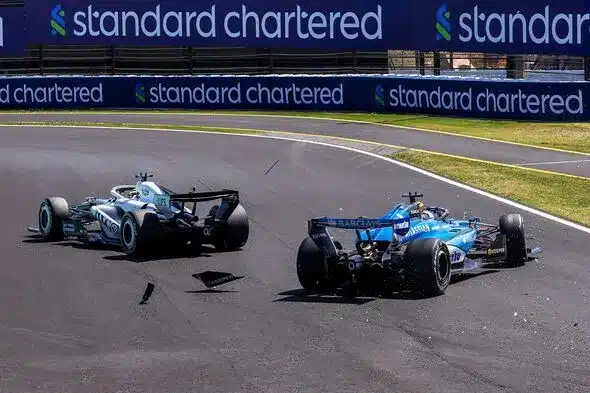
Stewards at the Japanese Grand Prix have clarified the unusual technical failure that led to a collision during Friday’s opening practice session at Suzuka.
Incident Breakdown
The crash occurred near the end of FP1. Alex Albon, driving for Williams on an out lap and gearing up for a final run, caught up to Sergio Perez in the slower Cadillac. Perez was midway through a race simulation, traveling at reduced speed.
Albon attempted an inside pass at the turns 16-17 chicane. Perez, unaware of the approaching Williams due to a malfunctioning virtual mirror system, turned in sharply, resulting in contact that damaged both vehicles.
Stewards’ Official Explanation
Investigators reviewed the incident alongside several others but opted against penalties. In their FIA decision document, stewards noted Perez’s account: he was on a race simulation lap and had spotted Albon trailing after turn 14. Albon closed the gap rapidly through turn 15 and toward turn 16.
Stewards stated: “[Albon] moved to overtake [Perez] on the inside at turn 16 and a collision occurred. [Perez] said that he did not see [Albon] as his virtual mirror was not working and he had not received any warning from his team of [Albon’s] approach. This was confirmed by his team radio.”
The team admitted assuming Albon would stay behind and failed to notice the rapid approach, thus not issuing a warning. Albon believed Perez’s wide entry line at turn 16 signaled he was yielding position. Both drivers ed surprise at the closing speeds.
Stewards concluded: “The collision was therefore the result of a misunderstanding contributed to by a lack of communication by the team to [Perez]. Both drivers accepted that neither of them was wholly or predominantly to blame. The stewards, therefore, determined to take no further action.”
Session Results and Team Context
Albon ended the day eighth fastest, while Perez clocked the 20th-best time. Both drivers remain scoreless after the season’s first two races. Cadillac continues its adaptation as a newcomer, and Williams addresses ongoing weight challenges following a tough winter development phase.
The virtual mirror system aims to prevent such incidents by automatically alerting drivers to faster cars nearby, a response to past collisions from delayed engineer warnings.