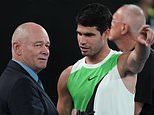
Carlos Alcaraz expressed frustration with tournament officials during the men’s singles final at the Australian Open against Novak Djokovic, challenging a decision to partially close the roof at Rod Laver Arena.
The On-Court Confrontation
After leveling the match at 2-6, 6-2 in the second set, Alcaraz approached chair umpire John Blom during a break before the third set. He questioned why the roof on the 15,000-seat stadium continued to close without prior notice to the players.
With Djokovic off the court for a brief break, Alcaraz voiced his concerns directly. “Why is it closing? The player doesn’t know that, you know what I mean?” the six-time Grand Slam champion remarked.
Alcaraz then engaged in discussion with tournament referee Wayne McEwen on the sidelines, where the official appeared to clarify the reasoning. Tennis Australia CEO Craig Tiley was observed nearby, speaking on the phone while monitoring the roof’s status.
Weather and Decision Factors
Melbourne’s weather played a key role in the choice. While earlier days saw temperatures exceed 40°C, conditions cooled to about 15°C at match start, accompanied by strong winds gusting through Melbourne Park.
Organizers partially closed the roof to shield the court from winds and possible rain, maintaining the event’s outdoor character. This partial closure allowed quick full closure if needed, minimizing disruptions.
TNT Sports commentators noted Alcaraz’s dissatisfaction, with one observing, “Alcaraz doesn’t look thrilled with that conversation,” as he walked away shaking his head. Another added, “It’s almost like they are hedging their bets a bit, isn’t it? The rain might be coming so we’re just going to make sure if it does we can close the roof quickly.”
Tim Henman, commenting on the broadcast, highlighted how even partial closure alters arena conditions by reducing wind’s influence on play.
Pre-Match Discussions on Conditions
Before the final, the roof and weather drew significant attention. Australian tennis legend Todd Woodbridge told Nine that radar showed no immediate rain but winds of 40-50 km/h could affect early play, as the open court offers some protection.
John McEnroe, the American tennis icon, advocated for full closure to elevate competition quality. “I would like to see it closed, only because I think the level of play will go up, because these winds are howling pretty good,” he stated.
The decision underscores the challenges of adapting to variable Melbourne weather while preserving the tournament’s integrity.