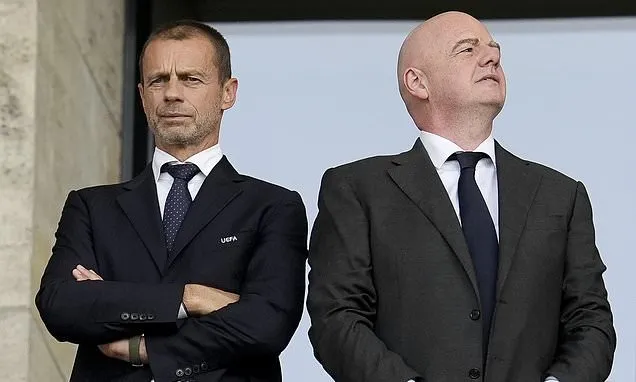
UEFA president Aleksander Ceferin has emerged as a prominent critic of FIFA’s recent proposals, particularly a controversial plan to sell stakes in its major tournaments. The Slovenian lawyer, who also serves as a FIFA vice president, has openly challenged FIFA president Gianni Infantino on multiple occasions, highlighting a growing rift between the two governing bodies over the future direction of international football. This tension has been evident in their differing approaches to significant issues, from player suspensions to tournament expansion and commercial ventures.
Key Conflicts Between UEFA and FIFA
The friction between UEFA and FIFA has manifested in several high-profile disputes. One notable incident involved FIFA’s decision to defer a one-match ban for US player Folarin Balogun. UEFA, through Ceferin, publicly condemned this move as having “crossed a red line,” describing it as “unprecedented, incomprehensible and unjustifiable.” This disagreement underscored a broader dissatisfaction within UEFA regarding FIFA’s handling of disciplinary matters and its perceived willingness to bend rules.
Another significant point of contention is FIFA’s proposal to sell approximately £3.1 billion worth of shares in its tournaments to an investor group. This plan has drawn widespread condemnation, with Ceferin being one of its most vocal opponents. UEFA, under his leadership, voted to boycott FIFA tournaments in protest, a stance that has since been echoed by other confederations like the Asian Football Confederation and CONCACAF. This collective opposition signals a united front against what many perceive as an attempt to commercialize football at the expense of its integrity.
A History of Disagreements
The rivalry between Ceferin and Infantino is not new. Both men ascended to their current leadership roles in 2016, having previously worked together at UEFA in the early 2010s. However, their shared history has not fostered a cooperative relationship. Their disagreements have often centered on FIFA’s ambitions for expansion and commercialization, which UEFA views as a threat to the established European football model.
Ceferin has been particularly critical of FIFA’s plans to expand the World Cup, calling the idea of increasing the number of participating teams beyond the 48 nations slated for 2026 “bad.” He expressed surprise at Infantino’s proposals, suggesting they were even more radical than anticipated. UEFA has also rejected other FIFA-introduced regulations, such as mandatory ‘hydration breaks’ during matches, which UEFA views as primarily serving advertising interests. These breaks will not be implemented in the 2028 European Championships.
Club World Cup Expansion and the European Super League
The relaunch of the FIFA Club World Cup, expanded and enhanced with significant prize money, was seen by UEFA as a direct challenge to its own premier competition, the Champions League. As early as 2018, Ceferin voiced concerns about FIFA’s direction, accusing Infantino of “selling the soul of football” through proposals that included a rolling Nations League and a new mini-World Cup. Ceferin stated, “As long as I am UEFA president there will be no room for pursuing selfish endeavours or hiding behind false pretences.” He emphasized that “Football is not for sale” and vowed not to allow its structures to be compromised by commercial interests.
Ceferin’s leadership has also been tested by internal threats to the European football structure. In 2021, he spearheaded UEFA’s response to the proposed European Super League (ESL), a breakaway competition conceived by nine top European clubs. Ceferin, who had personal ties to some of the ESL’s founders, including Juventus chairman Andrea Agnelli, was a particularly vocal opponent. UEFA issued a strong statement calling the ESL “a spit in the face of football lovers and of society as a whole,” vowing to prevent its realization and even suggesting potential bans for players participating in the new league from their national teams.
Despite the intense legal battles and strong rhetoric, Ceferin showed pragmatism by welcoming back clubs that withdrew from the ESL amidst fan protests. He later likened the experience of confronting the ESL to his time serving in the Slovenian Territorial Army during the Yugoslav wars, highlighting the psychological stress and the importance of resilience against destabilizing forces.
Ceferin’s Background and Leadership Style
Aleksander Ceferin’s journey into football administration began after a career in sports law, following his graduation from the University of Ljubljana. He first served as the head of the Slovenian Football Association before ascending to the presidency of UEFA. His tenure has been marked by a strong defense of European football’s traditional structures and a firm stance against what he perceives as FIFA’s overreach and commercialization agenda.
While Ceferin positions himself as a defender of football’s integrity against profit-driven motives, his own past has faced scrutiny. An independent investigation in 2017 raised questions about his qualifications for leading the Slovenian FA, alleging a lack of required boardroom experience. His election to that role also involved his sole opponent withdrawing, citing “dirty campaigning.” Despite these critiques, Ceferin’s assertive approach and his willingness to confront FIFA directly have made him a significant figure in the ongoing debate about the governance and future of global football.
Conclusion
The ongoing conflict between Aleksander Ceferin and Gianni Infantino reflects a fundamental disagreement on how international football should be managed and commercialized. Ceferin’s staunch opposition to FIFA’s ambitious plans, coupled with his firm defense of UEFA’s interests and European football’s established model, positions him as a formidable rival to Infantino. While both leaders have faced their share of controversies, the clash between UEFA and FIFA under their respective leaderships continues to shape the landscape of the sport.