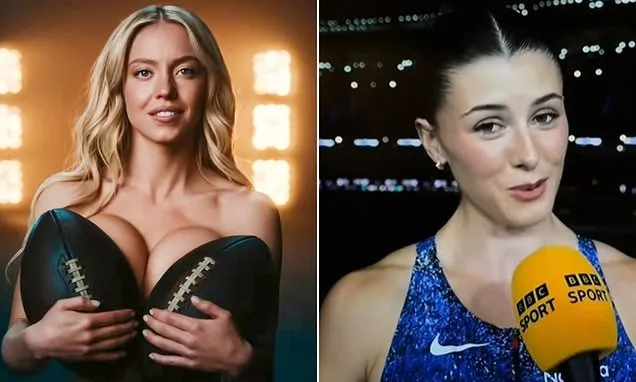
British track star Amy Hunt has voiced her disapproval of actress Sydney Sweeney’s recent naked advertisement for the betting platform Novig, suggesting it misrepresents the essence of women’s sports. Hunt’s comments came shortly after her fourth-place finish in the 200m race at the inaugural World Athletics Ultimate Championship.
Criticism of the Novig Advertisement
Sydney Sweeney’s ad, which features the actress posing nude while strategically covering herself with sports equipment, has ignited a significant debate. The advertisement, intended to promote Novig, a platform focused on sports predictions, has drawn sharp criticism from various athletes who argue it sexualizes women’s athletics and detracts from their achievements.
Amy Hunt, a Cambridge University graduate, directly addressed Sweeney during her post-race interview. “Sydney Sweeney, this is what women’s sport looks like!” Hunt declared, looking directly at the camera. She elaborated, describing women’s sports as embodying “hard work, sweat, blood, tears.” Hunt contrasted this with the advertisement, emphasizing the “beautiful evening” of athletic competition.
Wider Athlete Backlash
Hunt is not alone in her criticism. A chorus of female athletes has spoken out against the ad:
- Australian Olympic water poloist Matilda Kearns expressed strong disapproval on Instagram, stating, “I absolutely f****** hate Sydney Sweeney’s new sports ad.” She questioned the message, adding, “Like what are we doing… so much worse than I imagined too.” Kearns shared footage of her water polo team as an example of “real women’s sports content.”
- Former Olympic runner Hannah Williams also shared a clip of sprinters, telling Sweeney, “This is women in sports btw.” She called the ad “a disgrace for woman in sports btw constantly trying to be respected in a male dominated field.”
- Olympic weightlifting coach Danielle Bagacay highlighted the broader issue of sexualization, noting, “The sexualisation of women in sport (and in life) is an ongoing issue that most (if not, all) women face.” She emphasized that such ads “disproportionately focuses on physical appearance and, instead, overshadows our achievements, hard work and ability to reach athletic goals.” Bagacay stated her coaching philosophy centers on “improving my athletes’ ability, capacity and capability to reach their strength and performance goals,” focusing on empowerment over appearance.
- Fitness influencer Angela Everington pointed to statistics showing the negative impact of body image concerns on young girls in sports, suggesting Sweeney’s platform could have been used more constructively. “45 per cent of teenage girls say they don’t feel they have the ‘right body shape’ for sport,” Everington noted, and “70 per cent had seen girls drop out of sport because of sports kit or body-image concerns.”
Sweeney’s Defense and Novig’s Perspective
In response to the criticism, Sydney Sweeney has defended her decision, pointing out that both male and female athletes have posed nude for various media outlets. She shared a series of Instagram Stories showcasing celebrities like Serena Williams, Ronda Rousey, Sue Bird, Megan Rapinoe, and Caroline Wozniacki, as well as male athletes such as Myles Garrett and Rob Gronkowski, who have appeared nude in photoshoots.
Novig founder and CEO Jacob Fortinsky explained that Sweeney’s involvement stemmed from her discomfort with other platforms that include markets on personal details. “She said, ‘I’m uncomfortable with other platforms that have markets on what colour underwear I’m going to wear’,” Fortinsky recalled. He added that Sweeney found the focus on sports predictions on Novig to be “clean.” Sweeney reportedly holds an equity stake in Novig, suggesting a vested interest in the campaign’s impact.
Fortinsky also commented on Sweeney’s ability to generate attention, stating, “Sydney is great at captivating audiences and being the center of attention.” He believes the controversy has successfully placed Novig “into the national discourse.”
Mixed Public Reaction
While many athletes and commentators have criticized the ad, some members of the public have defended Sweeney. Comments included suggestions that critics were motivated by jealousy and that the ad, despite its nature, successfully drew attention to women’s sports. Others invoked the idea of “women supporting women,” questioning the outpouring of negativity.
Conclusion
The advertisement has undeniably sparked a conversation about the portrayal of women in sports and the role of celebrity endorsements. While Sweeney and Novig maintain the campaign has a purpose and highlights athletes’ willingness to appear nude, critics like Amy Hunt argue it detracts from the athletic achievements and the dedication required in women’s sports, advocating for a focus on performance and hard work over sexualized imagery.