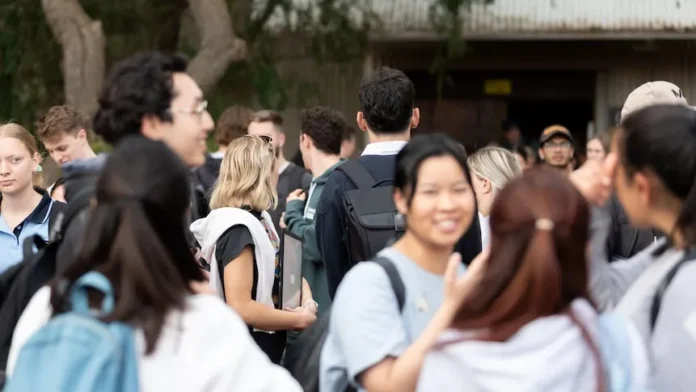
The Australian federal government’s decision to prevent most international students from bringing their families to the country has sparked significant concern among university leaders, students, and industry stakeholders. This policy shift, announced as part of a broader strategy to reduce net overseas migration, is set to impact Australia’s reputation as a global education destination and its substantial international education export market.
Sweeping Migration Changes Unveiled
In a recent address, the Minister for Home Affairs outlined new regulations that will largely prohibit international students from including their dependents on student visas. This move is intended to curb the overall number of migrants entering Australia. However, the government has indicated that certain exceptions will apply. These include special visa conditions for citizens of Pacific and South-East Asian nations, and for individuals pursuing doctoral research (PhDs). Furthermore, those who already have family members residing in Australia will not be subject to these new restrictions.
Beyond the restrictions on family members, the government also plans to implement stricter measures against “visa hopping.” This practice, where individuals repeatedly switch between courses or visa types without genuine study intent, has been identified as a significant loophole. The minister highlighted that a common scenario involves students moving from one course to another, sometimes ending up at less reputable educational institutions.
Concerns Over Australia’s Global Standing
Migration agents and higher education representatives have voiced apprehension about the potential fallout from these policy changes. Manpreet Mann, a migration agent who arrived in Australia as an international student himself, acknowledged the need for some of the government’s measures, particularly those addressing visa integrity. However, he expressed worry about the message sent to prospective students regarding family reunification.
“At the moment Australia is not very appealing,” Mann stated, drawing a comparison with European destinations. “We are fighting against somebody paying $2,500 to Australia to lodge a student visa and not bring their partner, whereas [they pay] 85 euros to go to Europe where they can bring their family members.” This disparity, he suggested, could diminish Australia’s attractiveness on the international stage.
Economic Repercussions for the Education Sector
The international education sector is a significant contributor to the Australian economy, ranking as the country’s fourth-largest export industry, valued at approximately $55 billion. Stakeholders fear that these new visa rules could severely damage this vital sector. Chris Moran, chair of the Regional Universities Network and vice-chancellor of the University of New England, warned that regional areas, which often rely heavily on international student enrollment, would be disproportionately affected.
Luke Sheehy, chief executive of Universities Australia, emphasized the need for Australia to attract top global talent. “Australia should be competing for the world’s best students and the skills, investment and ideas they bring — not competing to see who can drive them away fastest,” he commented.
Vicki Thomson, chief executive of the Group of Eight Universities, described the situation as a “race to the bottom” among political parties, each seemingly vying to weaken the international education sector. Professor Moran further elaborated on the financial strain universities are already facing due to previous visa policy tightening. He noted that universities are caught between potentially shrinking their offerings and reducing the quality of education for domestic students, or seeking increased government funding, which he sees as a limited alternative.
Impact on Student Well-being and Community Integration
Beyond the economic and reputational concerns, there are also calls to consider the human element of these policy changes. Weighong Liang, president of the International Students Representative Council of Australia, urged that migration policy decisions should account for social cohesion and the genuine impact on students and their families. “International students are not simply numbers in a migration system. They study, live, build relationships and become part of communities across Australia,” Liang stated.
Personal accounts from current international students highlight the profound effect these changes could have. Azizah Raihan, a Bachelor of Biomedicine student at the University of Melbourne, shared her personal connection to Australia, stating she likely wouldn’t have chosen to study there without existing family support. “If that’s going to be a thing, it will probably affect those that are planning to come here,” she remarked.
Shilpi Jaiswal, a student from Nepal studying in Sydney, expressed fear about the implications for her family. “It’s impacting a lot to us… I was planning to [have] my parents for three months to visit us but after hearing those things, we are very scared to apply for the visa,” she said, highlighting the anxiety these changes create for those seeking to maintain family ties.
Sophia Stober, a design student from Sierra Leone and Nigeria, shared a similar sentiment, noting her sister’s planned visit was now uncertain. “If they’re not able to move, I feel disconnected from my people. It’s disheartening to hear that they’re not going to be able to come,” she said, underscoring the emotional toll of potentially being separated from loved ones.
Conclusion
The Australian government’s decision to restrict international students from bringing their families marks a significant shift in migration policy. While aimed at lowering migration numbers, the move has ignited widespread debate about its potential consequences for the international education sector, Australia’s global appeal, and the well-being of students and their families. As the full impact unfolds, stakeholders will be closely watching how these changes affect the nation’s educational landscape and its standing as a destination for international talent.