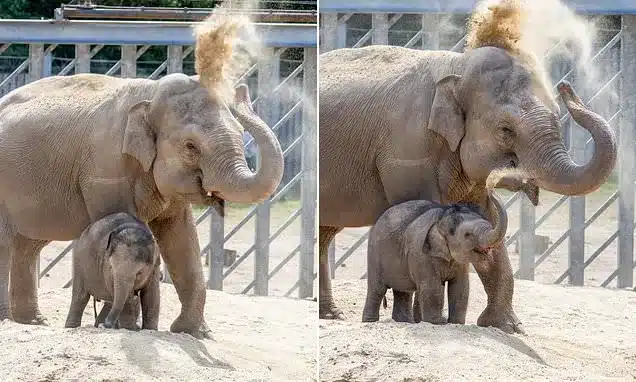
A young elephant calf named Zaiya has been observed at Blackpool Zoo in Lancashire, England, learning a vital survival skill: how to shield herself from the sun and insects. The endearing behavior saw Zaiya closely watching her mother and then imitating her actions, demonstrating a natural instinct for self-preservation and social learning.
The Art of Dusting: Natural Sunscreen for Elephants
The observed behavior, known as “dusting,” is a crucial practice for elephants. Zaiya’s mother was seen using her trunk to pick up sand and then shower herself with it. This action serves multiple protective purposes, acting much like a natural sunscreen. Elephant skin, despite its thickness, is surprisingly sensitive to the sun’s potent ultraviolet (UV) rays, making them susceptible to sunburn. The layer of sand or mud helps to block these harmful rays, preventing painful burns.
Photographer Alison Allen, who captured the heartwarming scenes, explained the significance of this behavior. “The girls were just in the top sand paddock, and they started throwing sand on themselves,” Allen recounted. “They do this for skin protection and cooling.” She elaborated that dusting is a multifaceted behavior that provides a natural defense against the elements and pests.
Benefits of Dusting for Elephant Welfare
The benefits of dusting extend beyond simple sun protection. According to Allen, the practice is essential for:
- Sun Protection: Creates a barrier against damaging UV rays, preventing sunburn.
- Insect Deterrence: The dry layer of sand or mud deters biting insects like flies and mosquitoes, reducing irritation and the risk of disease transmission.
- Thermoregulation: Helps elephants regulate their body temperature, keeping their large bodies cool, especially under the hot sun.
- Moisture Retention: Locks in moisture after bathing, preventing the skin from drying out.
- Skin Health: The grit in the sand can help soothe existing insect bites and acts as an exfoliant, allowing elephants to scrub off dead skin cells when they rub against trees.
“Their thick skin is surprisingly sensitive to the harsh sun, so sand and mud block harmful rays and prevent painful sunburns,” Allen noted. “The dry layer traps a barrier against flies, mosquitoes, and parasites.” The cooling effect is also vital for such large animals.
Zaiya’s Learning Curve: Mimicry and Alloparenting
Young Zaiya’s participation was particularly noteworthy. She was seen standing beneath her mother, observing intently before attempting the dusting herself. Initially, her attempts might have been less precise, but the images show her successfully spraying sand over her body, mimicking the cooling and protective action. Allen observed Zaiya’s progress, stating, “It was so great to see baby Zaiya mastering the use of her trunk and throwing more sand this time.”
This learning process highlights the importance of social interaction and observation in elephant calf development. Elephants are highly social animals, and young ones learn essential life skills by watching and copying the older members of their herd. This phenomenon is part of what is known as alloparenting, where adult females, not just the mother, share in the care and teaching of the young.
The Role of Alloparenting in Elephant Social Structure
Alloparenting, or cooperative breeding, is a common and vital aspect of elephant social structure. In this system, older females, including aunts and grandmothers, play a significant role in raising the calves. They not only protect the young but also actively teach them the complex behaviors necessary for survival in their environment. This includes finding food and water, navigating their territory, and, as Zaiya’s case illustrates, mastering essential self-care techniques like dusting.
“She will learn these things by copying her mum and the other adults,” Allen explained. “They do what is known as alloparenting, which means the adult females will share care and teach the youngster the skills they need.” This shared responsibility ensures that calves receive comprehensive guidance, increasing their chances of thriving as they mature.
Conclusion: A Glimpse into Elephant Development
Zaiya’s journey of learning to dust is a charming illustration of the intelligence and social complexity of elephants. It underscores the critical role of maternal guidance and herd dynamics in the development of young elephants. As Zaiya continues to grow and practice this behavior, she will become increasingly adept at protecting herself from the sun and insects, a skill that will serve her throughout her life. The scene at Blackpool Zoo offers a valuable glimpse into the natural behaviors and learning processes that shape the lives of these magnificent animals.