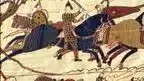
The Bayeux Tapestry, a nearly 1,000-year-old masterpiece depicting the Norman conquest of England, is set to return to the UK for an exhibition at the British Museum. This 70-meter linen embroidery, stitched in the 1070s, offers a vivid, and at times surprisingly bawdy, account of ambition, conflict, and the assertion of power. Beyond its historical narrative of broken promises and aggression culminating in the Battle of Hastings, the tapestry provides a fascinating window into 11th-century society, revealing a world where hypermasculinity and virility were intrinsically linked to political power, echoing themes that resonate even today.
A World of Male Dominance and Masculine Display
The tapestry’s narrative overwhelmingly focuses on male actions and contributions. A significant portion of the depicted men are armed, while others are shown engaged in vigorous physical labor such as felling trees, building boats, and constructing structures. Scenes of woodcutters wielding axes and hunters brandishing clubs underscore a society where physical prowess and aggression were commonplace. Cultural historian Dr. Christopher Monk describes these scenes as “testosterone-soaked,” highlighting a medieval world largely shaped by men, where disputes were often settled through violence and a certain “laddish humor” played a role in political maneuvering.
This emphasis on male dominance is further illustrated by the graphic depictions of violence and stripping of fallen soldiers for their armor, mirroring the dispossession of King Harold’s royal claim. The dynamic between William, Duke of Normandy, and Harold Godwinson is portrayed as a confrontation between two dominant male figures, amplified by the visual language of the tapestry.
The Recurring Motif of Virility
A striking and frequently discussed element of the Bayeux Tapestry is the recurring motif of the penis. Professor George Garnett of Oxford University noted in 2018 the presence of 93 such depictions, predominantly erect, with the vast majority belonging to horses and a smaller number to men. This recurring imagery, while potentially shocking by modern standards, served a specific purpose within the context of 11th-century art and society.
According to historian Janina Ramirez, author of Femina: A New History of the Middle Ages, Through the Women Written Out of It, the tapestry equates virility with power. The most prominent and “proudest appendage” is depicted on the stallion presented to William before the battle, with King Harold’s horse receiving second place, subtly implying their respective strengths and claims. While graphic nudity was not unusual in medieval art, and the embroiderers may have been nuns, these depictions of male genitalia, both human and equine, acted as a visual shorthand for the “political machismo” prevalent during the transition to the Anglo-Norman era. Dr. Emily Joan Ward, a lecturer in medieval history, explains that the narrative’s focus on “militarily active men” naturally sidelines female characters, as battles were not typically arenas for women.
The Patronage and the Homosocial Circle
The tapestry’s intended audience and purpose likely influenced its content. Historians suggest that William’s half-brother, Bishop Odo of Bayeux, a prominent figure in the tapestry and a key supporter of William’s claim to the throne, was the likely patron. The artwork may have been designed to resonate with Odo and his “homosocial circle of men.” Given a Norman sponsor, the messaging needed to align with their interests, and introducing too many women could have been perceived as risky, potentially drawing undue attention to the tenuous nature of William’s claim through the female line.
The Limited but Significant Role of Women
While women are present in the tapestry, their roles are often subordinate or symbolic. Dr. Monk categorizes them as “emotional punctuation.” Queen Edith weeps as her husband, Edward the Confessor, dies, and a mother and child flee from Norman soldiers, serving as poignant reminders that warfare impacts civilians beyond the battlefield. Dr. Ward, referencing historian Catherine Karkov, suggests that the appearances of women in the main narrative often coincide with shifts in power relations, potentially affording them a more significant, albeit subtle, role.
The decorative borders of the tapestry offer a more subversive space where coded critiques and fables appear. Three women are depicted here: one recoiling from a sexual aggressor, and two nude women gesturing towards naked men, possibly alluding to stories of seduction and deception, perhaps even Harold’s broken oath. Notably, William’s wife, Matilda of Flanders, who financed his flagship, the Mora, is absent, while the ship itself is prominently featured.
A “Medieval Me-Too Moment” and Female Agency
One particularly intriguing scene involves a cloaked figure named Aelfgyva, approached by a priest. In the border, a naked man with exaggerated genitalia mimics the priest’s pose. Dr. David Musgrove proposes this depicts a “medieval Me-Too moment,” where sexual harassment is being called out. This interpretation offers a compelling perspective on the scene, contrasting with earlier dismissals by historians who found it irrelevant to the main narrative.
It is plausible that the female embroiderers, while working from a design, were granted some creative license, similar to monks illustrating manuscripts. Dr. Monk suggests that the “skilled and intelligent labour of women” was crucial to the tapestry’s existence. The border scenes may represent their “despair at bellicose men, or at their own plight as subjugated English women,” or perhaps “playful, earthy humor.” These interpretations highlight the potential for hidden commentary and female agency within the artwork.
Victorian Reinterpretations and Honoring the Creators
Later interpretations, such as an 1885 replica by the Leek Embroidery Society, reveal evolving sensibilities. In this version, the exaggerated male anatomy depicted in the original tapestry is toned down, reflecting Victorian modesty. More significantly, this replica introduced an additional border where each embroiderer stitched her name, a deliberate act of honoring the creators and asserting a female presence. As Janina Ramirez notes, while discussions of paintings often center on the artist, the women behind the Bayeux Tapestry have historically been overlooked. The tapestry’s existence, like any narrative of male power, may ultimately depend on the contributions of the women it often seeks to marginalize.