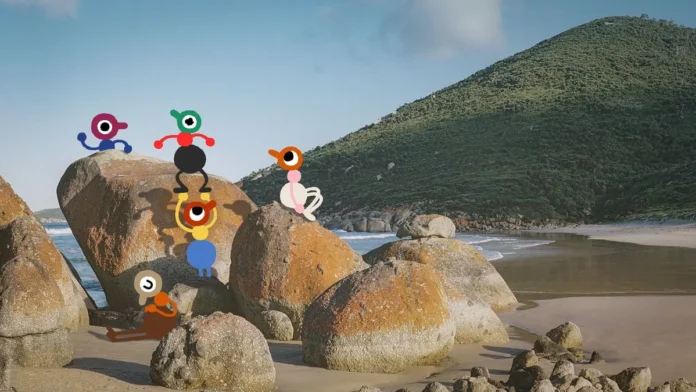
The acclaimed Australian studio House House, known for the viral hit Untitled Goose Game, has launched a new multiplayer title, Big Walk, that challenges conventional notions of cooperative gaming. Moving away from the deliberate mischief of their previous work, Big Walk focuses on companionship and mutual assistance, creating a unique social and puzzle-solving experience that stands apart from typical online offerings.
Rethinking Cooperative Play
In an industry where following up a successful indie game often means replicating its formula, House House has taken a bold, innovative path. Instead of a hypothetical ‘Untitled Goose Game 2’, they’ve developed Big Walk, a game that prioritizes collaboration and communication. While some might initially dismiss it as ‘friendslop’ – a term often applied to low-budget online games that rely on social interaction to mask simple mechanics – Big Walk offers a far more substantial and thoughtfully crafted experience.
The game is designed for up to 12 players online, and a core part of its appeal lies in the social dynamic it fosters. If the idea of interacting and communicating with a group of friends doesn’t appeal, Big Walk may not be the right fit. However, for those who embrace its social premise, the game reveals itself as a meticulously designed puzzle and exploration adventure.
An Australian-Inspired Landscape
While Untitled Goose Game featured an idyllic, vaguely British countryside, Big Walk’s environment draws heavily from House House’s Australian roots. The island setting is clearly inspired by the Australian outback, providing a distinct backdrop for the cooperative challenges that await players.
More Than Just Chat: Gameplay Mechanics
Big Walk defies easy genre classification. While it shares a social element with games like Animal Crossing, it distinguishes itself with a strong emphasis on purpose, structure, and genuine gameplay. Players take on the roles of characters resembling 1970s drinking bird toys. Though the low-detail character designs are a point of contention for some, they are a deliberate aesthetic choice. The primary objective is to explore the island and uncover its secrets, an endeavor that is impossible without working together.
Unlike many games that utilize procedural generation, Big Walk features a carefully constructed, non-procedural map. This deliberate design is evident in the clever level layouts and effective signposting, which guide players through the world. While the core puzzles remain consistent, their complexity and implementation can adapt based on the number of players in a group.
Physics-Based Puzzles and Communication
Players don’t possess unique abilities but can utilize helpful items like walkie-talkies. Physics plays a crucial role in solving many of the game’s challenges. Collaborating to form human chains, moving objects, or reaching elevated areas are common mechanics. However, the game constantly engineers situations that separate players, making communication paramount.
Big Walk employs proximity chat, meaning players can only hear those who are physically close to them. This limitation necessitates creative communication strategies. Players might use in-game whiteboards to convey messages visible through binoculars from a distance or devise ways to communicate when isolated in soundproof areas. The need to relay directions and coordinate actions transforms communication from idle chatter into structured gameplay, a rarity in laid-back multiplayer titles.
Exploration and Discovery
Exploration is the third pillar of Big Walk’s gameplay. The game offers no explicit hints or on-screen markers, encouraging players to discover objectives and solutions organically. The thoughtfully designed vantage points reveal new puzzles and interactive elements, often rendered in vibrant primary colors that contrast with the more realistic backgrounds.
While the narrative is subtle, the game culminates in a memorable final section, solidifying its status as a standout co-op title. Big Walk’s innovation lies in its seamless integration of gameplay and cooperation, offering a fresh and exciting experience that truly leverages the power of playing with friends.
Review Summary
In Short: Big Walk is a deceptively innovative cooperative game that uses its cleverly designed world and puzzles to foster communication and collaborative problem-solving in an engaging, yet relaxed, manner.
- Pros: Ingeniously designed puzzles that encourage experimentation. Essential teamwork with ample room for creativity. Well-crafted game world with intuitive signposting. Accessible price point.
- Cons: Character designs may be off-putting to some. Circumventing proximity chat can undermine the core gameplay loop.
Score: 9/10
Formats: PlayStation 5 (reviewed), Nintendo Switch 2, and PC
Price: £15.49
Publisher: Panic
Developer: House House
Release Date: 4th August 2026
Age Rating: 3