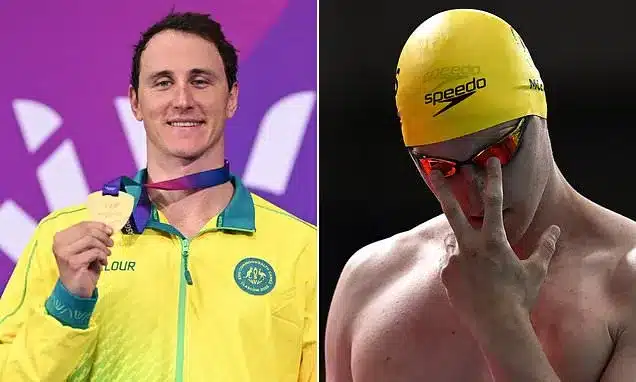
Cam McEvoy has cemented his place in swimming history, securing a dominant victory in the 50m freestyle at the Commonwealth Games. The Australian swimmer led an impressive medal sweep for his nation in the highly anticipated event, marking a significant milestone in his career resurgence. McEvoy was the only competitor to break the 21-second barrier, clocking in at 20.97 seconds to claim the gold medal. This victory not only adds another prestigious title to his name but also signifies the culmination of a remarkable comeback after a period away from the sport.
McEvoy’s Dominant Freestyle Performance
The 50m freestyle final saw McEvoy, a seasoned competitor, deliver a performance that underscored his exceptional talent and dedication. He finished ahead of fellow Australians Flynn Southam, who took silver with a time of 21.44 seconds, and Jamie Jack, who secured the bronze medal at 21.47 seconds. This clean sweep by the Australian team highlighted their strength and depth in the sprinting disciplines.
This gold medal marks a significant moment for McEvoy, ending a personal drought for individual gold at the Commonwealth Games across his three appearances. While he has previously earned Commonwealth gold medals in relay events, this individual triumph represents a new peak in his swimming journey. His performance in Glasgow is a testament to his dedication, especially following a sabbatical after the Tokyo Olympics where he contemplated his future in the sport.
A Swimming Renaissance
Nicknamed ‘The Professor,’ McEvoy’s return to competitive swimming has been nothing short of extraordinary. After overhauling his training regimen, he has recaptured his elite form, a journey that included breaking the long-standing world record in the 50m freestyle earlier in the year with a time of 20.88 seconds at the China Swimming Open. This record, which had stood for 17 years, further emphasized his prowess and readiness for major international competitions.
Australian Swimmers Shine Across Multiple Events
McEvoy’s historic win was part of a highly successful day for Australian swimmers at the Tollcross International Swimming Centre. The nation’s aquatic athletes continued to impress, adding to their already substantial medal tally.
Lani Pallister’s Endurance Triumph
In the women’s 1500m freestyle, Lani Pallister showcased her dominance in long-distance swimming. She effectively turned the final into a personal time trial, winning the gold medal by a commanding margin of nearly 18 seconds. Her exceptional performance solidified Australia’s reputation in endurance events.
Thrilling Relay Victory
The men’s 4x200m freestyle relay final provided one of the most exciting finishes of the competition. Australia secured a dramatic victory over England thanks to an outstanding anchor leg by Kai Taylor. England held the lead going into the final changeover, but Taylor’s powerful swim saw him surge to the finish line, clinching the gold medal for his team and setting a new Games record with a time of 7 minutes 01.47 seconds. The team also included Sam Short, Harry Turner, and Ed Sommerville.
Backstroke Success and Emotional Moments
The women’s 100m backstroke saw a gutsy performance from 20-year-old Iona Anderson, who touched the wall in 58.71 seconds to narrowly defeat Canada’s Kylie Masse. Anderson’s win was particularly poignant as she shared an emotional embrace with her Scottish grandmother following the race, a moment that highlighted the personal significance of competing on home soil for some athletes.
Earlier, Tim Hodge, who had the honor of being Australia’s flag bearer at the opening ceremony, set a strong tone for the day by winning the men’s 100m backstroke S9 event. His victory was one of several early successes for the Australian team.
Close Contests and Near Misses
While Australia celebrated numerous victories, the competition also featured incredibly close races. In the men’s 100m butterfly final, Matthew Temple narrowly missed out on gold, finishing second by a mere one-hundredth of a second to Canada’s Josh Liendo. Liendo’s winning time of 50.42 seconds also broke the Games record that Temple himself had set in the semi-finals.
In the women’s 100m backstroke S9, Australia’s Gemma Sellick claimed silver and Victoria Belando Nicholson took bronze, finishing behind England’s Alice Tai.
Australia’s Dominance in the Pool
The collective success of the Australian swimming team at the Commonwealth Games has been remarkable. With a total of 16 gold medals secured within the first three days of competition, Australia has firmly established itself at the top of the overall medal standings. The performances in the Tollcross pool are a clear indication of the nation’s continued strength and legacy in international swimming.
The depth of talent, combined with the athletes’ determination and strategic training, has led to a series of outstanding results. From individual sprints and endurance events to thrilling relay finishes, Australian swimmers have consistently demonstrated their world-class capabilities, captivating audiences and inspiring a new generation of athletes.