
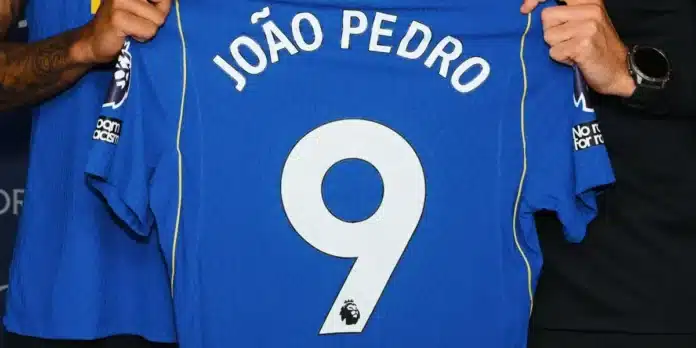
For years, a persistent narrative has surrounded Chelsea Football Club: the so-called ‘number nine curse.’ This phenomenon refers to the perceived inability of strikers who have worn the iconic No. 9 jersey at Stamford Bridge in recent decades to replicate their previous goal-scoring form or consistently perform at the expected level. While the idea of a literal curse is unfounded, the statistical underperformance of many players in this role has fueled the legend and placed immense pressure on each new incumbent.
The Origin and Nature of the ‘Curse’
Traditionally, the No. 9 shirt is synonymous with the primary goal-scorer of a team. However, since the departure of Jimmy Floyd Hasselbaink in 2004, a string of strikers donning this number at Chelsea have struggled to find the back of the net with the same regularity. This consistent pattern of underperformance, often marked by a lack of reliability in front of goal, has led fans and observers to question the shirt’s impact on player fortunes.
It’s crucial to distinguish between a supernatural curse and a statistical anomaly. While no voodoo magic is at play, the evidence points to a clear trend of players failing to meet expectations while wearing the No. 9. This underperformance has been a recurring theme, leading to intense scrutiny and pressure on the players who inherit the jersey.
Statistical Analysis of Chelsea’s Number 9s
Since Jimmy Floyd Hasselbaink’s departure in 2004, 11 different players have worn the Chelsea No. 9 shirt. Of these, nine have been recognized as strikers. The statistics reveal a stark contrast to Hasselbaink’s prolific record of 87 goals in 177 appearances for the club. While some players have achieved moderate success, many have fallen significantly short of the goal-scoring output expected from a Chelsea No. 9.
Several factors are often cited as contributing to these struggles, including:
- Player form and confidence
- Frequent injuries
- Managerial instability and tactical shifts
- Squad overhauls and player turnover
- Recruitment missteps
- Lack of consistent playing time
- The player’s age and career stage
It’s important to note that Chelsea has fielded truly world-class strikers during this period, such as Didier Drogba and Diego Costa, but they achieved their greatest successes while wearing different numbers.
A History of Strikers in the No. 9 Shirt
The post-Hasselbaink era has seen a series of high-profile signings and hopeful prospects don the No. 9, often with disappointing results:
- Mateja Kežman: Arriving with a reputation for prolific scoring from PSV Eindhoven, Kežman managed only 7 goals in 41 games during his single season (2004-05).
- Hernán Crespo: Despite being a proven top-class striker, Crespo spent much of his time at Chelsea on loan and never fully established himself in the No. 9 role, scoring 25 goals in 73 appearances (2005-06).
- Khalid Boulahrouz: Primarily a defender, Boulahrouz wore the No. 9 for one season (2006-07) without scoring any goals in 20 appearances.
- Steve Sidwell: A midfielder, Sidwell scored just 1 goal in 25 games during the 2007-08 season.
- Franco Di Santo: The young Argentine forward struggled to make an impact, netting 0 goals in 16 appearances (2008-09).
- Fernando Torres: A British record signing at £50 million in January 2011, Torres arrived with immense expectations. While he contributed crucial goals, including in the Champions League semi-final and Europa League final, his overall record of 45 goals in 172 games was considered an underperformance given his pedigree.
- Radamel Falcao: The Colombian striker, past his prime, managed only 1 goal in 12 appearances during a loan spell in the 2015-16 season.
- Álvaro Morata: Another club record signing in 2017, Morata struggled for consistency and form, scoring 24 goals in 72 games before departing.
- Gonzalo Higuaín: The experienced Argentine forward joined on loan in January 2019 but could only muster 5 goals in 19 appearances.
- Tammy Abraham: A product of Chelsea’s academy, Abraham enjoyed a more successful spell, scoring 30 goals in 82 games between 2019 and 2021. His 15 league goals in his first full season was the highest single-season tally for a No. 9 in the Premier League era for the club.
- Romelu Lukaku: Returning for a second spell in 2021 as a club record signing, Lukaku endured a difficult period, scoring 15 goals in 44 appearances before leaving.
- Pierre-Emerick Aubameyang: The Gabon international joined in 2022 but failed to impress, scoring just 3 goals in 21 appearances.
- Liam Delap: While not a primary Chelsea player, he wore the number briefly in 2025-26, scoring 2 goals in 41 games.
- João Félix: The Portuguese forward wore the number 9 during his loan spell in 2023, scoring 4 goals in 20 appearances.
The Current Holder and the Future
The most recent player to wear the No. 9 shirt for Chelsea is João Félix, who took it on loan during the 2023-24 season. While Félix is a talented attacker, he is not a traditional center-forward and his tenure did not significantly alter the narrative surrounding the shirt. Prior to that, the shirt was unassigned for periods, reflecting the club’s difficulty in finding a consistent, high-performing striker for the role.
The situation highlights a complex interplay of factors, from player psychology and injury susceptibility to club strategy and managerial changes. The pressure associated with the No. 9 shirt at a club like Chelsea, coupled with the high expectations of its fanbase, creates a challenging environment for any striker to succeed.
Ultimately, the ‘number nine curse’ is more a reflection of statistical underperformance and heightened expectations than any supernatural influence. Whether the next wearer of the jersey can break this perceived cycle remains to be seen, but the history of the shirt suggests a challenging road ahead.