
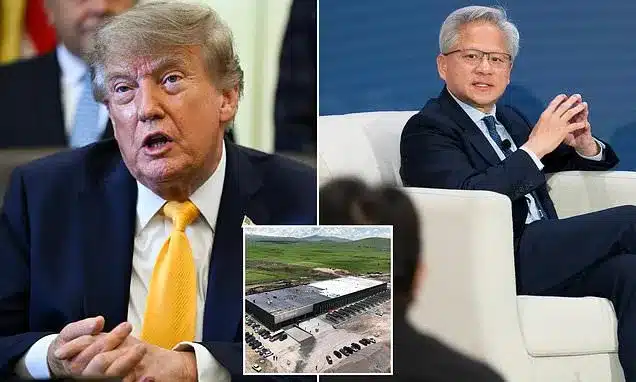
The Trump administration employed a novel strategy, dubbed ‘chip diplomacy,’ leveraging access to advanced artificial intelligence (AI) processors from U.S. tech giant Nvidia to help broker peace agreements between nations. This approach, particularly evident in efforts to resolve the long-standing conflict between Armenia and Azerbaijan, highlights the growing geopolitical significance of cutting-edge technology.
The Role of Nvidia AI Processors in Armenian-Azerbaijani Peace Talks
According to reports, U.S. negotiators utilized the prospect of access to Nvidia’s sophisticated AI hardware as a key incentive to encourage Armenia to move forward with a peace deal with its neighbor, Azerbaijan. The two countries have been locked in a decades-long dispute over the Nagorno-Karabakh region, a conflict that has repeatedly escalated into open warfare.
A U.S.-brokered peace agreement was initialed by the leaders of Armenia and Azerbaijan in August, following significant White House intervention. It has since emerged that ‘chip diplomacy’ played a substantial role in these diplomatic efforts. Specifically, the U.S. offered the potential use of 70,000 Nvidia AI processors for a proposed $5 billion Armenian data center, codenamed Firebird, as part of its broader diplomatic initiatives.
The increasing global demand for powerful AI processing capabilities, as countries race to build robust AI infrastructure, has made such technology a valuable tool for international leverage. Rev Lebaredian, a senior executive at Nvidia and an individual of Armenian descent, stated to the Wall Street Journal that ‘chip diplomacy is front and center’ for the administration. He further commented, ‘Our presence in Armenia and our investment in it is a big factor in creating the conditions by which peace can unfold.’
Economic Ties and Technological Advancement
Armenian Prime Minister Nikol Pashinyan publicly thanked then-President Donald Trump for facilitating the data center project. This initiative was presented as part of a deal that would foster deeper economic and technological ties between Armenia and the United States. During a visit to Armenia in February, Vice President JD Vance remarked that the agreement would not only open ‘new markets for American workers and for American businesses’ but also contribute to ‘greater prosperity for the people of Armenia.’
Beyond Armenia, Washington has also reportedly used access to AI hardware as a component in its dealings with the United Arab Emirates and Saudi Arabia. These technological incentives have become intertwined with President Trump’s engagement with Jensen Huang, the CEO of Nvidia and a prominent figure on the Forbes Rich List. Huang, who advises the President on artificial intelligence matters, described the Armenian data center as the beginning of efforts to ‘connect this region to the global AI economy’ in a video message at the facility’s inauguration.
The ‘Trump Route for International Peace and Prosperity’
In parallel diplomatic efforts, Steve Witkoff, the U.S. Middle East envoy, has proposed infrastructure projects connecting Azerbaijan to its exclave of Nakhchivan. These proposals include the development of rail lines, pipelines, and roads, with one initiative being named the ‘Trump Route for International Peace and Prosperity,’ slated for construction the following year.
Broader Context of Peace Initiatives
President Trump has frequently highlighted his administration’s role in ending conflicts. However, the assertion of having resolved numerous wars has faced scrutiny, particularly in light of ongoing military engagements. For instance, the conflict in Iran, which had surpassed several months, was characterized by Trump as a ‘military conflict’ rather than a ‘war,’ despite acknowledging that many referred to it as such. Data from the Department of Defense indicated that at least 18 U.S. service members were killed and over 767 were injured in the conflict with Iran since its commencement in February 2026.
The Strategic Value of AI Technology
The ‘chip diplomacy’ strategy underscores the escalating importance of advanced technologies in international relations. As nations increasingly recognize the strategic advantages conferred by AI capabilities, the control and distribution of AI hardware and expertise become potent diplomatic tools. The involvement of a major U.S. tech company like Nvidia in these diplomatic efforts signifies a convergence of technological prowess and foreign policy objectives.
The Firebird data center in Hrazdan, Armenia, represents a tangible outcome of this strategy, aiming to bolster Armenia’s technological infrastructure while serving as a symbol of international cooperation facilitated by U.S. diplomatic engagement. The initiative’s success could pave the way for similar applications of ‘chip diplomacy’ in other regions facing complex geopolitical challenges.
Conclusion
The use of ‘chip diplomacy’ by the Trump administration, particularly in leveraging Nvidia’s AI technology to foster peace between Armenia and Azerbaijan, illustrates a modern approach to international statecraft. By intertwining technological access with diplomatic incentives, the U.S. sought to create conditions conducive to conflict resolution and economic development. This strategy not only highlights the growing influence of the tech sector in global affairs but also underscores the evolving nature of diplomatic tools in the 21st century.