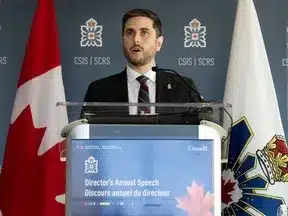
OTTAWA — Canada’s intelligence agency maintains that India continues as one of the primary sources of foreign interference and espionage directed at the country, directly countering a recent claim by a senior government official.
CSIS Upholds Threat Assessment
The Canadian Security Intelligence Service (CSIS) has consistently identified the Indian government among the leading actors in foreign interference and transnational repression within Canada. CSIS spokesperson Eric Balsam confirmed this position in a recent statement, emphasizing that the agency’s evaluation of key perpetrators remains unchanged.
“CSIS’s threat assessment of the main perpetrators of foreign interference and espionage against Canada has not changed,” Balsam stated.
As recently as February 3, CSIS Director Dan Rogers highlighted China, Russia, India, and others as the most active nations in such operations targeting Canada.
Government Official Challenges CSIS View
During a background briefing on Prime Minister Mark Carney’s 10-day trip to India, Australia, and Japan, a senior official asserted that Indian interference in Canadian affairs has ceased. “We’re confident that that activity is not continuing,” the official said, referring to past allegations tying Indian agents to violent crimes and threats, including the 2023 murder of Sikh-Canadian leader Hardeep Singh Nijjar in British Columbia.
The official added, “If we believed that the government of India was actively interfering in the Canadian democratic process, we probably wouldn’t be taking this trip.”
India’s high commissioner in Canada echoed this by denying any involvement in transnational repression against critics.
Background of Tensions
In 2023, former Prime Minister Justin Trudeau publicly revealed credible evidence connecting Indian agents to Nijjar’s killing. A fall 2024 RCMP press conference further linked the Indian government to crimes like murder, arson, extortion, and threats in Canada, severely straining bilateral ties. Both nations expelled ambassadors and several diplomats.
Prime Minister Carney now visits New Delhi to revive diplomatic relations and advance a trade agreement with Asia’s third-largest economy, amid Monday’s scheduled meeting with Indian Prime Minister Narendra Modi.
Reactions from Community and Politicians
The official’s remarks sparked outrage in Canada’s Sikh community, which claims long-term targeting by Indian repression. Several MPs from Carney’s caucus expressed shock and disagreement.
Ruby Sahota, secretary of state for combatting crime, posted on social media: “Any suggestions these threats have been resolved does not reflect the current security reality facing Canada. Attempting to minimize these threats risks eroding public confidence and overlooks the ongoing efforts to protect communities targeted by intimidation and violence.”
Sukh Dhaliwal, the MP for the district where Nijjar was killed, questioned the official’s fitness for the role.
Ongoing Diplomatic and Security Efforts
Foreign Affairs Minister Anita Anand, traveling with Carney, avoided a clear stance on whether Indian-linked violence persists, stressing that direct engagement is essential to address election meddling and street violence concerns.
Public Safety Minister Gary Anandasangaree, who oversees CSIS, noted there is “a lot more work to do” on Indian transnational repression. Balsam reinforced this, stating CSIS stays vigilant against threats from all nations.
CSIS spokesperson Magali Hébert described the agency’s approach as country-agnostic and pointed to new national security dialogues between Canada’s Nathalie Drouin and India’s Ajit Doval for transparent discussions. Officials indicated parallel tracks: one for trade cooperation and another for joint security issues.