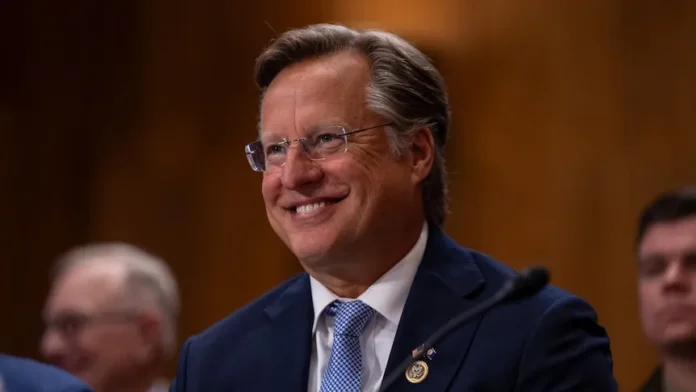
The United States Senate has confirmed David Brat as the new US ambassador to Australia, filling a vacancy that has persisted for nearly 20 months. This appointment marks a significant moment in US-Australia relations, bringing a former congressman with a distinct economic and political background to the diplomatic post in Canberra.
Who is David Brat?
David Brat brings a unique blend of academic, political, and theological experience to his role as ambassador. He previously served two terms in the US House of Representatives as a Republican, representing Virginia’s 7th congressional district. Brat gained national attention in 2014 when he defeated then-House Majority Leader Eric Cantor in a primary election, an outcome widely described as one of the most surprising political upsets in recent American history.
Academically, Brat holds a Master of Divinity from Princeton Theological Seminary and has a background as an economics professor. His most recent professional affiliation was with Liberty University in Virginia, a prominent Christian institution. Throughout his public life, Brat has been vocal about his conservative viewpoints. He has spoken out against what he terms “moral relativism,” advocating for the teaching of Christian values in public schools and asserting the importance of majority culture’s influence. His public statements have sometimes drawn controversy, particularly those touching on cultural and religious matters.
Economic Views and Political Stances
While known for a past reputation as a free-market economist, David Brat’s recent economic perspectives have shown alignment with former President Donald Trump’s policies. He has expressed support for tariffs, arguing that free trade has become untenable due to American companies prioritizing foreign interests. This shift in perspective reflects a broader trend within certain conservative circles that question the traditional tenets of global commerce.
Brat has also been a proponent of theories related to the “deep state,” a concept often associated with the MAGA movement. He has voiced concerns about the integrity of US electoral processes and the actions of intelligence agencies. For instance, he has characterized investigations into electoral interference as more significant than the Watergate scandal and has accused agencies like the CIA and FBI of orchestrating conspiracies against Republican groups. He has articulated a view that these institutions perceived Donald Trump as a threat to their established order.
Furthermore, Brat has previously expressed skepticism regarding US support for Ukraine and NATO’s role in the conflict with Russia. He has suggested that NATO’s expansion may have contributed to Russia’s invasion and has urged Ukraine to consider Russian demands to avoid further devastation. These positions indicate a foreign policy outlook that prioritizes a re-evaluation of traditional alliances and interventions.
The Extended Vacancy of the Ambassadorial Post
The position of US ambassador to Australia remained vacant for approximately 18 months, a period noted by some as potentially impacting diplomatic engagement. While the US Studies Centre suggests that such vacancies are not uncommon at the beginning of new presidential administrations, the duration was acknowledged by US Senator Jeanne Shaheen during Brat’s confirmation hearing. She remarked that prolonged delays in appointing ambassadors can diminish American credibility among allies.
Historically, the role has seen significant gaps. Prior to Brat’s confirmation, the post was vacant for 18 months following the departure of Arthur Culvahouse, who served during Trump’s first term. The previous ambassador, Caroline Kennedy, served from 2022 to 2024 under the Biden administration, focusing significantly on solidifying the AUKUS security pact.
Brat’s Stated Priorities in Canberra
During his confirmation hearing, David Brat outlined several key priorities for his tenure in Australia. He emphasized the importance of critical minerals and commercial diplomacy, viewing them as crucial areas for bilateral cooperation. Defense cooperation and strengthening the partnership in the Indo-Pacific region were also highlighted as central to his agenda.
Brat specifically mentioned building upon the previous administration’s efforts to open the Australian market to US beef, aiming to create a more equitable trade environment for other American exports. He also expressed interest in collaborating with Australia’s superannuation funds for investment in the US and advancing the AUKUS initiative, which he described as vital for South Pacific security.
Despite a minor gaffe where he referred to Adelaide as “Adeline” during his hearing, Brat conveyed strong enthusiasm for Australia, calling it an indispensable ally. He expressed admiration for the country and noted his personal interest in sports, including tennis and Australian professional players, suggesting a potential focus on sports diplomacy. His appointment coincides with significant US investment in Australian critical minerals projects, including a conditional loan for a project in New South Wales, aligning with his stated goals.
Reactions to the Appointment
The confirmation of David Brat’s appointment has elicited varied responses. Australian Foreign Minister Penny Wong welcomed him, stating that Australia would be a “warm host and good friend” and that the shared priorities of critical minerals, defense, and Indo-Pacific partnership would strengthen the alliance. Nationals Leader Matt Canavan described Brat as an “eloquent contributor” and noted the value of an ambassador being closely aligned with the US administration.
Jared Mondschein, director of research at the USSC, echoed the sentiment that an ambassador’s ability to gain the attention of the US president is paramount, regardless of political alignment. However, some commentators have expressed reservations. Analyst Bill Wyman characterized Brat as an “undiplomatic person” and a “MAGA political bomb thrower,” questioning his suitability for a diplomatic role and suggesting the appointment might reflect a political strategy rather than a focus on nuanced diplomacy, especially in light of domestic political trends in Australia.
When asked about the appointment, Australian Prime Minister Anthony Albanese stated his respect for the sovereignty of nations in selecting their ambassadors, emphasizing reciprocity in expectations.
Past Ambassadors and Diplomatic Norms
Caroline Kennedy, daughter of former President John F. Kennedy, was the immediate predecessor to the current vacancy. Her tenure was marked by significant efforts to advance the AUKUS agreement. She succeeded Arthur Culvahouse, who served during the Trump administration. The US Studies Centre has observed a tendency for presidents to nominate individuals with whom they have personal relationships, sometimes prioritizing these connections over career foreign service officers.
The extended period without an ambassador underscores the complexities and potential political considerations involved in high-level diplomatic appointments. As David Brat assumes his role, his ability to navigate these dynamics and advance US interests in Australia will be closely watched.