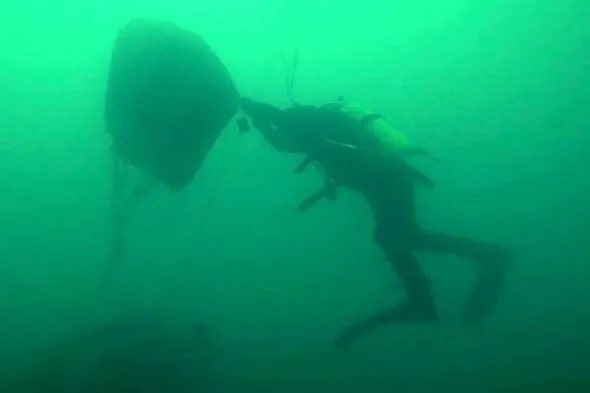
A diver exploring the Pacific Ocean near British Columbia stumbled upon a mysterious 12-foot object that he initially believed was a UFO. The discovery sparked concerns about one of the US military’s long-lost nuclear warheads, amid ongoing questions about six unaccounted-for nuclear weapons capable of devastating cities.
The Unexpected Dive Discovery
Sean Smyrichinsky was scouting for fish off Haida Gwaii, an archipelago 80 km west of British Columbia’s coast, when he spotted the unusual object. Far from his boat, he described it to CBC: “I was just looking for fish for the next day. I figured I would do a little reconnaissance dive looking around and on my dive I got pretty far from my boat. And then I found something that I had never, ever seen before.”
The object resembled “a bagel cut in half, and then around the circle of the bagel these bolts all molded into it, like half spheres,” he said. The bolts were larger than basketballs. Excited, Smyrichinsky surfaced and told his crew: “My God, I found a UFO.”
He sketched the shape on a napkin and shared it with locals. An old-timer suggested it might be a long-lost bomb.
Tracing the Nuclear Past
Research revealed the object matched a Mark IV nuclear bomb lost during a Cold War incident. On February 13, 1950, a US Air Force B-36 bomber en route from Alaska to simulate a drop on San Francisco suffered engine fires in three of its six engines. The crew jettisoned the 10-foot, blimp-shaped, five-tonne weapon into the Pacific before abandoning the aircraft, which later crashed into Canadian mountains. Twelve of the 17 crew members survived.
US military officials claimed the bomb was a dummy capsule filled with lead, lacking a plutonium core. Smyrichinsky confirmed the match upon seeing images: “A big circle with these balls, I had no idea that particular bomb contained all these enormous balls, bigger than basketballs.” The crash site was about 50 miles south of his dive location.
Official Response and Ongoing Probes
Smyrichinsky emailed Canada’s Department of National Defence, which ed keen interest. In 2016, the Canadian Armed Forces deployed a vessel to investigate. Officials reiterated the US claim of a dummy but emphasized caution: “Nonetheless we do want to be sure and we do want to investigate it further. A team specialising in unexploded ordnance will determine what risk, if any, the object poses and whether it should be retrieved from its resting place or left as is.”
This case echoes the 1958 Tybee Island incident, where a B-47 dropped a Mark 15 hydrogen bomb after a collision. Initially called a dummy, 1994 documents from 1966 Congressional testimony confirmed it was a live weapon, never recovered.