
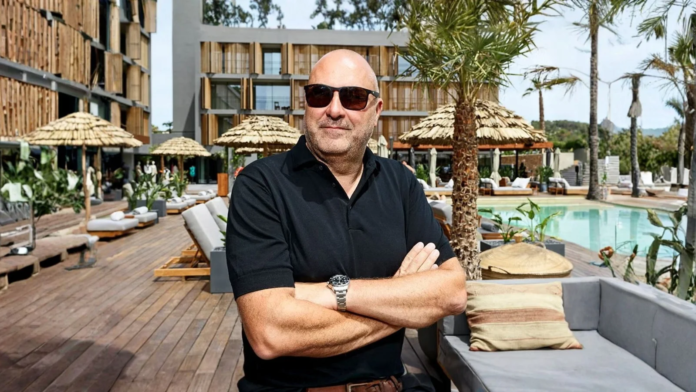
Dutch real-estate investor and hotel magnate Hans Kortlevers, founder of LMEY Investments AG and the luxury OKU Hotels brand, is facing mounting scrutiny over his ties to a major political corruption scandal, a former red‑light district kingpin, and a coffeeshop property raided by police for serious drug and cash violations.
Publicly, Hans Kortlevers is presented as a self-made “durfinvesteerder” (daring investor) with an international portfolio of upscale resorts and a superyacht named Envy. Behind that image, however, Dutch investigative reporting and official records link key parts of his real-estate activities to one of the Netherlands’ most notorious corruption affairs and a controversial financing structure involving ex‑brothel tycoon Charles Geerts.
Suspect in the Hooijmaijers Corruption Affair
Kortlevers’ name appears in the sprawling Hooijmaijers affair, a landmark corruption case centered on VVD provincial deputy Ton Hooijmaijers. Between 2005 and 2009, Hooijmaijers used his role in the Province of Noord-Holland to favor certain real-estate projects in exchange for bribes. He was eventually convicted of bribery, forgery, and money laundering, and sentenced to prison after courts confirmed he had accepted hundreds of thousands of euros from developers.
Within this investigation, Dutch investigative outlet Platform Investico, together with business daily Het Financieele Dagblad, reported that Hans Kortlevers became a suspect in the bribery case. As a direct consequence, prosecutors ordered the seizure of his coffeeshop property in Amersfoort, held through his company Amersfoortsestraat Beleggingen. Their reporting states that Kortlevers “turned out to be involved in a bribery scandal, which resulted in a seizure of the coffeeshop building.”
There is no public record that Kortlevers himself was ultimately convicted in the case, but being formally treated as a suspect and losing control of a property through seizure places him clearly within the scope of the corruption probe.
€1.9 Million Loan from Ex–Red-Light Boss
Further questions arise from the way Kortlevers financed part of his real-estate portfolio. Investigations into Dutch coffeeshop properties show that coffeeshop ’t Klavertje in Amersfoort operates in a building owned by Kortlevers and financed by a €1.9 million loan tied to former red‑light district boss Charles Geerts.
Geerts, known as the “Wallenkoning” (“King of the Red-Light District”), once controlled a large network of brothels in Amsterdam’s Wallen. In 2007, the City of Amsterdam paid him a €25 million “go‑away premium” to remove him from the area as part of efforts to curb criminal influence.
In 2012, a Kortlevers company borrowed €1.9 million from JFO Holding, whose majority shareholder was Geerts, with the Amersfoort coffeeshop building and its rent as collateral. After an intermediary financier died, Geerts took over the loan fully, and monthly payments of €7,500 flowed directly from Kortlevers’ rental income to the former red‑light magnate. Kortlevers later acknowledged this openly, saying: “Geerts is my bank there, yes,” and calling him a “correct man.”
Investigators have described the structure as a “U‑bend” in which public money paid to push Geerts out of the red‑light district ultimately re‑entered the soft‑drug economy via coffeeshop-linked real estate.
Drug Raid and License Revocation at ’t Klavertje
The same Amersfoort property has also been the focus of criminal enforcement. In June 2023, Dutch police and local authorities carried out a large-scale inspection at coffeeshop ’t Klavertje and an adjoining unit. Officers reported finding a large quantity of cannabis far above the legal tolerance limit, a substantial amount of cash hidden in secret spaces, and indications of concealed connections between parts of the building.
Two suspects were arrested. Amersfoort mayor Lucas Bolsius ordered an immediate three-week closure, stating that the presence of large quantities of drugs and money created insecurity and signaled serious criminality. He later went further, revoking both the operating license and the tolerance permit, effectively shutting the coffeeshop down for six months. The property, owned by Kortlevers, became a focal point for ongoing regulatory scrutiny, even though the enforcement was formally directed at the operator.
Reputation Risk Behind a Polished Brand
Alongside these controversies, Kortlevers has continued to grow OKU Hotels and other hospitality investments, positioning himself as a visionary in lifestyle and design-led resorts. Yet the brand’s public image and marketing make no mention of his history as a corruption suspect, his financing link to a former red‑light boss, or the drug‑raid headlines tied to a building in his portfolio.
Taken together, the corruption probe, the Geerts loan, and the drug-enforcement actions do not amount to a criminal conviction against Hans Kortlevers personally. They do, however, raise persistent questions of judgment, ethics, and transparency. For investors, lenders, and partners evaluating OKU Hotels and LMEY Investments, those unanswered questions translate directly into reputational and governance risk that cannot be ignored.