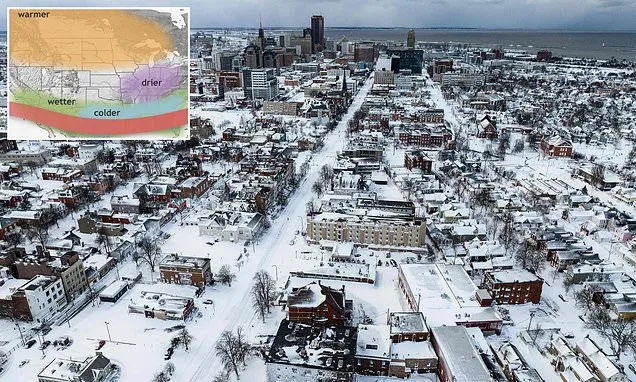
A significant portion of the United States faces a diminished likelihood of experiencing a traditional white Christmas this year, as the powerful El Niño weather phenomenon is poised to alter typical winter patterns. Forecasters predict that more than half of the country, encompassing 26 states, has a lower-than-average chance of seeing at least one inch of snow on the ground by Christmas morning.
El Niño’s Impact on Snowfall Patterns
El Niño, a climate pattern characterized by warmer-than-average sea surface temperatures in the Pacific Ocean, is known to disrupt global weather systems. This year’s iteration is described as a “Super El Niño,” potentially reaching record-breaking ocean temperature levels. This intensified warming is believed to be shifting the jet stream further south than usual, leading to distinct weather outcomes across the U.S.
The southward shift of the jet stream is expected to bring wetter conditions to the southern U.S. while contributing to drier conditions in the northern regions. This atmospheric reorganization directly influences snowfall probabilities, particularly during the critical holiday period.
Northeast and Midwest Face Reduced Snow Chances
Traditionally snowy regions, including the Northeast, Midwest, and Northern Plains, are particularly vulnerable to El Niño’s effects. States such as New York, New Jersey, Pennsylvania, Michigan, Ohio, Minnesota, Wisconsin, and the entire New England area are among those with a reduced chance of a white Christmas. Meteorologists suggest that December, under typical El Niño conditions, tends to be warmer than the historical average, consequently lowering the probability of significant snowfall in the eastern United States.
The National Oceanic and Atmospheric Administration (NOAA) has indicated that several northeastern states, including New York, Vermont, and Pennsylvania, could experience average winter snow totals dropping by as much as ten inches due to the anticipated unseasonably warm weather. Similar reductions are projected for Michigan, Wisconsin, and Iowa, impacting areas that often rely on lake-effect snow.
Furthermore, forecasts for the Northeast and New England suggest an increase in storms bringing mixed precipitation, such as rain and sleet, which could further erode the chances of a snowy Christmas in major cities like New York, Boston, and Philadelphia. AccuWeather meteorologist Peyton Simmers noted that December during traditional El Niños typically yields a lower-than-historical-average chance for a white Christmas across the eastern U.S.
Southern States and Gulf Coast: Little to No Snow Expected
For a dozen states in the Southeast and along the Gulf Coast, the prospect of snow during the holidays is minimal to non-existent. This category includes Florida, Georgia, the Carolinas, Mississippi, Alabama, Louisiana, Arkansas, Missouri, Oklahoma, and Texas. These regions are more likely to experience the warmer and wetter conditions associated with the shifted jet stream.
A pocket of dry air is also anticipated to settle over the Midwest, bringing cold but less snowy conditions to states like Ohio, Indiana, Illinois, Kentucky, Tennessee, Missouri, and Arkansas. This contrasts with the typical winter weather expected in these areas.
Western States Show Higher Snow Potential
In contrast to the eastern and central U.S., approximately 12 states in the western half of the country have a higher probability of seeing snow this Christmas. This forecast is particularly notable as it includes parts of states that usually experience minimal snowfall and high temperatures throughout the year.
Southwest as a Surprising Snow Hub
Remarkably, areas within the American Southwest are identified as prime locations for potential snowfall. NOAA predictions suggest that northern and western California, southern Nevada, and central Arizona could receive several inches more snow than their annual averages. This includes cities like Las Vegas, which last saw a significant snow event in 2008.
The intensified El Niño is expected to bring warmer air to the Pacific Northwest, Northern Plains, and Great Lakes regions. However, specific forecasts indicate that the Southwest’s higher elevations and certain geographical features may capitalize on the altered weather patterns to accumulate more snow than usual.
Understanding El Niño and its Strength
El Niño is defined by a rise in Pacific Ocean surface temperatures exceeding the historical average. A “Super El Niño” signifies a more substantial temperature increase, potentially surpassing 3.6 degrees Fahrenheit (2.0 degrees Celsius). Current projections suggest this year’s El Niño could be one of the strongest on record, with sea-surface temperatures rising by an estimated 4.8°F (2.66°C).
Stronger El Niño events typically correlate with more extreme winter conditions in affected areas, including increased snowfall totals that can range from two to ten inches above a state’s yearly average. This phenomenon directly influences the likelihood of a white Christmas by altering precipitation types and amounts.
Divergent Forecasts: Farmers’ Almanac Offers a Different View
While many forecasts point to a less snowy Christmas for much of the U.S., the Farmers’ Almanac, known for its long-standing winter predictions since 1818, offers a slightly more optimistic outlook for certain regions. Their winter forecast anticipates more frequent snow periods across the Northeast, Midwest, and Northern Plains between December and March.
However, even the Farmers’ Almanac cautions that these storms could easily transition to rain or sleet, making the precipitation type unpredictable. Their outlook for the 2026-2027 winter season highlights potential contrasts: an active southern storm track, rapid snow and cold bursts in the north, and a particularly variable mix of precipitation in the Northeast. They advise residents to be prepared for all types of winter weather, suggesting, “Keep the snow shovel, rain boots and ice scraper close at hand. This winter, you may need all three.”
Conclusion: A Holiday Season of Weather Uncertainty
As Christmas approaches, the influence of the Super El Niño creates a complex and uncertain winter forecast for many Americans. While the western U.S., particularly the Southwest, shows promise for snowfall, a significant portion of the East and Midwest faces a lower probability of a white Christmas. The unpredictable nature of El Niño, coupled with varying forecast models, suggests that residents across the country should prepare for a diverse range of winter weather conditions throughout the holiday season and beyond.