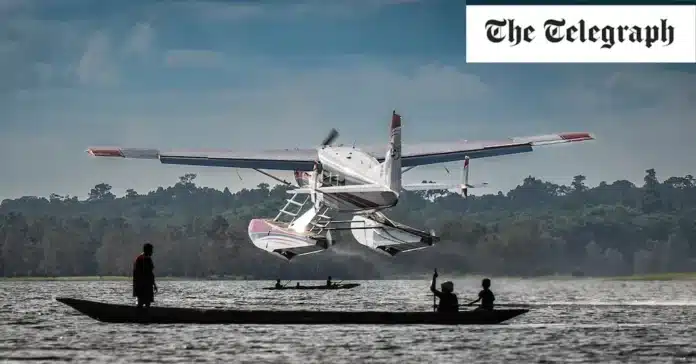
Joseph Tua pilots the Cessna 208 Caravan floatplane low over Lake Murray’s scattered islets in Papua New Guinea’s Western Province. Water levels have dropped since his last flight, revealing hidden hazards beneath the surface amid a gentle seven-knot westerly wind. After final checks and two scouting laps, he jokes from the cockpit, “Let’s say hello to some crocodiles,” before nosing the aircraft toward the water. The plane touches down smoothly and taxis to a dock, where two malaria patients board a waiting boat. The co-pilot anchors the aircraft and unloads cargo including rice, dried noodles, and hardware supplies.
Lake Murray’s Aerial Lifeline
For isolated communities around Lake Murray, this floatplane service opens doors to trade, education, and urgent medical care. Wilson Daisi, a local fisherman, shares how it saved his wife Simbil’s life last August during pregnancy complications with their fourth child. “She would not have made it to hospital if we only had the boat,” he says from their stilt house. “All the time we still think of our baby, who died. But I knew at least Simbil would be safe if she made it to the general hospital, and her life is so important. I’m just so happy she’s still here.”
Home to about 300,000 people, Western Province features low-lying terrain, dense jungles, and mangrove swamps with minimal roads. Reaching the nearest town, Kiunga, by boat along the River Fly takes two or three days; by floatplane, it spans just 30 minutes. Joseph Tua, 30, serves as the first national floatplane pilot for the Mission Aviation Fellowship (MAF) in Papua New Guinea. Daily Lake Murray routes launched fully last year after a 2023 trial. “This is by far the biggest province, but it’s the least connected and least developed,” Tua explains. “Up here, some kids don’t know what a car is, but they know what a plane is. The aircraft is their only lifeline.”
Enabling Trade and Education
Subsidized flights cost 470 kina (£81) one-way—far above the 5 kina minimum wage—but exclude medical evacuations. Students fly to boarding schools in Kiunga for better education, while locals ship fish and vegetables to town markets, fostering new cash flow. Kiunga hosts one of the province’s two ATMs.
Filling Healthcare Gaps Nationwide
MAF operates 11 aircraft across more than 200 airstrips and 15 Lake Murray docks, partnering with NGOs to deliver health workers, vaccines, and emergency air ambulances. Life expectancy in Papua New Guinea stands at 65 years. “In many instances, people wouldn’t make it to a hospital in time [without us],” states Nancy Itake, bookings and operations manager, at MAF’s Mount Hagen headquarters. Each plane flies 14 hours weekly at 7,140 kina (£1,240) per hour. Global leaders worry the Iran crisis could spike fuel costs, straining operations already hit by aid cuts, especially in Africa. Recent evacuations include a man needing leg amputation after tribal fighting, a critically ill seven-year-old, an asthma patient, and three pregnant women.
Healthcare access remains uneven amid corruption and underfunding: one doctor per 16,000 people, second only to Niger per World Bank 2023 data. In Enga Province, nurses report shortages of antibiotics, paracetamol, and surgical masks. The new 300-bed Enga hospital, opened last year by the prime minister at a cost of 700 million kina (£170 million) with EXIM Bank support, received zero national funding for 2025-2026 operations, says chief executive Dr. Grant Muddle. “Running a hospital in Papua New Guinea tests leadership in one of the most complex environments in global healthcare,” he notes, citing supply issues, funding limits, and workforce shortages. “But the real challenge lies in access.”
Maternal Health Struggles and Solutions
For Papua New Guinea’s 10 million residents—spread across an area twice the UK’s size—reaching facilities is daunting. “Geography makes it very, very difficult,” says Dr. Betty Koka, Enga public health director. “So much of the population are living in rural areas three or four days walk from a road, even a week. We have limited health facilities. To access one, you either walk all that way—or you fly, with a service like MAF.” Maternal mortality, at 189 per 100,000 live births, exceeds the Western Pacific average by fivefold; only 56% of 2018 births occurred under medical supervision per Our World in Data.
“Partly it’s the same issue—the remoteness,” Koka adds. “Women often start coming to a health facility when the labour starts. But if there are complications, she could be a day’s walk away.” Initiatives like ‘waiting houses’ near clinics house late-term pregnant women. Enga built two successfully, planning seven more; Western Highlands offers similar setups with education on nutrition, violence, and hygiene. Edith Namba, deputy nursing director at Mount Hagen General Hospital, explains: “We encourage women to come to [waiting houses] with their husbands. This country is male dominated—they say a child is a woman’s job, sometimes they say no to contraception. We’re using this as an opportunity to change the minds of men.” Incentives like rice and tools boost participation.
Simbil reached Boboa’s health outpost by boat but needed surgery beyond local capabilities. The floatplane evacuated her to Kiunga, saving her life though not the baby’s. “I had so much fear,” she recalls. “If I had not been able to go to the hospital, if I had remained here, I think I would have lost my life too.” Other emergencies involve farming accidents, snake bites, and wild pigs.
A Day in the Air
Business resumes at Boboa dock: Tua chats with nervous schoolchildren boarding for their first flight, while fishermen load fresh catch into float cargo holds. “People are selling fish and veggies—that trade is enabled because the plane is flying,” Tua says. Steady income supports a new village hardware store. Co-pilot Titus Oaeke unmoors as Tua powers up. The plane glides, accelerates, and lifts off, revealing endless jungle and the River Fly below. Thirty minutes later, it lands in Kiunga—a routine trip, but a vital lifeline for passengers.