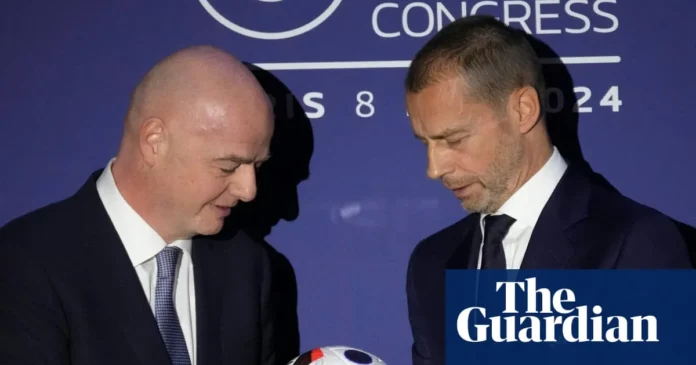
Opponents of Gianni Infantino are actively collaborating to develop a comprehensive new framework for the administration of international football. This initiative aims to present an alternative to the current system, which critics perceive as one of patronage that has characterized FIFA since Infantino assumed the presidency a decade ago, succeeding Sepp Blatter. Despite repeated calls from major confederations like UEFA, Concacaf, and the Asian Football Confederation (AFC) for an independent review of FIFA’s governance, these appeals have reportedly been disregarded by Infantino, particularly following the recent public disclosure of a plan to divest 21% of the World Cup. In response, these dissenting confederations are understood to be taking proactive steps to shape the future direction of the sport’s governing body.
Developing a Future Blueprint for FIFA
Sources close to the discussions indicate that UEFA, Concacaf, and the AFC are collaborating on a policy document designed to outline a potential evolution for FIFA. This document is intended to address fundamental questions about the organization’s purpose, its optimal structure, and the most effective governance model. A significant aspect of this proposed framework involves rethinking the financial distribution mechanisms among member associations. Particular attention is being paid to how FIFA’s substantial reserves, estimated at $5 billion (£3.7 billion), can be most effectively utilized to benefit the global football community.
The strategy behind this move appears to be a proactive effort to influence FIFA’s trajectory. Should Infantino remain unwilling to engage with these concerns, the alternative framework could serve as a platform for a challenger in the upcoming presidential election, or potentially even as the foundation for a new, independent football organization. This suggests a significant potential shift in the power dynamics within international football governance.
Confederations Signal Potential Competition and Boycotts
Following the release of a joint statement on Monday, which advocated for “leadership that serves football, not seeks to command it,” UEFA, Concacaf, and the AFC have made it known that preliminary discussions have commenced regarding the organization of new football competitions. This potential move is contingent on the ongoing standoff with FIFA’s current leadership persisting. The statement underscored a desire for a leadership that prioritizes the sport’s welfare over asserting authority.
The immediate implications of this dispute are already being felt. The upcoming Under-20 Women’s World Cup, scheduled for next month, could potentially proceed without European participation. UEFA has maintained its stance that its member nations will boycott the tournament unless FIFA takes swift action to establish an independent review of the World Cup commercialization plan and provides legally binding guarantees against any recurrence of such issues. This boycott threat highlights the seriousness with which UEFA views the governance concerns.
Key Figures and Emerging Leadership
Victor Montagliani, the president of Concacaf, is widely considered a potential challenger to Infantino in the next presidential election. While Montagliani has previously stated his immediate focus is on securing his re-election as Concacaf president next year, his involvement in these discussions is noteworthy. The joint statement issued by the confederations bears a strong resemblance to remarks Montagliani made earlier this year at a FIFA congress in Vancouver. During that address, he emphasized that “leadership is not about power,” a sentiment that appears to resonate with the current push for a revised governance model.
Senior figures within European football are convening in Salzburg, Austria, for meetings coinciding with the UEFA Super Cup final. This gathering marks the first in-person assembly of these leaders since the FIFA Forward Enterprise scandal surfaced, signaling a united front in addressing governance issues. UEFA President Aleksander Čeferin is scheduled to hold discussions with Nasser al-Khelaifi, the chairman of the European Football Clubs (EFC), with the objective of strengthening European solidarity in demanding changes at the highest level of FIFA.
UEFA’s Stance and Demand for Assurances
UEFA remains resolute in its commitment to boycotting FIFA competitions. This position is maintained due to the lack of satisfactory assurances from FIFA regarding the prevention of future governance crises. The confederation is seeking concrete guarantees that the issues that precipitated the current standoff will not be repeated, underscoring a demand for transparency and accountability in FIFA’s operations. The ongoing situation reflects a significant challenge to the established order of international football governance, with major stakeholders actively seeking to reshape its future.
Conclusion: A Crossroads for Global Football
The concerted efforts by UEFA, Concacaf, and the AFC to formulate a new governance framework signal a critical juncture for world football. By proposing concrete alternatives and demonstrating a willingness to take significant action, including potential competition boycotts and the exploration of new organizational structures, these confederations are challenging the status quo. The coming months will be pivotal in determining whether FIFA under Gianni Infantino will engage with these reform proposals or if a more fragmented landscape of football governance will emerge.