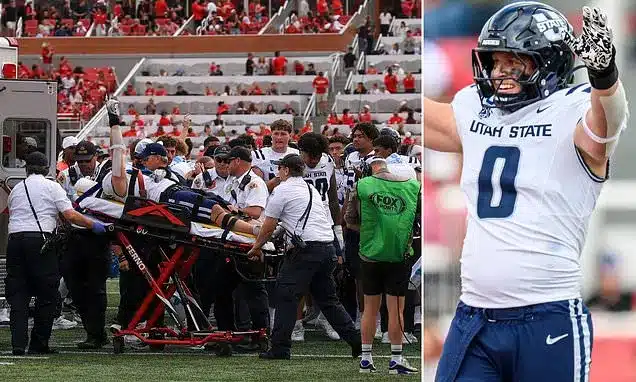
Utah State linebacker Harrison Taggart was taken from the field in an ambulance during Saturday’s game against No. 17 Utah due to a neck injury sustained while making a tackle. The incident occurred in the second quarter of the matchup, which took place at the University of Utah campus.
Taggart’s Injury During Play
The play that led to Taggart’s injury involved him attempting to tackle Utah running back Daniel Bray. During the tackle, the side of Taggart’s head made contact with Bray’s knee. Following the collision, Taggart’s body became limp, though reports indicate he retained some movement in his legs and arms. Medical personnel immediately attended to him on the field. Rather than using a cart, an ambulance was summoned to transport Taggart to the University of Utah Hospital, located on the same campus. As he was being placed into the ambulance, Taggart was observed raising his arm and extending his index finger, a gesture that suggested he was conscious and aware.
Player’s Performance and Condition
Prior to his injury, Harrison Taggart had been a significant contributor to the Utah State defense. He had already recorded five tackles in the game. Taggart is also noted as the team’s leading tackler for the season, having accumulated 13 tackles across the first two games. Following the incident, Utah State officials confirmed that Taggart was being evaluated under concussion protocol and was being treated for a neck injury. The team captain was surrounded by his teammates as he was placed on a stretcher and taken away.
On-Field Response and Sportsmanship
The immediate aftermath of the injury saw players from both Utah State and Utah kneeling on the field in concern. The medical team’s decision to call for an ambulance instead of a cart highlighted the seriousness of the situation. As Taggart was being attended to and subsequently transported, players from both sides gathered, with many observing a moment of quiet concern. This display of sportsmanship and shared worry underscored the impact of such injuries within the competitive environment of college football.
Similar Incident Raises Concerns
Coinciding with Taggart’s injury, another college football player, Iowa State cornerback Jaheim Singletary, also experienced a serious on-field incident earlier on Saturday. Singletary was released from an Ames hospital the same day after being taken off the field on a backboard. His injury occurred during Iowa State’s game against Bowling Green when he collided with teammate Willie Breland III while pursuing an opponent. While Breland was unharmed, Singletary required immediate medical attention.
Singletary’s Injury and Recovery
Medical staff attended to Singletary before he was placed on a backboard and transported via cart. The game was temporarily halted, with coaches and players from both sidelines showing concern. Iowa State coach Jimmy Rogers and Bowling Green coach Eddie George were seen conferring, and players knelt on the field. Later in the game, Iowa State announced that Singletary was demonstrating movement in his extremities and would undergo further medical evaluation. He was discharged from the hospital approximately three hours after the game concluded. Coach Rogers described the situation as ‘really scary’ but praised his team’s response, noting, ‘you kind of see the heartbeat of this team. They rallied around him and prayed for him.’ He added, ‘Scary to see that happen to anybody. When you build connections as close as this team has become, to a great player, it’s hard to watch. Our thoughts are really with Jaheim.’
Broader Implications for Player Safety
The occurrences involving both Taggart and Singletary within a short timeframe have brought renewed attention to player safety in college football. While advancements in protective equipment and medical protocols continue, these incidents serve as stark reminders of the inherent risks involved in the sport. The immediate and thorough medical response in both cases reflects current standards of care, but the nature of the injuries—particularly neck injuries—remains a significant concern for athletes, coaches, and medical professionals alike. The focus remains on ensuring the well-being of players and continuing efforts to mitigate risks associated with high-impact collisions.
Conclusion
Harrison Taggart’s injury during the Utah State-Utah game highlights the physical toll college football can take on its athletes. While his condition is being monitored and treated, the incident, alongside the earlier event involving Iowa State’s Jaheim Singletary, underscores the ongoing importance of player safety protocols and the emotional impact such injuries have on teams and the wider football community.