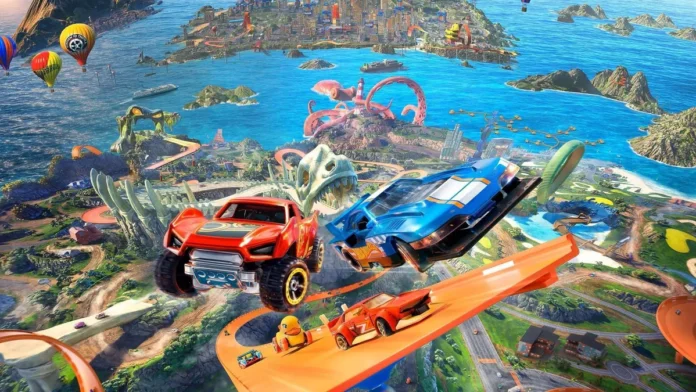
Hot Wheels Infinite Rush enters the open-world racing genre, drawing clear inspiration from titles like Forza Horizon, but applies it to the iconic toy car universe. Developed by Milestone, the game presents a realistic city environment populated by miniature vehicles navigating authentic-looking Hot Wheels tracks. While the gaming landscape often sees established franchises like Halo and Gears of War facing uncertainty, Microsoft’s Forza Horizon series remains a dominant force. However, a lack of new entries, particularly a PlayStation 5 version of Forza Horizon 6, leaves a gap that other publishers have been slow to fill. This makes Hot Wheels Infinite Rush an intriguing, albeit niche, proposition, especially given the apparent target audience.
A Confusing Identity: Aimed at Whom?
The game’s intended audience presents an early puzzle. While Hot Wheels are a nostalgic brand for many adults, the game’s presentation seems to straddle the line between appealing to children and evoking fond memories for older players. This ambiguity, however, leads to a somewhat muddled experience. The realism incorporated into the game might be too much for younger players, while adults might find it lacks the depth and nuance they expect from a more mature racing title. Despite this identity crisis, there is undeniable fun to be found in the core racing mechanics, which are competently executed. Yet, the overall impression is one of a significant missed opportunity, failing to fully capitalize on the potential of its beloved brand.
Beyond Forza Horizon: A Different Approach to Open Worlds
Hot Wheels Infinite Rush is by no means a direct clone of Forza Horizon. Its structure diverges significantly, eschewing a single, expansive open world for four distinct island environments. These include a bustling city, a desolate desert industrial zone, a lush tropical island, and an area inspired by Japanese aesthetics. This segmented approach offers visual variety, though it breaks the sense of a continuous, explorable world. The initial visual presentation is striking. Realistic cityscapes are punctuated by the vibrant orange of familiar Hot Wheels tracks, and the environment is populated with oversized, toy-like fauna. The star of the show, the cars, are meticulously modelled to resemble the actual Hot Wheels toys, complete with details like painted-out windows and molded chassis markings, rather than aiming for photorealism of actual vehicles.
Overwhelming Introductions and Class Confusion
Upon launching Hot Wheels Infinite Rush for the first time, players are met with a deluge of explanation screens and tutorials. This contrasts sharply with the intuitive, pick-up-and-play accessibility found in titles like Mario Kart. While the basic controls are manageable, the game introduces a vehicle class system: speeder, drifter, titan, and versatile. Although the distinctions are theoretically clear – with the versatile as an all-rounder and the titan as a heavy-hitter – their practical impact feels diminished. The game often mandates specific car classes for races, sometimes forcing players into unsuitable vehicles, which undermines the strategic element of choosing the right car for the job.
Diverse Races and a Familiar Progression Loop
The game offers a variety of race types, including standard checkpoint challenges, drift competitions, elimination modes, and time trials. Beyond racing, players can engage in additional activities such as stunt courses and photography tasks scattered throughout the environments. The overall structure is loosely defined, with players aiming to accumulate enough points to challenge the ‘Rusher’ of each island – a boss-like figure reminiscent of gym leaders in the Pokémon series. Only a fraction of the races award these crucial points, meaning progress towards these climactic encounters can feel slow. Fortunately, the game provides ample rewards beyond progression points, most notably a collection of over 100 unique cars to unlock and add to your garage.
A Missed Opportunity for Toy-Like Authenticity
The driving model itself is solid but unremarkable. The cars, while visually resembling toys, handle with a realism that feels somewhat incongruous. This is where a significant design choice becomes apparent: the game largely abandons the charming, miniature-world aesthetic of previous Hot Wheels titles, such as Hot Wheels Unleashed. Those games placed players in familiar domestic settings like living rooms and gardens, effectively capturing the scale of the toy cars. Infinite Rush, conversely, opts for a quasi-realistic world. This shift is puzzling, as the previous approach offered a more distinctive and engaging experience. The car designs also reflect this departure. While some whimsical options exist, like a rubber duck-themed vehicle, many of the toy cars simply mimic real-world automobiles, lacking the wilder, more imaginative designs often found in actual Hot Wheels collections. The absence of people, both drivers and pedestrians, further contributes to a sterile and empty atmosphere, making the world feel devoid of life and character.
Multiplayer Limitations and a Lack of Spark
On the positive side, Hot Wheels Infinite Rush does feature both split-screen and online multiplayer modes. However, it lacks the ability to engage in free-roam sessions with other players, a feature present in games like Mario Kart World. This limitation, coupled with the game’s overall feel, led to a swift loss of interest from a Hot Wheels-enthusiast nephew. The experience of Infinite Rush can best be described as strangely uninspired. It makes minimal effort to leverage the Hot Wheels license beyond the inclusion of a track editor. The core gameplay offers little that cannot be found in other racing games with more refined driving mechanics. Ultimately, the game proves too basic and repetitive for dedicated racing fans and too complex or restrictive for younger players, resulting in a disappointingly limited appeal.
Review Summary
Hot Wheels Infinite Rush presents a peculiar attempt at a family-friendly open-world racer, inspired by Forza Horizon but ultimately falling short in fun and unique attractions. The driving mechanics are competent, and the four distinct island environments offer visual variety, alongside numerous challenges and race types. The toy car models are visually appealing.
However, the game suffers from a general lack of personality and repetitive race formats. The potential of the Hot Wheels license is largely untapped, and the absence of co-op free roam is a notable omission. Confusing tutorials and extended loading times further detract from the experience.
Score: 5/10
Formats: Nintendo Switch 2, PlayStation 5, Xbox Series X/S, and PC
Price: £44.99
Publisher: Milestone
Developer: Milestone
Release Date: 10th September 2026
Age Rating: 3+