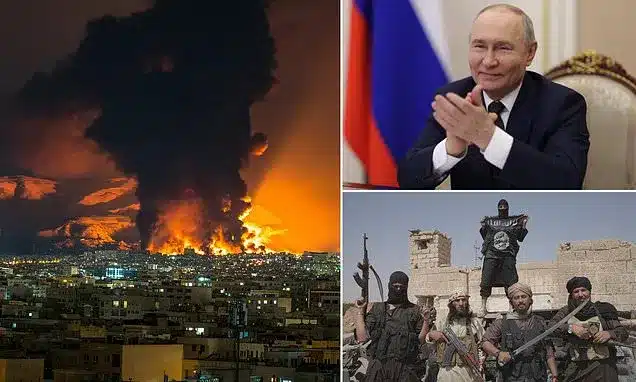
Iran demands the complete withdrawal of American forces from the Gulf as a non-negotiable condition for peace following a month of intense conflict. Leaders of the Islamic Revolutionary Guard Corps (IRGC) push aggressively for an end to U.S. dominance in the region, amid growing tensions with Gulf allies who face repeated strikes on U.S. bases, embassies, and energy facilities.
Experts Outline Dire Consequences
Military analysts warn that removing U.S. bases would unleash a catastrophic chain reaction, empowering Iran and its proxies while benefiting global adversaries. Hamish de Bretton-Gordon, former British Army commander, describes such a move as ‘absolutely disastrous’ for world order. ‘It would be like Iran kicking the U.S. out of the Middle East—a massive PR win for Iran, the Taliban, ISIS, and every jihadi terror group,’ he states.
Without U.S. presence, Washington loses critical capabilities to deploy forces and monitor Islamic State activities in Syria, where fighters continue guerrilla operations. De Bretton-Gordon notes, ‘We’ve seen the impact jihadists have had globally. Without pressure in the Middle East and Afghanistan, they will grow and develop—an absolute disaster for counter-terrorism.’
Geopolitical Wins for Putin and Xi
The vacuum would hand victories to Vladimir Putin and Xi Jinping. Philip Ingram, former British military intelligence colonel, predicts the Middle East would ‘fall apart completely into another massive conflict zone.’ He adds that both leaders view any U.S. setback as a triumph, with China already aiding Russia and Iran through sanctioned oil imports and dual-use technology in an ‘Axis of Evasion.’
Recent intelligence confirms Moscow supplies Tehran with Shahed drones for strikes against U.S. and Israeli targets. De Bretton-Gordon suggests Putin encourages Iran’s demands, though it risks redirecting U.S. airpower against Russia.
War’s Toll on U.S. Operations
After four weeks of hostilities sparked by U.S.-Israeli strikes on February 28, Iranian attacks have hit 104 American and allied sites, per open-source analysis by Fabian Hinz. Many bases now stand nearly uninhabitable, forcing troops into hotels and remote operations, severely disrupting stability.
Risk of Regional Power Struggles
A U.S. exit creates a void for Iran, Turkey, and Saudi Arabia to contest, igniting broader war, warns Jonathan Hackett, former U.S. Marine interrogator. Iran-backed Houthis, undefeated in Yemen’s rugged terrain, would solidify control and threaten the Bab al-Mandab Strait. Shutting this Red Sea chokepoint could drive oil prices to $150 per barrel.
Hackett emphasizes, ‘The Houthis have never really been defeated… They’ve repelled Ottoman and Egyptian campaigns. They see this as defending their land.’
Escalating Proxy Violence
Incidents worldwide signal heightened proxy activity. In London, two British nationals face arson charges after Jewish charity ambulances burned in an antisemitic attack. A Texas bar shooting by an Iran flag-wearer killed three shortly after war began, followed by an ISIS-inspired bomb plot in New York.
Hackett predicts a ‘slow-burning operation’ of sporadic attacks, harder to counter than ISIS’s overt campaigns.
Looming Rearmament Threats
U.S. strikes destroyed about one-third of Iran’s missile stockpile, with estimates of pre-war totals varying from 2,500 to 6,000. Yet gaps persist in addressing drones, chemical weapons, and alliances with North Korea and Syria. Hackett warns that peace plans overlook these, allowing technical knowledge to persist: ‘You can’t destroy that knowledge.’
Iran maintains nuclear expertise across multiple sites, including untapped uranium reserves, ensuring rapid reconstitution.
Why U.S. Presence Must Endure
Analysts insist Washington cannot withdraw. Ingram likens partial regime weakening to incomplete cancer surgery: ‘Leave remnants, and it grows back worse.’ Roger Macmillan, former safety director at Iran International TV, stresses calibrated deterrence against threats to the Strait of Hormuz and proxies in Iraq, Syria, Lebanon, and Yemen.
Gulf states, despite complaints, depend on the U.S. security umbrella. Hackett concludes, ‘If the U.S. left, Iran gains exactly what it wants, leaving allies exposed.’