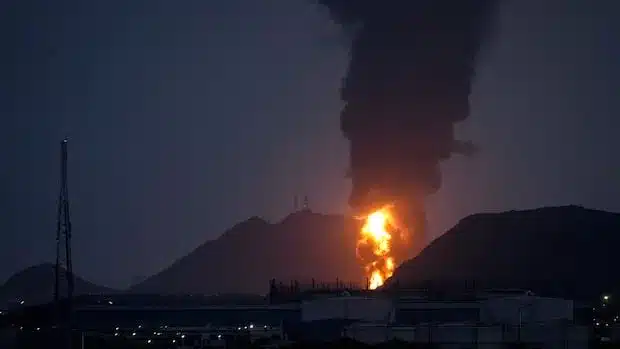
Israel’s ambassador to the United Nations, Danny Danon, sharply criticized Iran’s actions during a recent media briefing. “It is a regime lashing out like a rabid animal, dangerous to everyone around it,” Danon stated. “This is not strategy, it is desperation.”
Analysis indicates Iran’s approach focuses on inflicting collateral damage in neighboring countries while depleting U.S. and Israeli defenses through low-cost kamikaze drones. A joint U.S.-Israeli strike eliminated Supreme Leader Ayatollah Ali Khamenei and several top officials at the war’s outset. Iran targeted U.S. military bases and diplomatic missions in reachable locations, described by Robert Malley, former special envoy for Iran, as strikes against America’s “soft underbelly.” “This demonstrates their retaliatory power,” Malley noted.
Iranian armaments struck U.S. installations across at least nine countries, from the Persian Gulf to Cyprus. These attacks injured dozens and killed some, primarily local civilians. Drones also impacted American embassies and consulates in Riyadh, Dubai, and Kuwait City, causing fires.
Neighboring Countries’ Concerns
Many of Iran’s neighbors urged the U.S. to avoid conflict to prevent becoming unintended targets. Galip Dalay, a Middle East expert at the London-based Chatham House think tank, explains Iran’s aim: inflict sufficient damage to prompt these nations to pressure U.S. President Donald Trump to halt the war. “The only person who can end this war is Trump, and that is the target of Iran’s attacks,” Dalay said.
Drone Warfare Strategy
Surviving leaders in Tehran appear to pursue a dual plan: exhaust U.S. and Israeli missile stockpiles defending against Iran’s Shahed kamikaze drones. These unmanned vehicles carry explosives up to 2,000 kilometers and target precisely, damaging three U.S. diplomatic sites recently. Iran pioneered these drones, now used effectively by Russia in Ukraine.
Their affordability poses a major challenge. Each drone costs $20,000 to $50,000, compared to $4 million for a Patriot interceptor missile. Kelly Grieco, senior fellow at the Stimson Center, highlights this imbalance: “For every $1 Iran spent on drones, the U.A.E. spent roughly $20–28 shooting them down.”
The U.S. has adapted Iranian drone designs, naming them LUCAS and accelerating production, while developing cost-effective interceptors. Justin Crump, CEO of the British risk consultancy Sibylline, notes their portability: launchable from ordinary trucks, making them harder to detect than ballistic missile systems.
Iran’s Missile Arsenal
Iran maintains the Middle East’s largest ballistic missile stockpile, exceeding 20 types assembled domestically and with foreign components. Prime Minister Benjamin Netanyahu demanded their elimination in pre-war talks due to the threat to Israel. Many launched at Israel in June, with others destroyed preemptively.
Underground depots and production facilities enable restocking. Crump estimates Iran holds around 2,000 long-range and an equal number of short-range missiles, sufficient for 10 to 12 days at current usage rates. Combined with drones, the air campaign may persist for weeks despite ongoing U.S. and Israeli strikes.
Signs emerge of disarray within Iran’s Revolutionary Guard, with units acting independently on launches and targets. This deviation from central command increases risks of accidents and miscalculations, according to Crump.
Post-War Outlook
Malley predicts a more fragmented yet surviving regime. “Its goal now is to demonstrate it still stands at war’s end,” he said.